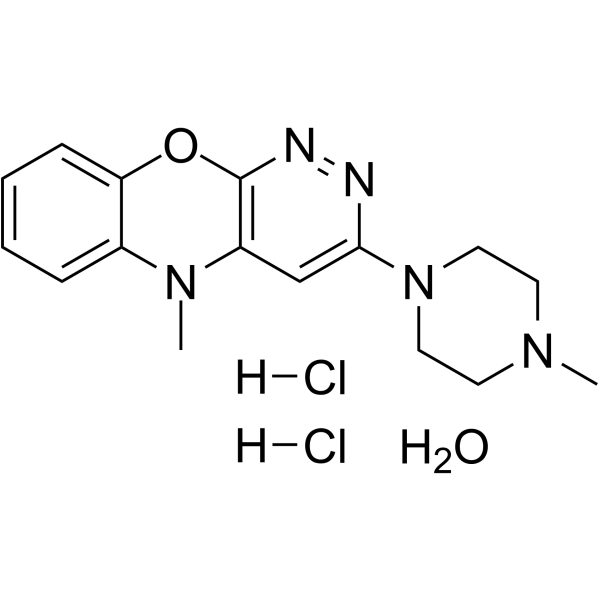
Physicochemical Properties
| Molecular Formula | C16H23CL2N5O2 |
| Molecular Weight | 388.2921 |
| Exact Mass | 387.122 |
| CAS # | 63302-99-8 |
| Related CAS # | Azaphen;24853-80-3 |
| PubChem CID | 2728833 |
| Appearance | Light yellow to green yellow solid powder |
| Hydrogen Bond Donor Count | 3 |
| Hydrogen Bond Acceptor Count | 7 |
| Rotatable Bond Count | 1 |
| Heavy Atom Count | 25 |
| Complexity | 387 |
| Defined Atom Stereocenter Count | 0 |
| InChi Key | VKMOGSQJNTXLNA-UHFFFAOYSA-N |
| InChi Code | InChI=1S/C16H19N5O.2ClH.H2O/c1-19-7-9-21(10-8-19)15-11-13-16(18-17-15)22-14-6-4-3-5-12(14)20(13)2;;;/h3-6,11H,7-10H2,1-2H3;2*1H;1H2 |
| Chemical Name | 5-methyl-3-(4-methylpiperazin-1-yl)pyridazino[3,4-b][1,4]benzoxazine;hydrate;dihydrochloride |
| Synonyms | 63302-99-8; Azaphen dihydrochloride monohydrate; Azaphen (dihydrochloride monohydrate); Azaphenonxazine dihydrochloride monohydrate; 5-Methyl-3-(4-methylpiperazin-1-yl)-5H-benzo[B]pyridazino[4,3-E][1,4]oxazine dihydrochloride hydrate; 5-methyl-3-(4-methylpiperazin-1-yl)pyridazino[3,4-b][1,4]benzoxazine;hydrate;dihydrochloride; Azafen dihydrochloride monohydrate; Cambridge id 5175311; |
| HS Tariff Code | 2934.99.9001 |
| Storage |
Powder-20°C 3 years 4°C 2 years In solvent -80°C 6 months -20°C 1 month Note: Please store this product in a sealed and protected environment, avoid exposure to moisture. |
| Shipping Condition | Room temperature (This product is stable at ambient temperature for a few days during ordinary shipping and time spent in Customs) |
Biological Activity
| Targets | SSRI; tricyclic antidepressant (TCA) |
| ln Vitro | Pipofezine Dihydrochloride Monohydrate 2 [1] The MicroED structure 2 was solved in a monoclinic P 21/c space group at the resolution of 0.82 Å (Figure 2b and Figure 3), with the unit cell parameters of a = 6.88 Å, b = 15.61 Å, c = 15.93 Å, α = 90.0°, β = 97.2°, γ = 90.0°. Two conforms, namely 2a and 2b were identified in the uniFig t cell. Each can be transformed by inversion symmetry or 180° rotation of C11‒N4/C11′‒N4′ bond. The crystal packing is formed mainly by hydrogen bonds and ion-dipole interactions between 2a/2b and chloride anions along b- and c-axes, i.e. hydrogen bonds N5/N5′─H···Cl1 (3.01 Å) and N3/N3′─H···O2 (2.67 Å); ion-dipole interactions between CH atoms and chloride anions (Figure S3, Supporting Information). The water molecules serve as hydrogen bond donors to Cl1 or Cl2 anions that bridge 2a and 2b molecules together (Figure S3, Supporting Information). The packing along the a-axis is facilitated by strong parallel-displaced pi-stacking interactions between the phenyl and pyridazine rings in 2a and 2b (3.65 Å). In 2, bond angles are mostly fixed, with only one freely rotating bond (C10‒C11‒N4‒C15 and C10′‒C11′‒N4′‒C15′, measured at ±178.60° in 2a and 2b), generating a co-planar arrangement of piperazine ring and tricyclic moiety (Figure S4, Supporting Information).[5] |
| Enzyme Assay | 2‒hSERT Complexes[1] 2 was tested at the central (S1) and allosteric (S2) sites in hSERT (Figure S12c, Supporting Information),[32] however the final docking center was found near S2 site due to the weak binding observed in S1 site (i.e., only the hydrophobic interactions). A salt bridge between Asp98 and piperazine ring, together with one pi-stacking (Phe335), one pi-cation interaction (Arg104), and three hydrophobic interactions (Phe335, Phe556) to the tricyclic moiety stabilized the binding complex of 2/hERT (Figure 4c). The structures of 2 in its drug-formulation state and biologically active state are very similar, with only 3–6° rotation C11′‒N4′ bond (Figure S4, Supporting Information), and maintain the piperazine ring and tricyclic moiety in a nearly co-planar geometry (C10‒C11‒N4‒C15≈180°) for both states. The minimum conformational changes ensure small entropy differences upon binding which is beneficial for the binding of 2 to the receptor. |
| References |
[1]. Shinaev NN, Akzhigitov RG. Azaphen: a return to clinical practice.Zh Nevrol Psikhiatr Im S S Korsakova. 2005;105(10):55-6. [2]. Ignatowicz L, Ignatowicz R, Wdowiak MW, Jaremko A. Azaphen in the treatment of enuresis in children.Psychiatr Pol. 1977 Jan-Feb;11(1):29-33. [3]. Liberman SS, Sharova SA. A comparison of the effect of the tricyclic antidepressants azaphen and imizin on the gastrointestinal tracts of experimental animals.Farmakol Toksikol. 1975 Jan-Feb;38(1):29-32. [4]. Misurec J, Náhunek K, Kamenická V, Chmelar M. Proceedings: Influence of azaphen, a new antidepressive drug, on the human EEG. Act Nerv Super (Praha). 1974;16(4):245-6. |
| Additional Infomation | Most treatments to alleviate major depression work by either inhibiting human monoamine transporters, vital for the reuptake of monoamine neurotransmitters, or by inhibiting monoamine oxidases, which are vital for their degradation. The analysis of the experimental 3D structures of those antidepressants in their drug formulation state is key to precision drug design and development. In this study, microcrystal electron diffraction (MicroED) is applied to reveal the atomic 3D structures for the first time of five of the most prevalent antidepressants (reboxetine, pipofezine, ansofaxine, phenelzine, and bifemelane) directly from the commercially available powder of the active ingredients. Their modes of binding are investigated by molecular docking, revealing the essential contacts and conformational changes into the biologically active state. This study underscores the combined use of MicroED and molecular docking to uncover elusive drug structures and mechanisms to aid in further drug development pipelines.[1] |
Solubility Data
| Solubility (In Vitro) |
H2O : ≥ 100 mg/mL (~257.54 mM) DMSO : ~1 mg/mL (~2.58 mM) |
| Solubility (In Vivo) |
Solubility in Formulation 1: 50 mg/mL (128.77 mM) in PBS (add these co-solvents sequentially from left to right, and one by one), clear solution; with sonication. (Please use freshly prepared in vivo formulations for optimal results.) |
| Preparing Stock Solutions | 1 mg | 5 mg | 10 mg | |
| 1 mM | 2.5754 mL | 12.8770 mL | 25.7539 mL | |
| 5 mM | 0.5151 mL | 2.5754 mL | 5.1508 mL | |
| 10 mM | 0.2575 mL | 1.2877 mL | 2.5754 mL |