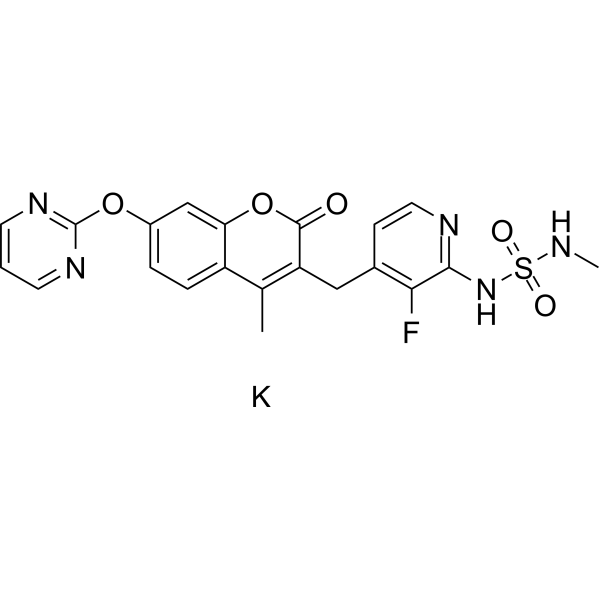
Physicochemical Properties
| Molecular Formula | C21H18FKN5O5S |
| Molecular Weight | 510.56 |
| Exact Mass | 509.0571 |
| CAS # | 946128-90-1 |
| Related CAS # | 946128-88-7; 946128-90-1 |
| PubChem CID | 51030988 |
| Appearance | Typically exists as solids at room temperature |
| Hydrogen Bond Donor Count | 1 |
| Hydrogen Bond Acceptor Count | 11 |
| Rotatable Bond Count | 7 |
| Heavy Atom Count | 34 |
| Complexity | 851 |
| Defined Atom Stereocenter Count | 0 |
| InChi Key | KYKJFDDJHVJFIF-UHFFFAOYSA-N |
| InChi Code | InChI=1S/C21H17FN5O5S.K/c1-12-15-5-4-14(31-21-25-7-3-8-26-21)11-17(15)32-20(28)16(12)10-13-6-9-24-19(18(13)22)27-33(29,30)23-2;/h3-9,11,23H,10H2,1-2H3;/q-1;+1 |
| Chemical Name | potassium [3-fluoro-4-[(4-methyl-2-oxo-7-pyrimidin-2-yloxychromen-3-yl)methyl]-2-pyridinyl]-(methylsulfamoyl)azanide |
| Synonyms | Ro 5126766 potassium; Avutometinib potassium; VS-6766 potassium; RO5126766 potassium; RO-5126766 potassium; ...; 946128-90-1; CH5126766 potassium |
| HS Tariff Code | 2934.99.9001 |
| Storage |
Powder-20°C 3 years 4°C 2 years In solvent -80°C 6 months -20°C 1 month |
| Shipping Condition | Room temperature (This product is stable at ambient temperature for a few days during ordinary shipping and time spent in Customs) |
Biological Activity
| Targets | MEK (IC50 = 160 nM); BRAF V600E (IC50 = 8.2 nM); Braf (IC50 = 190 nM); CRAF (IC50 = 56 nM) |
| References |
[1]. McNamara B, et al. Preclinical efficacy of RAF/MEK clamp avutometinib in combination with FAK inhibition in low grade serous ovarian cancer. Gynecol Oncol. 2024 Apr;183:133-140. [2]. Abstract A091: The RAF/MEK clamp avutometinib as the backbone of therapy for pancreatic cancer: Novel combinations with standard of care chemotherapy, FAK inhibitors, KRAS G12D inhibitors and/or autophagy inhibitors[J]. Cancer Research, 2024, 84(2_Supplement): A091-A091. |
| Additional Infomation | Efficacy was evaluated in RAMP-201 (NCT04625270), an open-label, multicenter trial that included 57 adult patients with measurable KRAS-mutated recurrent LGSOC. Patients were required to have received at least one prior systemic therapy, including a platinum-based regimen. KRAS mutation status was determined by prospective local testing of tumor tissue. Patients received avutometinib 3.2 mg orally twice weekly (Day 1 and Day 4) and defactinib 200 mg orally twice daily, both taken for the first 3 weeks of each 4-week cycle until disease progression or unacceptable toxicity. The major efficacy outcome measure was overall response rate (ORR) assessed by blinded independent review committee according to RECIST v1.1. An additional efficacy outcome measure was duration of response (DOR). Confirmed ORR was 44% (95% CI: 31, 58) and the DOR range was 3.3 months to 31.1 months. The most common adverse reactions (≥25%), including laboratory abnormalities, were increased creatine phosphokinase, nausea, fatigue, increased aspartate aminotransferase, rash, diarrhea, musculoskeletal pain, edema, decreased hemoglobin, increased alanine aminotransferase, vomiting, increased blood bilirubin, increased triglycerides, decreased lymphocyte count, abdominal pain, dyspepsia, dermatitis acneiform, vitreoretinal disorders, increased alkaline phosphatase, stomatitis, pruritus, visual impairment, decreased platelet count, constipation, dry skin, dyspnea, cough, urinary tract infection, and decreased neutrophil count. The recommended avutometinib dose is 3.2 mg (four 0.8 mg capsules) taken orally twice weekly (Day 1 and Day 4) for the first 3 weeks of each 4-week cycle until disease progression or unacceptable toxicity. The recommended defactinib dose is 200 mg (one tablet) taken orally twice daily for the first 3 weeks of each 4-week cycle until disease progression or unacceptable toxicity. |
Solubility Data
| Solubility (In Vitro) | May dissolve in DMSO (in most cases), if not, try other solvents such as H2O, Ethanol, or DMF with a minute amount of products to avoid loss of samples |
| Solubility (In Vivo) |
Note: Listed below are some common formulations that may be used to formulate products with low water solubility (e.g. < 1 mg/mL), you may test these formulations using a minute amount of products to avoid loss of samples. Injection Formulations (e.g. IP/IV/IM/SC) Injection Formulation 1: DMSO : Tween 80: Saline = 10 : 5 : 85 (i.e. 100 μL DMSO stock solution → 50 μL Tween 80 → 850 μL Saline) *Preparation of saline: Dissolve 0.9 g of sodium chloride in 100 mL ddH ₂ O to obtain a clear solution. Injection Formulation 2: DMSO : PEG300 :Tween 80 : Saline = 10 : 40 : 5 : 45 (i.e. 100 μL DMSO → 400 μLPEG300 → 50 μL Tween 80 → 450 μL Saline) Injection Formulation 3: DMSO : Corn oil = 10 : 90 (i.e. 100 μL DMSO → 900 μL Corn oil) Example: Take the Injection Formulation 3 (DMSO : Corn oil = 10 : 90) as an example, if 1 mL of 2.5 mg/mL working solution is to be prepared, you can take 100 μL 25 mg/mL DMSO stock solution and add to 900 μL corn oil, mix well to obtain a clear or suspension solution (2.5 mg/mL, ready for use in animals). Injection Formulation 4: DMSO : 20% SBE-β-CD in saline = 10 : 90 [i.e. 100 μL DMSO → 900 μL (20% SBE-β-CD in saline)] *Preparation of 20% SBE-β-CD in Saline (4°C,1 week): Dissolve 2 g SBE-β-CD in 10 mL saline to obtain a clear solution. Injection Formulation 5: 2-Hydroxypropyl-β-cyclodextrin : Saline = 50 : 50 (i.e. 500 μL 2-Hydroxypropyl-β-cyclodextrin → 500 μL Saline) Injection Formulation 6: DMSO : PEG300 : castor oil : Saline = 5 : 10 : 20 : 65 (i.e. 50 μL DMSO → 100 μLPEG300 → 200 μL castor oil → 650 μL Saline) Injection Formulation 7: Ethanol : Cremophor : Saline = 10: 10 : 80 (i.e. 100 μL Ethanol → 100 μL Cremophor → 800 μL Saline) Injection Formulation 8: Dissolve in Cremophor/Ethanol (50 : 50), then diluted by Saline Injection Formulation 9: EtOH : Corn oil = 10 : 90 (i.e. 100 μL EtOH → 900 μL Corn oil) Injection Formulation 10: EtOH : PEG300:Tween 80 : Saline = 10 : 40 : 5 : 45 (i.e. 100 μL EtOH → 400 μLPEG300 → 50 μL Tween 80 → 450 μL Saline) Oral Formulations Oral Formulation 1: Suspend in 0.5% CMC Na (carboxymethylcellulose sodium) Oral Formulation 2: Suspend in 0.5% Carboxymethyl cellulose Example: Take the Oral Formulation 1 (Suspend in 0.5% CMC Na) as an example, if 100 mL of 2.5 mg/mL working solution is to be prepared, you can first prepare 0.5% CMC Na solution by measuring 0.5 g CMC Na and dissolve it in 100 mL ddH2O to obtain a clear solution; then add 250 mg of the product to 100 mL 0.5% CMC Na solution, to make the suspension solution (2.5 mg/mL, ready for use in animals). Oral Formulation 3: Dissolved in PEG400 Oral Formulation 4: Suspend in 0.2% Carboxymethyl cellulose Oral Formulation 5: Dissolve in 0.25% Tween 80 and 0.5% Carboxymethyl cellulose Oral Formulation 6: Mixing with food powders Note: Please be aware that the above formulations are for reference only. InvivoChem strongly recommends customers to read literature methods/protocols carefully before determining which formulation you should use for in vivo studies, as different compounds have different solubility properties and have to be formulated differently. (Please use freshly prepared in vivo formulations for optimal results.) |
| Preparing Stock Solutions | 1 mg | 5 mg | 10 mg | |
| 1 mM | 1.9586 mL | 9.7932 mL | 19.5863 mL | |
| 5 mM | 0.3917 mL | 1.9586 mL | 3.9173 mL | |
| 10 mM | 0.1959 mL | 0.9793 mL | 1.9586 mL |