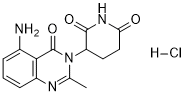
Avadomide HCl, the hydrochloride salt of Avadomide (formerly known as CC-122) with improved water solubility, is a novel, orally available pleiotropic pathway modulator with potential with anticancer and immunomodulatory activity. It targets the protein cereblon (CRBN), a substrate receptor of the cullin ring E3 ubiquitin ligase complex CRL4CRBN. Avadomide mimics an interferon response and has antitumor activity in DLBCL (Diffuse large B-cell lymphoma). Avadomide binds CRBN and promotes the degradation of Aiolos and Ikaros resulting in a mimicry of IFN signaling and apoptosis in DLBCL. As a new chemical entity and a pleiotropic pathway modifier, Avadomide has potential application in the treatment of cancer and immune disease.
Physicochemical Properties
| Molecular Formula | C14H14N4O3.HCL |
| Molecular Weight | 322.75 |
| Exact Mass | 322.083 |
| Elemental Analysis | C, 52.10; H, 4.68; Cl, 10.98; N, 17.36; O, 14.87 |
| CAS # | 1398053-45-6 |
| Related CAS # | 1398053-45-6 (HCl);1015474-32-4; |
| PubChem CID | 60199173 |
| Appearance | Solid powder |
| Hydrogen Bond Donor Count | 3 |
| Hydrogen Bond Acceptor Count | 5 |
| Rotatable Bond Count | 1 |
| Heavy Atom Count | 22 |
| Complexity | 530 |
| Defined Atom Stereocenter Count | 0 |
| SMILES | Cl.O=C1C(CCC(N1)=O)N1C(C2C(=CC=CC=2N=C1C)N)=O |
| InChi Key | BVJRNKXVSYLNFD-UHFFFAOYSA-N |
| InChi Code | InChI=1S/C14H14N4O3.ClH/c1-7-16-9-4-2-3-8(15)12(9)14(21)18(7)10-5-6-11(19)17-13(10)20;/h2-4,10H,5-6,15H2,1H3,(H,17,19,20);1H |
| Chemical Name | 3-(5-amino-2-methyl-4-oxoquinazolin-3(4H)-yl)piperidine-2,6-dione hydrochloride |
| Synonyms | CC 122 HCl; CC-122; CC122, Avadomide HCl; Avadomide hydrochloride |
| HS Tariff Code | 2934.99.9001 |
| Storage |
Powder-20°C 3 years 4°C 2 years In solvent -80°C 6 months -20°C 1 month |
| Shipping Condition | Room temperature (This product is stable at ambient temperature for a few days during ordinary shipping and time spent in Customs) |
Biological Activity
| Targets | Cereblon E3 ligase | ||
| ln Vitro | C-122 is a novel agent for DLBCL with antitumor and immunomodulatory activity. In DLBCL cell lines, It binds CRBN and induces degradation or short hairpin RNA-mediated knockdown of Aiolos and Ikaros which correlates with increased transcription of interferon (IFN)-stimulated genes independent of IFN-α, -β, and -γ production and/or secretion and results in apoptosis in both activated B-cell (ABC) and germinal center B-cell DLBCL cell lines. CRBN is the molecular target of CC-122, CC-122 binding to CRBN recruits Aiolos/Ikaros to CRL4CRBN, and E3 ligase enzymatic activity is necessary for ubiquitination of Aiolos and Ikaros and thus their proteasomal degradation induced by CC-122. CC-122 induces IFN-regulated proteins and its mediated effects on the IFN pathway is independent of autocrine type I and II IFN secretion and signaling. | ||
| ln Vivo | CC-122 reduces tumor growth in xenograft models established from ABC- and GCB-DLBCL cell lines, and stimulates IL-2 production in primary T cells. Also, in a single-arm CC-122 clinical trial, exposure to CC-122 reduced expression levels of Aiolos and Ikaros in each patient by 25% to 50% demonstrating the utility of these 2 proteins as pharmacodynamic markers of CC-122 | ||
| Enzyme Assay | CC-122 is a novel agent for DLBCL with antitumor and immunomodulatory activity.CC-122 binds CRBN and degrades Aiolos and Ikaros resulting in a mimicry of IFN signaling and apoptosis in DLBCL. In vitro: CC122 inhibits proliferation and induces apoptosis in ABC and GCB DLBCL. In DLBCL cell lines, CC122-induced degradation or short hairpin RNA-mediated knockdown of Aiolos and Ikaros correlates with increased transcription of interferon (IFN)-stimulated genes independent of IFN-α, -β, and -γ production and/or secretion and results in apoptosis in both activated B-cell (ABC) and germinal center B-cell DLBCL. | ||
| Cell Assay | Diffuse Large B-Cell Lymphoma are cultured in RPMI-1640 containing 10-20% fetal bovine serum, 1% Penicillin/Streptomycin and 1 mM sodium pyruvate. 2×10⁴ cells are plated per well in media containing either DMSO or various concentrations of CC-122. Cells are cultured for 5 days at 37 degrees Celsius after which tritiated thymidine is added to the cell culture for the final 6 hours. Cells are subsequently harvested onto filter plates. After the plates have dried, scintillation fluid is added to the plates and read on a Top-count reader. | ||
| Animal Protocol |
|
||
| ADME/Pharmacokinetics |
Pharmacokinetics, pharmacodynamics, and biomarkers[1] At all dose levels, the avadomide plasma concentration versus time profiles were characterized by a rapid absorption phase and similar median time to maximum concentration (Fig. 1). After attainment of maximum observed concentration in plasma, avadomide appeared to decrease in a monophasic manner at all dose levels. By visual inspection of mean plasma concentrations versus time profiles, avadomide plasma exposures increased in a dose-dependent manner across the 0.5- to 3.5-mg dose range. All 7 dose levels showed mild-to-moderate accumulation of avadomide plasma exposure after multiple doses. Supplementary Table S1 summarizes avadomide plasma pharmacokinetic parameters by day and dose level. In general, as assessed from the geometric coefficient of variation percentage, interpatient variability was noted for both avadomide area under the concentration–time curve and maximum observed concentration in plasma. The mean total recovery of avadomide in urine within 24 hours ranged from 18% to 35% across the 0.5- to 3.5-mg dose range. The mean avadomide renal clearance ranged from 0.53 to 1.31 L/h across the 0.5- to 3.5-mg dose range. The t1/2 ranged from 7.68 to 27.91 hours. |
||
| Toxicity/Toxicokinetics | Most patients (85%) had ≥1 TEAE that was suspected by the investigators of being related to avadomide. Across all cohorts, the most common TEAEs (≥15%) were fatigue (44%), neutropenia (29%), and diarrhea (15%). Avadomide-related grade ≥3 TEAEs occurred in 14 patients (41%). The most common grade ≥3 TEAEs were neutropenia (2 patients in the 1.0-mg cohort; 1 patient each in the 1.5-, 2.0-, 2.5-, and 3.5-mg cohorts; and 3 patients in the 3.0-mg cohort) and pneumonia (2 patients in the 3.0-mg cohort). Table 2 summarizes the TEAEs in the treated population. One death occurred within 28 days of the last dose of avadomide; 1 patient with pancreatic carcinoma in the 3.5-mg cohort died due to disease progression. | ||
| References |
[1].A First-in-Human Study of Novel Cereblon Modulator Avadomide (CC-122) in Advanced Malignancies. Clin Cancer Res. 2019 Jan 1;25(1):90-98. [2].CC-122, a pleiotropic pathway modifier, mimics an IFN response and has antitumor activity in DLBCL.Blood.Aug 6;126(6):779-89. |
||
| Additional Infomation | Avadomide Hydrochloride is the hydrochloride salt form of avadomide, a novel, small molecule, cereblon-modulating agent with potential antineoplastic, antiangiogenic and immunomodulatory activities. Upon oral administration, avadomide binds to and modulates cereblon to promote recruitment of the hematopoietic transcription factors Aiolos and Ikaros to the Cullin-4 RING E3 ubiquitin ligase complex. This binding results in the ubiquitination and rapid proteasomal degradation of Aiolos and Ikaros and the derepression of interferon (IFN)-stimulated genes, including DDX58 and IRF7, leading to apoptosis of certain tumor cells. Additionally, Aiolos degredation leads to derepression of the IL2 gene, thereby enhancing interleukin-2 production, costimulation of T-lymphocytes and IL-2-induced T-cell proliferation. Avadomide may also promote the activation of natural killer (NK) cells, potentially enhancing tumor cell killing. Aiolos and Ikaros are transcriptional repressors known to play an important role in normal B- and T-cell function. |
Solubility Data
| Solubility (In Vitro) |
|
|||
| Solubility (In Vivo) |
Note: Listed below are some common formulations that may be used to formulate products with low water solubility (e.g. < 1 mg/mL), you may test these formulations using a minute amount of products to avoid loss of samples. Injection Formulations (e.g. IP/IV/IM/SC) Injection Formulation 1: DMSO : Tween 80: Saline = 10 : 5 : 85 (i.e. 100 μL DMSO stock solution → 50 μL Tween 80 → 850 μL Saline) *Preparation of saline: Dissolve 0.9 g of sodium chloride in 100 mL ddH ₂ O to obtain a clear solution. Injection Formulation 2: DMSO : PEG300 :Tween 80 : Saline = 10 : 40 : 5 : 45 (i.e. 100 μL DMSO → 400 μLPEG300 → 50 μL Tween 80 → 450 μL Saline) Injection Formulation 3: DMSO : Corn oil = 10 : 90 (i.e. 100 μL DMSO → 900 μL Corn oil) Example: Take the Injection Formulation 3 (DMSO : Corn oil = 10 : 90) as an example, if 1 mL of 2.5 mg/mL working solution is to be prepared, you can take 100 μL 25 mg/mL DMSO stock solution and add to 900 μL corn oil, mix well to obtain a clear or suspension solution (2.5 mg/mL, ready for use in animals). Injection Formulation 4: DMSO : 20% SBE-β-CD in saline = 10 : 90 [i.e. 100 μL DMSO → 900 μL (20% SBE-β-CD in saline)] *Preparation of 20% SBE-β-CD in Saline (4°C,1 week): Dissolve 2 g SBE-β-CD in 10 mL saline to obtain a clear solution. Injection Formulation 5: 2-Hydroxypropyl-β-cyclodextrin : Saline = 50 : 50 (i.e. 500 μL 2-Hydroxypropyl-β-cyclodextrin → 500 μL Saline) Injection Formulation 6: DMSO : PEG300 : castor oil : Saline = 5 : 10 : 20 : 65 (i.e. 50 μL DMSO → 100 μLPEG300 → 200 μL castor oil → 650 μL Saline) Injection Formulation 7: Ethanol : Cremophor : Saline = 10: 10 : 80 (i.e. 100 μL Ethanol → 100 μL Cremophor → 800 μL Saline) Injection Formulation 8: Dissolve in Cremophor/Ethanol (50 : 50), then diluted by Saline Injection Formulation 9: EtOH : Corn oil = 10 : 90 (i.e. 100 μL EtOH → 900 μL Corn oil) Injection Formulation 10: EtOH : PEG300:Tween 80 : Saline = 10 : 40 : 5 : 45 (i.e. 100 μL EtOH → 400 μLPEG300 → 50 μL Tween 80 → 450 μL Saline) Oral Formulations Oral Formulation 1: Suspend in 0.5% CMC Na (carboxymethylcellulose sodium) Oral Formulation 2: Suspend in 0.5% Carboxymethyl cellulose Example: Take the Oral Formulation 1 (Suspend in 0.5% CMC Na) as an example, if 100 mL of 2.5 mg/mL working solution is to be prepared, you can first prepare 0.5% CMC Na solution by measuring 0.5 g CMC Na and dissolve it in 100 mL ddH2O to obtain a clear solution; then add 250 mg of the product to 100 mL 0.5% CMC Na solution, to make the suspension solution (2.5 mg/mL, ready for use in animals). Oral Formulation 3: Dissolved in PEG400 Oral Formulation 4: Suspend in 0.2% Carboxymethyl cellulose Oral Formulation 5: Dissolve in 0.25% Tween 80 and 0.5% Carboxymethyl cellulose Oral Formulation 6: Mixing with food powders Note: Please be aware that the above formulations are for reference only. InvivoChem strongly recommends customers to read literature methods/protocols carefully before determining which formulation you should use for in vivo studies, as different compounds have different solubility properties and have to be formulated differently. (Please use freshly prepared in vivo formulations for optimal results.) |
| Preparing Stock Solutions | 1 mg | 5 mg | 10 mg | |
| 1 mM | 3.0984 mL | 15.4919 mL | 30.9837 mL | |
| 5 mM | 0.6197 mL | 3.0984 mL | 6.1967 mL | |
| 10 mM | 0.3098 mL | 1.5492 mL | 3.0984 mL |