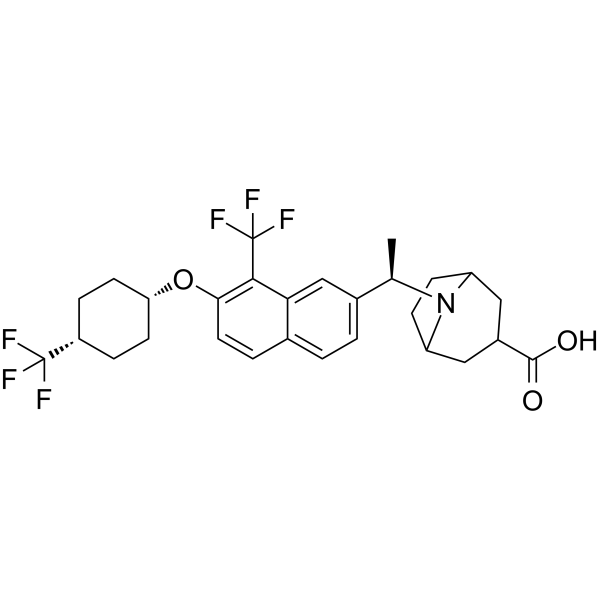
Physicochemical Properties
| Molecular Formula | C28H31F6NO3 |
| Molecular Weight | 543.54106926918 |
| Exact Mass | 543.22 |
| CAS # | 1548743-69-6 |
| PubChem CID | 90032900 |
| Appearance | White to off-white solid powder |
| Density | 1.3±0.1 g/cm3 |
| Boiling Point | 586.9±50.0 °C at 760 mmHg |
| Flash Point | 308.7±30.1 °C |
| Vapour Pressure | 0.0±1.7 mmHg at 25°C |
| Index of Refraction | 1.544 |
| LogP | 6.25 |
| Hydrogen Bond Donor Count | 1 |
| Hydrogen Bond Acceptor Count | 10 |
| Rotatable Bond Count | 5 |
| Heavy Atom Count | 38 |
| Complexity | 827 |
| Defined Atom Stereocenter Count | 1 |
| SMILES | C[C@H](C1=CC2=C(C=C1)C=CC(=C2C(F)(F)F)OC3CCC(CC3)C(F)(F)F)N4C5CCC4CC(C5)C(=O)O |
| InChi Key | PZASAAIJIFDWSB-WMHNCSEASA-N |
| InChi Code | InChI=1S/C28H31F6NO3/c1-15(35-20-7-8-21(35)13-18(12-20)26(36)37)17-3-2-16-4-11-24(25(23(16)14-17)28(32,33)34)38-22-9-5-19(6-10-22)27(29,30)31/h2-4,11,14-15,18-22H,5-10,12-13H2,1H3,(H,36,37)/t15-,18?,19?,20?,21?,22?/m1/s1 |
| Chemical Name | 8-[(1R)-1-[8-(trifluoromethyl)-7-[4-(trifluoromethyl)cyclohexyl]oxynaphthalen-2-yl]ethyl]-8-azabicyclo[3.2.1]octane-3-carboxylic acid |
| HS Tariff Code | 2934.99.9001 |
| Storage |
Powder-20°C 3 years 4°C 2 years In solvent -80°C 6 months -20°C 1 month |
| Shipping Condition | Room temperature (This product is stable at ambient temperature for a few days during ordinary shipping and time spent in Customs) |
Biological Activity
| ln Vitro | Autocrine motility protein is a new type of motility inducing protein. It is a secreted glycoprotein commonly prevalent in biological fluids such as blood, cancer ascites, synovial fluid, pleura and cerebrospinal fluid. It was originally produced from melanoma cells as an autocrine motility inducing factor. separated from the supernatant [1]. Autocrine motility factor is a member of the extracellular nucleotide pyrophosphatase/phosphodiesterase family (E-NPP), which hydrolyzes the phosphodiesterase (PDE) linkages of different nucleotides and derivatives [1]. |
| References |
[1]. Preparation of naphthalenes and isoquinolines as ATX modulating agents. WO 2014018881 A1. |
Solubility Data
| Solubility (In Vitro) | DMSO : ~100 mg/mL (~183.98 mM) |
| Solubility (In Vivo) |
Solubility in Formulation 1: ≥ 2.5 mg/mL (4.60 mM) (saturation unknown) in 10% DMSO + 40% PEG300 + 5% Tween80 + 45% Saline (add these co-solvents sequentially from left to right, and one by one), clear solution. For example, if 1 mL of working solution is to be prepared, you can add 100 μL of 25.0 mg/mL clear DMSO stock solution to 400 μL PEG300 and mix evenly; then add 50 μL Tween-80 to the above solution and mix evenly; then add 450 μL normal saline to adjust the volume to 1 mL. Preparation of saline: Dissolve 0.9 g of sodium chloride in 100 mL ddH₂ O to obtain a clear solution. Solubility in Formulation 2: ≥ 2.5 mg/mL (4.60 mM) (saturation unknown) in 10% DMSO + 90% (20% SBE-β-CD in Saline) (add these co-solvents sequentially from left to right, and one by one), clear solution. For example, if 1 mL of working solution is to be prepared, you can add 100 μL of 25.0 mg/mL clear DMSO stock solution to 900 μL of 20% SBE-β-CD physiological saline solution and mix evenly. Preparation of 20% SBE-β-CD in Saline (4°C,1 week): Dissolve 2 g SBE-β-CD in 10 mL saline to obtain a clear solution. Solubility in Formulation 3: ≥ 2.5 mg/mL (4.60 mM) (saturation unknown) in 10% DMSO + 90% Corn Oil (add these co-solvents sequentially from left to right, and one by one), clear solution. For example, if 1 mL of working solution is to be prepared, you can add 100 μL of 25.0 mg/mL clear DMSO stock solution to 900 μL of corn oil and mix evenly. (Please use freshly prepared in vivo formulations for optimal results.) |
| Preparing Stock Solutions | 1 mg | 5 mg | 10 mg | |
| 1 mM | 1.8398 mL | 9.1990 mL | 18.3979 mL | |
| 5 mM | 0.3680 mL | 1.8398 mL | 3.6796 mL | |
| 10 mM | 0.1840 mL | 0.9199 mL | 1.8398 mL |