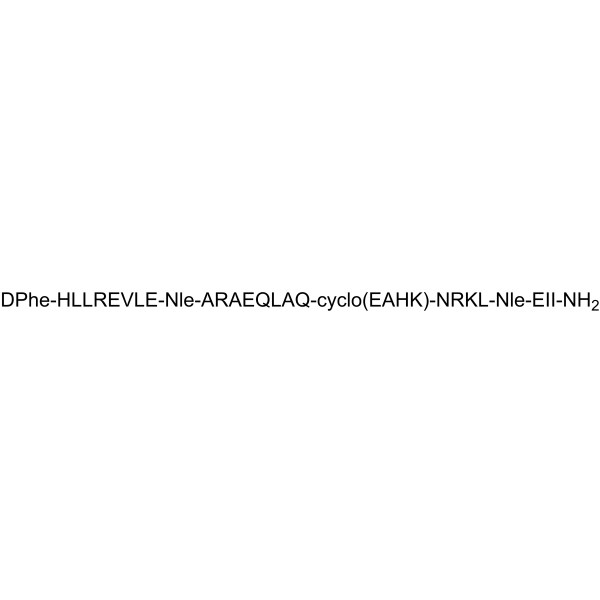
Physicochemical Properties
| Molecular Formula | C161H269N49O42 |
| Molecular Weight | 4043.66169999997 |
| Exact Mass | 3561.04 |
| CAS # | 170809-51-5 |
| PubChem CID | 16133798 |
| Appearance | White to off-white solid powder |
| LogP | 9.589 |
| Hydrogen Bond Donor Count | 51 |
| Hydrogen Bond Acceptor Count | 49 |
| Rotatable Bond Count | 119 |
| Heavy Atom Count | 252 |
| Complexity | 8350 |
| Defined Atom Stereocenter Count | 32 |
| SMILES | CCCCCC(NCC(NCC(NCC(NCC(NCC(NCC(NCC(NCC(N[C@@H]1C(=O)N[C@@H](C)C(=O)N[C@@H](CC2=CN=CN2)C(=O)N[C@H](C(NCC=O)=O)CCCCNC(=O)CC1)=O)=O)=O)=O)=O)=O)=O)=O)=O |
| InChi Key | HPYIIXJJVYSMCV-MGDXKYBTSA-N |
| InChi Code | InChI=1S/C161H269N49O42/c1-23-27-41-96(189-145(239)107(52-59-123(217)218)199-152(246)114(71-84(13)14)207-157(251)126(85(15)16)208-147(241)108(53-60-124(219)220)197-140(234)102(47-38-66-179-161(172)173)193-151(245)112(69-82(9)10)204-153(247)113(70-83(11)12)205-155(249)116(74-94-77-175-79-181-94)201-134(228)95(163)72-92-39-30-29-31-40-92)135(229)182-88(19)130(224)186-100(45-36-64-177-159(168)169)136(230)183-89(20)131(225)188-106(51-58-122(215)216)144(238)195-104(49-56-119(165)212)146(240)202-110(67-80(5)6)149(243)185-90(21)132(226)187-103(48-55-118(164)211)143(237)196-105-50-57-121(214)176-63-35-33-44-99(192-154(248)115(73-93-76-174-78-180-93)200-133(227)91(22)184-137(105)231)142(236)206-117(75-120(166)213)156(250)194-101(46-37-65-178-160(170)171)139(233)190-98(43-32-34-62-162)141(235)203-111(68-81(7)8)150(244)191-97(42-28-24-2)138(232)198-109(54-61-125(221)222)148(242)210-128(87(18)26-4)158(252)209-127(129(167)223)86(17)25-3/h29-31,39-40,76-91,95-117,126-128H,23-28,32-38,41-75,162-163H2,1-22H3,(H2,164,211)(H2,165,212)(H2,166,213)(H2,167,223)(H,174,180)(H,175,181)(H,176,214)(H,182,229)(H,183,230)(H,184,231)(H,185,243)(H,186,224)(H,187,226)(H,188,225)(H,189,239)(H,190,233)(H,191,244)(H,192,248)(H,193,245)(H,194,250)(H,195,238)(H,196,237)(H,197,234)(H,198,232)(H,199,246)(H,200,227)(H,201,228)(H,202,240)(H,203,235)(H,204,247)(H,205,249)(H,206,236)(H,207,251)(H,208,241)(H,209,252)(H,210,242)(H,215,216)(H,217,218)(H,219,220)(H,221,222)(H4,168,169,177)(H4,170,171,178)(H4,172,173,179)/t86-,87-,88-,89-,90-,91-,95+,96-,97-,98-,99-,100-,101-,102-,103-,104-,105-,106-,107-,108-,109-,110-,111-,112-,113-,114-,115-,116-,117-,126-,127-,128-/m0/s1 |
| Chemical Name | (4S)-5-[[(2S)-5-amino-1-[[(2S)-1-[[(2S)-1-[[(2S)-5-amino-1-[[(3S,6S,9S,18S)-18-[[(2S)-4-amino-1-[[(2S)-1-[[(2S)-6-amino-1-[[(2S)-1-[[(2S)-1-[[(2S)-1-[[(2S,3S)-1-[[(2S,3S)-1-amino-3-methyl-1-oxopentan-2-yl]amino]-3-methyl-1-oxopentan-2-yl]amino]-4-carboxy-1-oxobutan-2-yl]amino]-1-oxohexan-2-yl]amino]-4-methyl-1-oxopentan-2-yl]amino]-1-oxohexan-2-yl]amino]-5-carbamimidamido-1-oxopentan-2-yl]amino]-1,4-dioxobutan-2-yl]carbamoyl]-3-(1H-imidazol-4-ylmethyl)-6-methyl-2,5,8,12-tetraoxo-1,4,7,13-tetrazacyclooctadec-9-yl]amino]-1,5-dioxopentan-2-yl]amino]-1-oxopropan-2-yl]amino]-4-methyl-1-oxopentan-2-yl]amino]-1,5-dioxopentan-2-yl]amino]-4-[[(2S)-2-[[(2S)-2-[[(2S)-2-[[(2S)-2-[[(2S)-2-[[(2S)-2-[[(2S)-2-[[(2S)-2-[[(2S)-2-[[(2S)-2-[[(2S)-2-[[(2S)-2-[[(2R)-2-amino-3-phenylpropanoyl]amino]-3-(1H-imidazol-4-yl)propanoyl]amino]-4-methylpentanoyl]amino]-4-methylpentanoyl]amino]-5-carbamimidamidopentanoyl]amino]-4-carboxybutanoyl]amino]-3-methylbutanoyl]amino]-4-methylpentanoyl]amino]-4-carboxybutanoyl]amino]hexanoyl]amino]propanoyl]amino]-5-carbamimidamidopentanoyl]amino]propanoyl]amino]-5-oxopentanoic acid |
| HS Tariff Code | 2934.99.9001 |
| Storage |
Powder-20°C 3 years 4°C 2 years In solvent -80°C 6 months -20°C 1 month Note: Please store this product in a sealed and protected environment (e.g. under nitrogen), avoid exposure to moisture and light. |
| Shipping Condition | Room temperature (This product is stable at ambient temperature for a few days during ordinary shipping and time spent in Customs) |
Biological Activity
| ln Vitro | Astressin binds to cloned pituitary receptors with a high affinity (Ki=2 nM) and a low affinity for CRF binding proteins. Astressin has a strong ability to inhibit ACTH secretion and demonstrates a high affinity for cloned human CRF-RA1 that is stable expressed in CHO cells [1]. |
| ln Vivo | In stressed or adrenalectomy rats, astressin is more effective than any other antagonist that has been studied in the past at lowering pituitary adrenocorticotropic hormone (ACTH) output. Low dosages of astressin injected intravenously (30 μg and 100 μg/kg) nevertheless significantly decreased ACTH levels at 45 and 90 minutes, respectively [1]. Astressin cannot stop the effects of r/hCRF-induced locomotor activity in a familiar setting, but it can considerably reverse the anxiety-like reactions brought on by social stress and ICV rat/human CRF (r/hCRF) on the elevated plus maze [2]. A higher degree of protection than that seen with other CRF antagonists in other models of necrotizing neuronal injury was observed when the peptide was infused intracerebroventricularly 30 minutes prior to and 10 minutes following the start of seizures, reducing damage to specific hippocampal cell regions by 84%. As short as 10 minutes after exposure to excitotoxins, astressin begins to have protective effects [3]. |
| References |
[1]. Gulyas J, et al. Potent, structurally constrained agonists and competitive antagonists of corticotropin-releasing factor. Proc Natl Acad Sci U S A. 1995 Nov 7;92(23):10575-9. [2]. Spina MG, et al. Behavioral effects of central administration of the novel CRF antagonist astressin in rats. Neuropsychopharmacology. 2000 Mar;22(3):230-9. [3]. Maecker H, et al. Astressin, a novel and potent CRF antagonist, is neuroprotective in the hippocampus when administered after a seizure. Brain Res. 1997 Jan 2;744(1):166-70 |
| Additional Infomation | Astressin is a 30-membered homodetic cyclic peptide comprising the sequence D-Phe-His-Leu-Leu-Arg-Glu-Val-Leu-Glu-Nle-Ala-Arg-Ala-Glu-Gln-Leu-Ala-Gln-Glu-Ala-His-Lys-Asn-Arg-Lys-Leu-Nle-Glu-Ile-Ile-NH2 cyclised by an amide bridge, formed by condensation of the side-chain carboxy group of the Glu residue at position 19 and the side-chain amino group of the Lys residue at position 22. It has a role as a corticotropin-releasing factor receptor antagonist and a neuroprotective agent. It is a homodetic cyclic peptide and a polypeptide. |
Solubility Data
| Solubility (In Vitro) | H2O : ~18.18 mg/mL (~5.10 mM) |
| Solubility (In Vivo) |
Note: Listed below are some common formulations that may be used to formulate products with low water solubility (e.g. < 1 mg/mL), you may test these formulations using a minute amount of products to avoid loss of samples. Injection Formulations (e.g. IP/IV/IM/SC) Injection Formulation 1: DMSO : Tween 80: Saline = 10 : 5 : 85 (i.e. 100 μL DMSO stock solution → 50 μL Tween 80 → 850 μL Saline) *Preparation of saline: Dissolve 0.9 g of sodium chloride in 100 mL ddH ₂ O to obtain a clear solution. Injection Formulation 2: DMSO : PEG300 :Tween 80 : Saline = 10 : 40 : 5 : 45 (i.e. 100 μL DMSO → 400 μLPEG300 → 50 μL Tween 80 → 450 μL Saline) Injection Formulation 3: DMSO : Corn oil = 10 : 90 (i.e. 100 μL DMSO → 900 μL Corn oil) Example: Take the Injection Formulation 3 (DMSO : Corn oil = 10 : 90) as an example, if 1 mL of 2.5 mg/mL working solution is to be prepared, you can take 100 μL 25 mg/mL DMSO stock solution and add to 900 μL corn oil, mix well to obtain a clear or suspension solution (2.5 mg/mL, ready for use in animals). Injection Formulation 4: DMSO : 20% SBE-β-CD in saline = 10 : 90 [i.e. 100 μL DMSO → 900 μL (20% SBE-β-CD in saline)] *Preparation of 20% SBE-β-CD in Saline (4°C,1 week): Dissolve 2 g SBE-β-CD in 10 mL saline to obtain a clear solution. Injection Formulation 5: 2-Hydroxypropyl-β-cyclodextrin : Saline = 50 : 50 (i.e. 500 μL 2-Hydroxypropyl-β-cyclodextrin → 500 μL Saline) Injection Formulation 6: DMSO : PEG300 : castor oil : Saline = 5 : 10 : 20 : 65 (i.e. 50 μL DMSO → 100 μLPEG300 → 200 μL castor oil → 650 μL Saline) Injection Formulation 7: Ethanol : Cremophor : Saline = 10: 10 : 80 (i.e. 100 μL Ethanol → 100 μL Cremophor → 800 μL Saline) Injection Formulation 8: Dissolve in Cremophor/Ethanol (50 : 50), then diluted by Saline Injection Formulation 9: EtOH : Corn oil = 10 : 90 (i.e. 100 μL EtOH → 900 μL Corn oil) Injection Formulation 10: EtOH : PEG300:Tween 80 : Saline = 10 : 40 : 5 : 45 (i.e. 100 μL EtOH → 400 μLPEG300 → 50 μL Tween 80 → 450 μL Saline) Oral Formulations Oral Formulation 1: Suspend in 0.5% CMC Na (carboxymethylcellulose sodium) Oral Formulation 2: Suspend in 0.5% Carboxymethyl cellulose Example: Take the Oral Formulation 1 (Suspend in 0.5% CMC Na) as an example, if 100 mL of 2.5 mg/mL working solution is to be prepared, you can first prepare 0.5% CMC Na solution by measuring 0.5 g CMC Na and dissolve it in 100 mL ddH2O to obtain a clear solution; then add 250 mg of the product to 100 mL 0.5% CMC Na solution, to make the suspension solution (2.5 mg/mL, ready for use in animals). Oral Formulation 3: Dissolved in PEG400 Oral Formulation 4: Suspend in 0.2% Carboxymethyl cellulose Oral Formulation 5: Dissolve in 0.25% Tween 80 and 0.5% Carboxymethyl cellulose Oral Formulation 6: Mixing with food powders Note: Please be aware that the above formulations are for reference only. InvivoChem strongly recommends customers to read literature methods/protocols carefully before determining which formulation you should use for in vivo studies, as different compounds have different solubility properties and have to be formulated differently. (Please use freshly prepared in vivo formulations for optimal results.) |
| Preparing Stock Solutions | 1 mg | 5 mg | 10 mg | |
| 1 mM | 0.2473 mL | 1.2365 mL | 2.4730 mL | |
| 5 mM | 0.0495 mL | 0.2473 mL | 0.4946 mL | |
| 10 mM | 0.0247 mL | 0.1237 mL | 0.2473 mL |