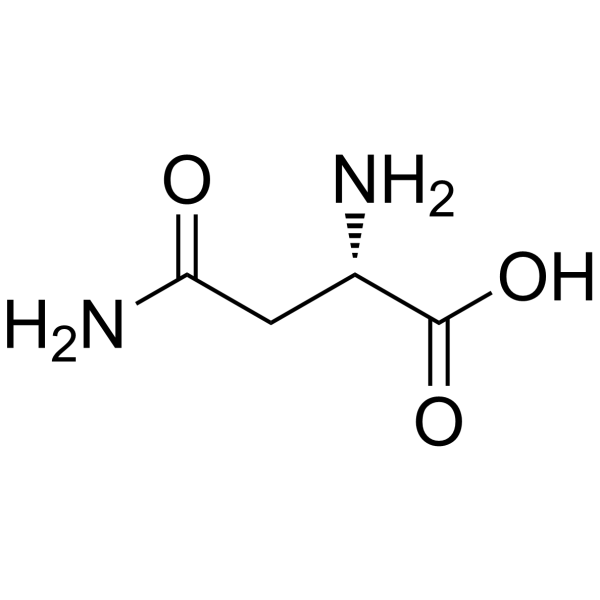
Physicochemical Properties
| Molecular Formula | C4H8N2O3 |
| Molecular Weight | 132.1179 |
| Exact Mass | 132.053 |
| CAS # | 70-47-3 |
| Related CAS # | 28088-48-4 |
| PubChem CID | 6267 |
| Appearance | White to off-white solid powder |
| Density | 1.4±0.1 g/cm3 |
| Boiling Point | 438.0±40.0 °C at 760 mmHg |
| Melting Point | 235 °C (dec.)(lit.) |
| Flash Point | 218.7±27.3 °C |
| Vapour Pressure | 0.0±2.3 mmHg at 25°C |
| Index of Refraction | 1.533 |
| LogP | -1.51 |
| Hydrogen Bond Donor Count | 3 |
| Hydrogen Bond Acceptor Count | 4 |
| Rotatable Bond Count | 3 |
| Heavy Atom Count | 9 |
| Complexity | 134 |
| Defined Atom Stereocenter Count | 1 |
| SMILES | C([C@@H](C(=O)O)N)C(=O)N |
| InChi Key | DCXYFEDJOCDNAF-REOHCLBHSA-N |
| InChi Code | InChI=1S/C4H8N2O3/c5-2(4(8)9)1-3(6)7/h2H,1,5H2,(H2,6,7)(H,8,9)/t2-/m0/s1 |
| Chemical Name | (2S)-2,4-diamino-4-oxobutanoic acid |
| HS Tariff Code | 2934.99.9001 |
| Storage |
Powder-20°C 3 years 4°C 2 years In solvent -80°C 6 months -20°C 1 month |
| Shipping Condition | Room temperature (This product is stable at ambient temperature for a few days during ordinary shipping and time spent in Customs) |
Biological Activity
| Toxicity/Toxicokinetics |
Toxicity Summary Asparagine, a non-essential amino acid is important in the metabolism of toxic ammonia in the body through the action of asparagine synthase which attaches ammonia to aspartic acid in an amidation reaction. Asparagine is also used as a structural component in many proteins. |
| References |
[1]. Asparagine Synthetase in Cancer: Beyond Acute Lymphoblastic Leukemia. Front Oncol. 2020 Jan 9;9:1480. [2]. Translational reprogramming marks adaptation to asparagine restriction in cancer. Nat Cell Biol. 2019 Dec;21(12):1590-1603. [3]. L-glutamine and L-asparagine stimulate ODC activity and proliferation in a porcine jejunal enterocyte line. Am J Physiol. 1995 Oct;269(4 Pt 1):G591-9. |
| Additional Infomation |
Pharmacodynamics A non-essential amino acid. Asparagine is critical for the production of the body's proteins, enzymes and muscle tissue. Supplements of this amino acid are claimed to balance nervous system function. |
Solubility Data
| Solubility (In Vitro) | H2O : ~6.67 mg/mL (~50.48 mM) |
| Solubility (In Vivo) |
Solubility in Formulation 1: 10 mg/mL (75.69 mM) in PBS (add these co-solvents sequentially from left to right, and one by one), clear solution; with sonication. (Please use freshly prepared in vivo formulations for optimal results.) |
| Preparing Stock Solutions | 1 mg | 5 mg | 10 mg | |
| 1 mM | 7.5689 mL | 37.8444 mL | 75.6888 mL | |
| 5 mM | 1.5138 mL | 7.5689 mL | 15.1378 mL | |
| 10 mM | 0.7569 mL | 3.7844 mL | 7.5689 mL |