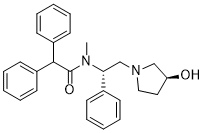
Physicochemical Properties
| Molecular Formula | C27H30N2O2 |
| Molecular Weight | 414.5393 |
| Exact Mass | 414.23 |
| Elemental Analysis | C, 78.23; H, 7.29; N, 6.76; O, 7.72 |
| CAS # | 153205-46-0 |
| Related CAS # | Asimadoline hydrochloride; 185951-07-9 |
| PubChem CID | 179340 |
| Appearance | White to off-white a crystalline solid |
| Density | 1.2±0.1 g/cm3 |
| Boiling Point | 605.8±55.0 °C at 760 mmHg |
| Flash Point | 320.2±31.5 °C |
| Vapour Pressure | 0.0±1.8 mmHg at 25°C |
| Index of Refraction | 1.617 |
| LogP | 3.71 |
| Hydrogen Bond Donor Count | 1 |
| Hydrogen Bond Acceptor Count | 3 |
| Rotatable Bond Count | 7 |
| Heavy Atom Count | 31 |
| Complexity | 531 |
| Defined Atom Stereocenter Count | 2 |
| SMILES | O[C@H]1CCN(C1)C[C@H](C2=CC=CC=C2)N(C)C(C(C3=CC=CC=C3)C4=CC=CC=C4)=O |
| InChi Key | JHLHNYVMZCADTC-LOSJGSFVSA-N |
| InChi Code | InChI=1S/C27H30N2O2/c1-28(25(21-11-5-2-6-12-21)20-29-18-17-24(30)19-29)27(31)26(22-13-7-3-8-14-22)23-15-9-4-10-16-23/h2-16,24-26,30H,17-20H2,1H3/t24-,25+/m0/s1 |
| Chemical Name | N-[(1S)-2-[(3S)-3-hydroxypyrrolidin-1-yl]-1-phenylethyl]-N-methyl-2,2-diphenylacetamide |
| Synonyms | EMD 61753; Asimadoline |
| HS Tariff Code | 2934.99.03.00 |
| Storage |
Powder-20°C 3 years 4°C 2 years In solvent -80°C 6 months -20°C 1 month |
| Shipping Condition | Room temperature (This product is stable at ambient temperature for a few days during ordinary shipping and time spent in Customs) |
Biological Activity
| Targets | guinea pig κ opioid ( IC50 = 5.6 nM ); human recombinant κ opioid ( IC50 = 1.2 nM ) |
| ln Vitro |
Asimadoline (EMD-61753) has high selectivity at 1:501:498 opioid binding ratios for κ: μ: δ in human recombinant receptors. At 3 µM for μ-opioid receptors and 0.7 µM for μ-opioid receptors, asimadoline's binding IC50 values are determined. All of the receptors: D1, D2, kainate, σ, PCP/NMDA, H1, α1, α2, M1/M2, glycine, 5HT1A, 5HT1C, 5HT1D, 5HT2, 5HT3, AMPA, and kainate/AMPA have IC50 values greater than 10 µM[1]. Asimadoline exhibits affinity for sodium and L type Ca2+ ion channels, with IC50 values ranging from 150 to 800 times higher than that of κ receptors[1]. Asimadoline exhibits spasmolytic action against 400 µM barium chloride in the rat duodenum at high concentrations (IC50=4.2 µM), indicating that Asimadoline may mitigate the direct stimulant effects of barium on smooth muscle via unidentified mechanisms[1]. |
| ln Vivo |
Asimadoline (EMD-61753; 1, 5, 15 mg/kg; s.c.) acutely reduces tactile allodynia and formalin-evoked hyperalgesia in diabetic rats[3]. In rats, the rate of absorption after oral administration is 80%, whereas in dogs and monkeys, it exceeds 90%. Asimadoline's metabolism is quick and seems to be similar in both humans and animals. Increases in joint fluid substance P levels are one way that asimadoline's peripheral anti-inflammatory effects are partially mediated[1]. Asimadoline (5 mg/kg/day; intraperitoneal) treatment results in a significant (and long-lasting) reduction in the illness with all three time regimens[2]. |
| Animal Protocol |
Adult female Sprague-Dawley rats 1, 5, 15 mg/kg SC; single dose |
| References |
[1]. Asimadoline, a κ-Opioid Agonist, and Visceral Sensation. Neurogastroenterol Motil. 2008 Sep; 20(9): 971–979. [2]. Involvement of substance P in the anti-inflammatory effects of the peripherally selective kappa-opioid asimadoline and the NK1 antagonist GR205171. Eur J Neurosci. 1999 Jun;11(6):2065-72. [3]. Dynorphin A, kappa opioid receptors and the antinociceptive efficacy of asimadoline in streptozotocin-induced diabetic rats. Diabetologia. 2006 Nov;49(11):2775-85. |
| Additional Infomation |
Asimadoline is a proprietary small molecule therapeutic, originally discovered by Merck KGaA of Darmstadt, Germany. Asimadoline was originally developed to treat peripheral pain such as arthritis. Asimadoline is an orally administered agent that acts as a kappa opioid receptor agonist. It has shown encouraging clinical efficacy for the treatment of IBS in a barostat study in IBS patients and has the potential for treating other gastrointestinal diseases. Drug Indication Investigated for use/treatment in irritable bowel syndrome (IBS). Mechanism of Action Asimadoline is an orally administered agent that acts as a kappa opioid receptor agonist. Kappa opioid receptors are found mostly in the digestive tract and are believed to play an important role in control of visceral pain and bowel motility. As such, kappa opioid agonists are ideal candidates to relieve the pain, discomfort an impaired motility common to IBS and other gastrointestinal disorders. |
Solubility Data
| Solubility (In Vitro) | May dissolve in DMSO (in most cases), if not, try other solvents such as H2O, Ethanol, or DMF with a minute amount of products to avoid loss of samples |
| Solubility (In Vivo) |
Note: Listed below are some common formulations that may be used to formulate products with low water solubility (e.g. < 1 mg/mL), you may test these formulations using a minute amount of products to avoid loss of samples. Injection Formulations (e.g. IP/IV/IM/SC) Injection Formulation 1: DMSO : Tween 80: Saline = 10 : 5 : 85 (i.e. 100 μL DMSO stock solution → 50 μL Tween 80 → 850 μL Saline) *Preparation of saline: Dissolve 0.9 g of sodium chloride in 100 mL ddH ₂ O to obtain a clear solution. Injection Formulation 2: DMSO : PEG300 :Tween 80 : Saline = 10 : 40 : 5 : 45 (i.e. 100 μL DMSO → 400 μLPEG300 → 50 μL Tween 80 → 450 μL Saline) Injection Formulation 3: DMSO : Corn oil = 10 : 90 (i.e. 100 μL DMSO → 900 μL Corn oil) Example: Take the Injection Formulation 3 (DMSO : Corn oil = 10 : 90) as an example, if 1 mL of 2.5 mg/mL working solution is to be prepared, you can take 100 μL 25 mg/mL DMSO stock solution and add to 900 μL corn oil, mix well to obtain a clear or suspension solution (2.5 mg/mL, ready for use in animals). Injection Formulation 4: DMSO : 20% SBE-β-CD in saline = 10 : 90 [i.e. 100 μL DMSO → 900 μL (20% SBE-β-CD in saline)] *Preparation of 20% SBE-β-CD in Saline (4°C,1 week): Dissolve 2 g SBE-β-CD in 10 mL saline to obtain a clear solution. Injection Formulation 5: 2-Hydroxypropyl-β-cyclodextrin : Saline = 50 : 50 (i.e. 500 μL 2-Hydroxypropyl-β-cyclodextrin → 500 μL Saline) Injection Formulation 6: DMSO : PEG300 : castor oil : Saline = 5 : 10 : 20 : 65 (i.e. 50 μL DMSO → 100 μLPEG300 → 200 μL castor oil → 650 μL Saline) Injection Formulation 7: Ethanol : Cremophor : Saline = 10: 10 : 80 (i.e. 100 μL Ethanol → 100 μL Cremophor → 800 μL Saline) Injection Formulation 8: Dissolve in Cremophor/Ethanol (50 : 50), then diluted by Saline Injection Formulation 9: EtOH : Corn oil = 10 : 90 (i.e. 100 μL EtOH → 900 μL Corn oil) Injection Formulation 10: EtOH : PEG300:Tween 80 : Saline = 10 : 40 : 5 : 45 (i.e. 100 μL EtOH → 400 μLPEG300 → 50 μL Tween 80 → 450 μL Saline) Oral Formulations Oral Formulation 1: Suspend in 0.5% CMC Na (carboxymethylcellulose sodium) Oral Formulation 2: Suspend in 0.5% Carboxymethyl cellulose Example: Take the Oral Formulation 1 (Suspend in 0.5% CMC Na) as an example, if 100 mL of 2.5 mg/mL working solution is to be prepared, you can first prepare 0.5% CMC Na solution by measuring 0.5 g CMC Na and dissolve it in 100 mL ddH2O to obtain a clear solution; then add 250 mg of the product to 100 mL 0.5% CMC Na solution, to make the suspension solution (2.5 mg/mL, ready for use in animals). Oral Formulation 3: Dissolved in PEG400 Oral Formulation 4: Suspend in 0.2% Carboxymethyl cellulose Oral Formulation 5: Dissolve in 0.25% Tween 80 and 0.5% Carboxymethyl cellulose Oral Formulation 6: Mixing with food powders Note: Please be aware that the above formulations are for reference only. InvivoChem strongly recommends customers to read literature methods/protocols carefully before determining which formulation you should use for in vivo studies, as different compounds have different solubility properties and have to be formulated differently. (Please use freshly prepared in vivo formulations for optimal results.) |
| Preparing Stock Solutions | 1 mg | 5 mg | 10 mg | |
| 1 mM | 2.4123 mL | 12.0616 mL | 24.1231 mL | |
| 5 mM | 0.4825 mL | 2.4123 mL | 4.8246 mL | |
| 10 mM | 0.2412 mL | 1.2062 mL | 2.4123 mL |