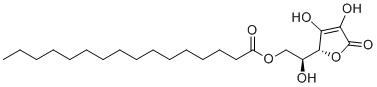
Ascorbyl palmitate is a novel and potent fat-soluble vitamin C analogue (ester formed from ascorbic acid and palmitic acid). It is used as a dietary supplement, food additive, and antioxidant, and can decrease free radical formation in pig skin.
Physicochemical Properties
| Molecular Formula | C22H38O7 |
| Molecular Weight | 414.53 |
| Exact Mass | 414.261 |
| CAS # | 137-66-6 |
| PubChem CID | 54680660 |
| Appearance | White to off-white solid powder |
| Density | 1.2±0.1 g/cm3 |
| Boiling Point | 512.7±50.0 °C at 760 mmHg |
| Melting Point | 115-118 °C(lit.) |
| Flash Point | 164.4±23.6 °C |
| Vapour Pressure | 0.0±3.0 mmHg at 25°C |
| Index of Refraction | 1.521 |
| LogP | 6.07 |
| Hydrogen Bond Donor Count | 3 |
| Hydrogen Bond Acceptor Count | 7 |
| Rotatable Bond Count | 18 |
| Heavy Atom Count | 29 |
| Complexity | 515 |
| Defined Atom Stereocenter Count | 2 |
| SMILES | CCCCCCCCCCCCCCCC(=O)OC[C@@H]([C@@H]1C(=C(C(=O)O1)O)O)O |
| InChi Key | QAQJMLQRFWZOBN-LAUBAEHRSA-N |
| InChi Code | InChI=1S/C22H38O7/c1-2-3-4-5-6-7-8-9-10-11-12-13-14-15-18(24)28-16-17(23)21-19(25)20(26)22(27)29-21/h17,21,23,25-26H,2-16H2,1H3/t17-,21+/m0/s1 |
| Chemical Name | (S)-2-((R)-3,4-dihydroxy-5-oxo-2,5-dihydrofuran-2-yl)-2-hydroxyethyl palmitate |
| Synonyms | BRN-0096552 6-Palmitoylascorbic acid NSC 402451CCRIS-3930Ascorbyl palmitateBRN 0096552 CCRIS 3930 HSDB 418 NSC 402451 BRN0096552 Vitamin C palmitate CCRIS3930 HSDB418 NSC 402451 HSDB-418 |
| HS Tariff Code | 2934.99.9001 |
| Storage |
Powder-20°C 3 years 4°C 2 years In solvent -80°C 6 months -20°C 1 month |
| Shipping Condition | Room temperature (This product is stable at ambient temperature for a few days during ordinary shipping and time spent in Customs) |
Biological Activity
| ADME/Pharmacokinetics |
Absorption, Distribution and Excretion When incorporated into the cell membranes of human red blood cells, ascorbyl palmitate has been found to protect them from oxidative damage and to protect alpha-tocopherol (a fat-soluble antioxidant) from oxidation by free radicals. However, the protective effects of ascorbyl palmitate on cell membranes have only been demonstrated in the test tube. Taking ascorbyl palmitate orally probably doesn't result in any significant incorporation into cell membranes because most of it appears to be hydrolyzed (broken apart into palmitate and ascorbic acid) in the human digestive tract before it is absorbed. The ascorbic acid released by the hydrolysis of ascorbyl palmitate appears to be as bioavailable as ascorbic acid alone. When applied topically to guinea pigs, ascorbyl palmitate penetrated the skin barrier so that ascorbic acid content in the skin, liver, and blood increased eight-, seven-, and four-fold, respectively, when compared to control animals that did not receive ascorbyl palmitate. (14)C-Ascorbyl palmitate was applied to the skin of scorbutic (affected by scurvy) guinea pigs. Following the topical application, ascorbic acid concentrations in the skin, liver, kidneys, and blood were four to eight times greater than in the control. Ascorbyl palmitate dissolved in a sodium taurocholate solution was hydrolyzed by homogenates of the liver, pancreas, and intestines of guinea pigs. Approximately 80% of ascorbyl palmitate was hydrolyzed to free ascorbic acid by homogenates of the small intestine and pancreas. ... Ascorbyl palmitate (the equivalent of 20 mg of ascorbic acid) was orally administered to guinea pigs, and the amount of free ascorbic acid excreted in the urine was measured. Greater amounts of acid were excreted at 0-24 hours than at 24-48 hours. A similar trend was found in these organs of free ascorbic acid content when L-ascorbic acid was administered instead, but a reverse tendency was observed with ascorbyl palmitate. Metabolism / Metabolites Vitamin C (ascorbic acid) is a non-enzymatic antioxidant important in protecting the lung against oxidative damage and is decreased in lung lining fluid of horses with airway inflammation. To examine possible therapeutic regimens in a species with ascorbate-synthesising capacity, ... Te effects of oral supplementation of two forms of ascorbic acid, (each equivalent to 20 mg ascorbic acid per kg body weight) on the pulmonary and systemic antioxidant status of six healthy ponies in a 3 x 3 Latin square design. Two weeks supplementation with ascorbyl palmitate significantly increased mean plasma ascorbic acid concentrations compared to control (29 +/-- 5 and 18 +/- 7 umol/L, respectively; p < 0.05). Calcium ascorbyl-2-monophosphate, a more stable form of ascorbic acid, also increased mean plasma ascorbic acid concentrations, but not significantly (23 +/- 1 umol/L; p = 0.07). The concentration of ascorbic acid in bronchoalveolar lavage fluid increased in five out of six ponies following supplementation with either ascorbyl palmitate or calcium ascorbyl-2-monophosphate compared with control (30 +/- 10, 25 +/- 4 and 18 +/- 8 umol/L, respectively; p < 0.01). Neither supplement altered the concentration of glutathione, uric acid or alpha-tocopherol in plasma or bronchoalveolar lavage fluid. In conclusion, the concentration of lung lining fluid ascorbic acid is increased following ascorbic acid supplementation (20 mg/kg body weight) in an ascorbate-synthesising species. It has been known that solid lipid nanoparticles (SLN) and nanostructured lipid carriers (NLC) have occlusive effects, but ascorbyl palmitate (AP) incorporation moisturized skin significantly better than placebo in short-term (p < 0.001) and long-term trials (p < 0.01) for both SLN and NLC. In the second part of the study, SLN and NLC were found to sustain the penetration of AP through excised human skin about 1/2 and 2/3 times compared to NE (p < 0.001 and p < 0.01), respectively... 6-O-Palmitoyl-L-ascorbic acid dissolved in a sodium taurocholate solution was hydrolyzed by homogenates of the pancreas, liver, and intestines of guinea pigs. |
| Toxicity/Toxicokinetics |
Interactions Male MEl mice in which hepatotoxicity had been induced by the feeding of 600 mg/kg acetaminophen had covalent binding of acetaminophen metabolites to hepatic proteins, a depletion of hepatic nonprotein sulphydryl groups after 2 hours, and a dramatic increase in plasma alanine aminotransferase activity after 24 hours. The coadministration of acetaminophen and ascorbyl palmitate reduced this binding within 2 and 4 hours (to 31% and 22%, respectively), reduced the depletion in nonprotein sulfhdryl groups and aminotransferase activity, and completely prevented the 35% mortality observed at 24 hours after acetaminophen treatment alone. Ascorbyl palmitate appeared to prevent hepatic damage by removing the reactive acetaminophen metabolites and by having a sparing action on reduced hepatic glutathione. Ascorbyl palmitate when topically applied at small doses inhibited 12-O-tetradecanoylphorbol-13-acetate-induced (TPA-induced) ornithine decarboxylase activity, tumor production, and DNA synthesis in mouse epithelial cell. A dose of 4 umol of ascorbyl palmitate inhibited by 60-70% after one topical application of 2 nmol TPA. When 5 nmol TPA was administered with 5 pmol ascorbyl palmitate twice weekly to previously initiated mice, 91% of tumors were inhibited per mouse. ... This work ... sought to determine the antioxidative properties of a lipid-soluble derivative of ascorbic acid, ascorbic acid-6-palmitate. ... Ascorbic acid-6-palmitate reduced cellular levels of reactive oxygen species following ultraviolet B irradiation. Treatment of keratinocytes with ascorbic acid-6-palmitate inhibited ultraviolet-B-mediated activation of epidermal growth factor receptor, extracellular regulated kinases 1 and 2, and p38 kinase because of its ability to prevent reduced glutathione depletion and scavenge hydrogen peroxide. Ascorbic acid-6-palmitate strongly promoted ultraviolet-B-induced lipid peroxidation, c-Jun N-terminal kinase activation, and cytotoxicity, however. End products of lipid peroxidation, such as 4-hydroxy-2-nonenal, have been reported to mediate stress-activated protein kinase activation and cell toxicity in epithelial cells. The lipid component of ascorbic acid-6-palmitate probably contributes to the generation of oxidized lipid metabolites that are toxic to epidermal cells. /The/ data suggest that, despite its antioxidant properties, ascorbic acid-6-palmitate may intensify skin damage following physiologic doses of ultraviolet radiation. ... The effects of various antioxidants, including ascorbyl palmitate, on rabbit platelet functions /were studied/ by means of thromboxane B2 synthesis and enzyme immunoassay. Ascorbyl palmitate inhibited A-23187-induced thromboxane B2 synthesis at 1.0 X 10⁻⁵ M and above, and thrombin-induced synthesis at 1. X 10-7 M when added simultaneously. The pretreatment of platelets with ascorbyl palmitate also inhibited both agonist-induced syntheses unless the platelets had been stimulated with thrombin. When the rabbits were fed ADI concentrations of ascorbyl palmitate for 5 days, agonist-induced activation of platelets also was reduced considerably. For more Interactions (Complete) data for Ascorbyl palmitate (14 total), please visit the HSDB record page. Non-Human Toxicity Values LD50 Guinea pig dermal >3 g/kg LD50 Mouse oral >2 g/kg /33% suspension/ LD50 Rat oral >5 g/kg /33% suspension/ |
| Additional Infomation |
Ascorbyl palmitate is a fatty acid ester. Mechanism of Action ... Whether L-ascorbic acid 6-palmitate (AAP), an amphipathic derivative of AA, has chemopreventive effects /was examined/ using a gap-junctional intercellular communication (GJIC) model. AAP and ascorbic acid (AA) exhibited dose-dependent free radical-scavenging activities and inhibited hydrogen peroxide (H(2)O(2))-induced intracellular reactive oxygen species (ROS) production in normal rat liver epithelial cells. Unexpectedly, however, AAP did not protect against the inhibition of GJIC induced by H(2)O(2); instead, it inhibited GJIC synergistically with H(2)O(2). AAP inhibited GJIC in a dose-dependent and reversible manner. This inhibitory effect was not due to the conjugated lipid structure of AAP, as treatment with palmitic acid alone failed to inhibit GJIC under the same conditions. The inhibition of GJIC by AAP was restored in the presence of mitogen-activated protein kinase/extracellular signal-regulated kinase (ERK) kinase (MEK) inhibitor U0126, but not in the presence of other signal inhibitors and antioxidant (PKC inhibitors, EGFR inhibitor, NADPH oxidase inhibitor, catalase, vitamin E, or AA), indicating the critical involvement of MEK signaling in the GJIC inhibitory activity of AAP. Phosphorylation of ERK and connexin 43 (Cx43) was observed following AAP treatment, and this was reversed by U0126. These results suggest that the AAP-induced inhibition of GJIC is mediated by the phosphorylation of Cx43 via activation of the MEK-ERK pathway. Therapeutic Uses Antimutagenic Agents; Antioxidants Ascorbyl palmitate has a vitamin C activity approximately equal to that of L-ascorbic acid. ... Vitamin C is an essential cofactor for prolyl and lysyl hydroxylases, the enzymes involved in the intracellular biosynthesis of collagen. /Experimental Therapy/ QR-333, a topical compound that contains quercetin, a flavonoid with aldose reductase inhibitor effects, ascorbyl palmitate, and vitamin D(3), was formulated to decrease the oxidative stress that contributes to peripheral diabetic neuropathy and thus alleviate its symptoms. ... This randomized, placebo-controlled, double-blind trial included 34 men and women (21-71 years of age) with Type 1 or 2 diabetes and diabetic neuropathy who applied QR-333 or placebo (2:1 ratio), three times daily for 4 weeks, to each foot where symptoms were experienced. ... QR-333 reduced the severity of numbness, jolting pain, and irritation from baseline values. Improvements were also seen in overall and specific quality-of-life measures. QR-333 was well tolerated. Eleven patients in the QR-333 group reported 23 adverse events (all mild or moderate); 4 in the placebo group reported 5 events (all moderate). One patient who applied QR-333 noted a pricking sensation twice, the only adverse event considered possibly related to study treatment... The presence of ascorbyl palmitate in oral supplements contributes to the ascorbic acid content of the supplement and probably helps protect fat-soluble antioxidants in the supplement. |
Solubility Data
| Solubility (In Vitro) |
DMSO : ~100 mg/mL (~241.24 mM) H2O : < 0.1 mg/mL |
| Solubility (In Vivo) |
Solubility in Formulation 1: ≥ 2.5 mg/mL (6.03 mM) (saturation unknown) in 10% DMSO + 90% Corn Oil (add these co-solvents sequentially from left to right, and one by one), clear solution. For example, if 1 mL of working solution is to be prepared, you can add 100 μL of 25.0 mg/mL clear DMSO stock solution to 900 μL of corn oil and mix evenly. (Please use freshly prepared in vivo formulations for optimal results.) |
| Preparing Stock Solutions | 1 mg | 5 mg | 10 mg | |
| 1 mM | 2.4124 mL | 12.0619 mL | 24.1237 mL | |
| 5 mM | 0.4825 mL | 2.4124 mL | 4.8247 mL | |
| 10 mM | 0.2412 mL | 1.2062 mL | 2.4124 mL |