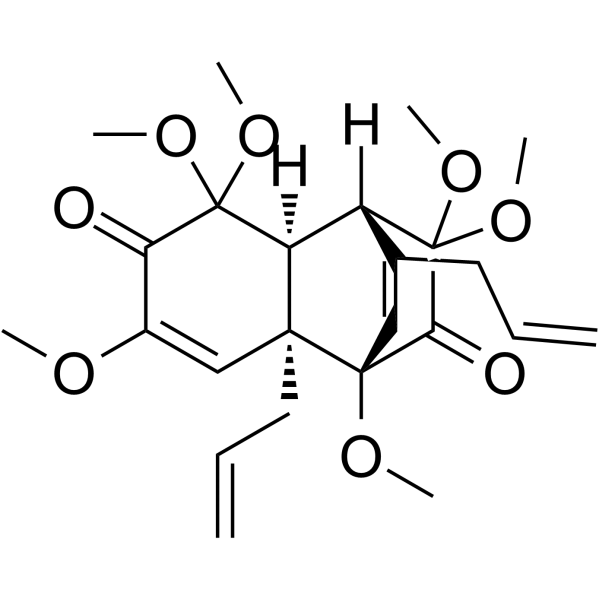
Asatone is a naturally occurring bioactive compound isolated from Radix et Rhizoma Asari with anti-inflammatory effects via activating NF-κB and down-regulating of p-MAPK (ERK, JNK and p38) pathways.
Physicochemical Properties
| Molecular Formula | C24H32O8 |
| Molecular Weight | 448.5061 |
| Exact Mass | 448.21 |
| CAS # | 38451-63-7 |
| PubChem CID | 134714897 |
| Appearance | White to off-white solid powder |
| Density | 1.19g/cm3 |
| Boiling Point | 536.1ºC at 760 mmHg |
| Flash Point | 228.9ºC |
| Index of Refraction | 1.533 |
| LogP | 2.356 |
| Hydrogen Bond Donor Count | 0 |
| Hydrogen Bond Acceptor Count | 8 |
| Rotatable Bond Count | 10 |
| Heavy Atom Count | 32 |
| Complexity | 878 |
| Defined Atom Stereocenter Count | 3 |
| SMILES | COC1=C[C@]2([C@H]([C@H]3C(=CC2(C(=O)C3(OC)OC)OC)CC=C)C(C1=O)(OC)OC)CC=C |
| InChi Key | XBKKBTPYPCCCKA-LWJBKALKSA-N |
| InChi Code | InChI=1S/C24H32O8/c1-9-11-15-13-22(28-4)20(26)23(29-5,30-6)17(15)18-21(22,12-10-2)14-16(27-3)19(25)24(18,31-7)32-8/h9-10,13-14,17-18H,1-2,11-12H2,3-8H3/t17-,18+,21+,22?/m1/s1 |
| Chemical Name | (1S,2S,7S)-3,3,5,8,10,10-hexamethoxy-7,11-bis(prop-2-enyl)tricyclo[6.2.2.02,7]dodeca-5,11-diene-4,9-dione |
| HS Tariff Code | 2934.99.9001 |
| Storage |
Powder-20°C 3 years 4°C 2 years In solvent -80°C 6 months -20°C 1 month Note: This product requires protection from light (avoid light exposure) during transportation and storage. |
| Shipping Condition | Room temperature (This product is stable at ambient temperature for a few days during ordinary shipping and time spent in Customs) |
Biological Activity
| Targets |
The action targets of Asatone are the nuclear factor-kappa B (NF-κB) signaling pathway and mitogen-activated protein kinase (MAPK) signaling pathway (including ERK1/2, JNK, p38 MAPK) [1] |
| ln Vitro |
Experiments were conducted on LPS-induced RAW264.7 macrophages (groups: control, LPS model (1 μg/mL), Asatone 10/20/40 μM + LPS) for 24 hours: 1. Pro-inflammatory cytokine inhibition: 40 μM Asatone reduced LPS-induced TNF-α by 68±5% and IL-6 by 62±4% (ELISA) [1] 2. Signaling pathway suppression: 40 μM Asatone decreased phosphorylation of p-p65 (72±6%), p-ERK1/2 (65±5%), p-JNK (60±4%), p-p38 (58±3%) (Western blot) [1] 3. Cell viability: Asatone (up to 40 μM) maintained RAW264.7 viability >90% (MTT) [1] |
| ln Vivo |
Experiments on LPS-induced acute lung injury (ALI) in C57BL/6 mice (groups: control, LPS model (5 mg/kg, intratracheal), Asatone 20/40 mg/kg (intraperitoneal, 1 h before LPS)) for 24 hours: 1. Lung edema relief: Asatone lowered lung W/D ratio from 4.8±0.3 (model) to 3.5±0.2 (20 mg/kg) and 2.9±0.1 (40 mg/kg) [1] 2. Lung damage reduction: Asatone decreased pathological score from 8.2±0.5 (model) to 5.1±0.3 (20 mg/kg) and 3.3±0.2 (40 mg/kg) (HE staining) [1] 3. Inflammation inhibition: 40 mg/kg Asatone reduced serum TNF-α (70±5%)/IL-6 (65±4%) and downregulated lung p-p65/p-ERK1/2/p-JNK/p-p38 (Western blot) [1] |
| Cell Assay |
1. Cell culture: RAW264.7 cells were cultured in DMEM (10% FBS, 1% penicillin-streptomycin) at 37°C, 5% CO2 [1] 2. Seeding & treatment: Cells were seeded in 96-well (5×10³ cells/well, MTT), 24-well (5×10⁵ cells/well, ELISA), 6-well (1×10⁶ cells/well, Western blot) plates, incubated overnight, then treated with LPS + Asatone for 24 hours [1] 3. Detection: - MTT: Added 5 mg/mL MTT (20 μL/well), incubated 4 h, dissolved in DMSO, read at 570 nm [1] - ELISA: Collected supernatant (1000×g, 10 min), detected TNF-α/IL-6 [1] - Western blot: Lysed cells with RIPA, quantified protein (BCA), detected p-p65/p-ERK1/2/p-JNK/p-p38/β-actin [1] |
| Animal Protocol |
1. Animal prep: C57BL/6 mice (20–22 g) acclimated 7 days (22±2°C, 12 h light/dark, free food/water) [1] 2. Drug admin: Asatone dissolved in normal saline (2/4 mg/mL), injected intraperitoneally (20/40 mg/kg, 0.1 mL/10 g) 1 h before LPS; control/model got saline [1] 3. ALI model: LPS (5 mg/kg, saline) instilled intratracheally after pentobarbital anesthesia [1] 4. Sample collection: Blood (orbital, serum for ELISA), lungs (W/D ratio, HE staining, Western blot) 24 h post-LPS [1] |
| Toxicity/Toxicokinetics |
24 h after Asatone (20/40 mg/kg, intraperitoneal): 1. Serum ALT/AST/BUN/Cr (liver/kidney function) showed no abnormalities [1] 2. No pathological damage in liver/kidney tissues (HE staining) [1] |
| References |
[1]. Asatone Prevents Acute Lung Injury by Reducing Expressions of NF-[Formula: see text]B, MAPK and Inflammatory Cytokines. Am J Chin Med. 2018;46(3):651-671. |
| Additional Infomation |
(1S,2S,7S)-3,3,5,8,10,10-hexamethoxy-7,11-bis(prop-2-enyl)tricyclo[6.2.2.02,7]dodeca-5,11-diene-4,9-dione has been reported in Asarum asperum, Asarum savatieri, and other organisms with data available. 1. Asatone is a natural compound, with research focusing on its anti-inflammatory effect and protection against acute lung injury (ALI) [1] 2. Mechanism: Alleviates ALI by inhibiting NF-κB/MAPK pathways, reducing pro-inflammatory cytokines (TNF-α/IL-6) [1] 3. Significance: Effective for LPS-induced ALI in mice, safe at therapeutic doses, and a potential candidate drug for ALI [1] |
Solubility Data
| Solubility (In Vitro) | DMSO : ~100 mg/mL (~222.96 mM) |
| Solubility (In Vivo) |
Solubility in Formulation 1: ≥ 2.5 mg/mL (5.57 mM) (saturation unknown) in 10% DMSO + 40% PEG300 + 5% Tween80 + 45% Saline (add these co-solvents sequentially from left to right, and one by one), clear solution. For example, if 1 mL of working solution is to be prepared, you can add 100 μL of 25.0 mg/mL clear DMSO stock solution to 400 μL PEG300 and mix evenly; then add 50 μL Tween-80 to the above solution and mix evenly; then add 450 μL normal saline to adjust the volume to 1 mL. Preparation of saline: Dissolve 0.9 g of sodium chloride in 100 mL ddH₂ O to obtain a clear solution. Solubility in Formulation 2: 2.5 mg/mL (5.57 mM) in 10% DMSO + 90% (20% SBE-β-CD in Saline) (add these co-solvents sequentially from left to right, and one by one), suspension solution; with ultrasonication. For example, if 1 mL of working solution is to be prepared, you can add 100 μL of 25.0 mg/mL clear DMSO stock solution to 900 μL of 20% SBE-β-CD physiological saline solution and mix evenly. Preparation of 20% SBE-β-CD in Saline (4°C,1 week): Dissolve 2 g SBE-β-CD in 10 mL saline to obtain a clear solution. Solubility in Formulation 3: ≥ 2.5 mg/mL (5.57 mM) (saturation unknown) in 10% DMSO + 90% Corn Oil (add these co-solvents sequentially from left to right, and one by one), clear solution. For example, if 1 mL of working solution is to be prepared, you can add 100 μL of 25.0 mg/mL clear DMSO stock solution to 900 μL of corn oil and mix evenly. (Please use freshly prepared in vivo formulations for optimal results.) |
| Preparing Stock Solutions | 1 mg | 5 mg | 10 mg | |
| 1 mM | 2.2296 mL | 11.1480 mL | 22.2960 mL | |
| 5 mM | 0.4459 mL | 2.2296 mL | 4.4592 mL | |
| 10 mM | 0.2230 mL | 1.1148 mL | 2.2296 mL |