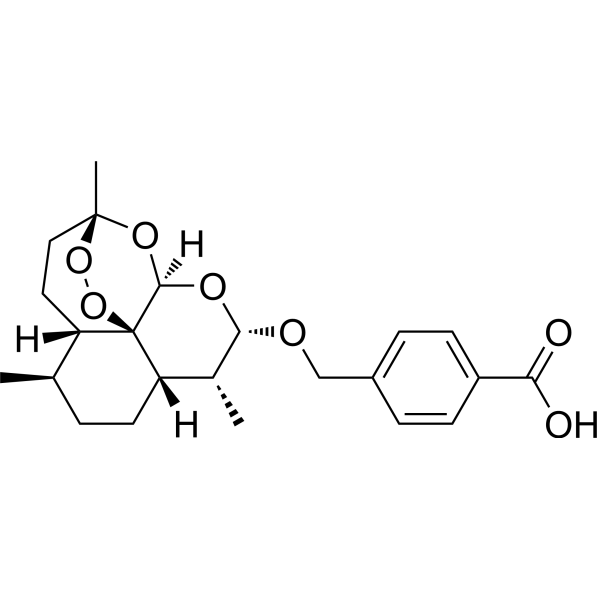
Physicochemical Properties
| Molecular Formula | C23H30O7 |
| Molecular Weight | 418.4801 |
| Exact Mass | 418.199 |
| CAS # | 120020-26-0 |
| PubChem CID | 10341948 |
| Appearance | White to off-white solid powder |
| Vapour Pressure | 2.28E-12mmHg at 25°C |
| LogP | 4.109 |
| Hydrogen Bond Donor Count | 1 |
| Hydrogen Bond Acceptor Count | 7 |
| Rotatable Bond Count | 4 |
| Heavy Atom Count | 30 |
| Complexity | 662 |
| Defined Atom Stereocenter Count | 8 |
| SMILES | O1[C@@]23[C@]4([H])O[C@@]([H])([C@]([H])(C([H])([H])[H])[C@]2([H])C([H])([H])C([H])([H])[C@@]([H])(C([H])([H])[H])[C@]3([H])C([H])([H])C([H])([H])[C@@](C([H])([H])[H])(O1)O4)OC([H])([H])C1C([H])=C([H])C(C(=O)O[H])=C([H])C=1[H] |
| InChi Key | UVNHKOOJXSALHN-ILQPJIFQSA-N |
| InChi Code | InChI=1S/C23H30O7/c1-13-4-9-18-14(2)20(26-12-15-5-7-16(8-6-15)19(24)25)27-21-23(18)17(13)10-11-22(3,28-21)29-30-23/h5-8,13-14,17-18,20-21H,4,9-12H2,1-3H3,(H,24,25)/t13-,14-,17+,18+,20+,21-,22-,23-/m1/s1 |
| Chemical Name | 4-[[(1R,4S,5R,8S,9R,10S,12R,13R)-1,5,9-trimethyl-11,14,15,16-tetraoxatetracyclo[10.3.1.04,13.08,13]hexadecan-10-yl]oxymethyl]benzoic acid |
| HS Tariff Code | 2934.99.9001 |
| Storage |
Powder-20°C 3 years 4°C 2 years In solvent -80°C 6 months -20°C 1 month |
| Shipping Condition | Room temperature (This product is stable at ambient temperature for a few days during ordinary shipping and time spent in Customs) |
Biological Activity
| ln Vivo | In dogs, the elimination time t1/2 for artemisinic acid (10 mg/kg; i.v.) is 0.37 hours, the CL is 14.99 mL/min/kg, the Vss is 9.52 L, and the AUC0–12h is 11219 ng h/mL. 1]. The elimination time t1/2 of artemisinic acid (10 mg/kg; IM) in dogs was 6.14 hours, the CL was 14.58 mL/min/kg, the Vss was 36.1 L, and the AUC0-12h was 96372 ng h/mL. 1]. Artemisinic acid (10 mg/kg; oral) in dogs had an AUC0–12h of 8839 ng h/mL, a CL of 14.6 mL/min/kg, a Vss of 16.2 L, and an elimination time t1/2 of 2.21 hours. 1]. |
| Animal Protocol |
Animal/Disease Models: 3-5 year old adult male beagle dogs [1] Doses: 10 mg/kg Route of Administration: intravenous (iv) (iv)injection (pharmacokinetic/PK/PK analysis) Experimental Results: Elimination time t1/2 was 0.37 hrs (hrs (hours)), CL was 14.99 mL/ min/kg, the Vss of dogs is 9.52 L, and the AUC0-12h is 11219 ng h/mL. |
| ADME/Pharmacokinetics |
Metabolism / Metabolites Beta-artelinic acid has known human metabolites that include Dihydroqinghaosu (DQHS). |
| References |
[1]. Li QG, et al. Pharmacology and toxicology of artelinic acid: preclinical investigations on pharmacokinetics, metabolism, protein and red blood cell binding, and acute and anorectic toxicities. Trans R Soc Trop Med Hyg. 1998 May-Jun;92(3):332-40. [2]. Hartell MG, et al. Nuclear magnetic resonance and molecular modeling analysis of the interaction of the antimalarial drugs artelinic acid and artesunic acid with beta-cyclodextrin. J Pharm Sci. 2004 Aug;93(8):2076-89. |
Solubility Data
| Solubility (In Vitro) | DMSO : ~100 mg/mL (~238.96 mM) |
| Solubility (In Vivo) |
Solubility in Formulation 1: 10 mg/mL (23.90 mM) in 10% DMSO + 40% PEG300 + 5% Tween80 + 45% Saline (add these co-solvents sequentially from left to right, and one by one), suspension solution; with sonication. For example, if 1 mL of working solution is to be prepared, you can add 100 μL of 100.0 mg/mL clear DMSO stock solution to 400 μL PEG300 and mix evenly; then add 50 μL Tween-80 to the above solution and mix evenly; then add 450 μL normal saline to adjust the volume to 1 mL. Preparation of saline: Dissolve 0.9 g of sodium chloride in 100 mL ddH₂ O to obtain a clear solution. Solubility in Formulation 2: ≥ 10 mg/mL (23.90 mM) (saturation unknown) in 10% DMSO + 90% (20% SBE-β-CD in Saline) (add these co-solvents sequentially from left to right, and one by one), clear solution. For example, if 1 mL of working solution is to be prepared, you can add 100 μL of 100.0 mg/mL clear DMSO stock solution to 900 μL of 20% SBE-β-CD physiological saline solution and mix evenly. Preparation of 20% SBE-β-CD in Saline (4°C,1 week): Dissolve 2 g SBE-β-CD in 10 mL saline to obtain a clear solution. Solubility in Formulation 3: ≥ 10 mg/mL (23.90 mM) (saturation unknown) in 10% DMSO + 90% Corn Oil (add these co-solvents sequentially from left to right, and one by one), clear solution. For example, if 1 mL of working solution is to be prepared, you can add 100 μL of 100.0 mg/mL clear DMSO stock solution to 900 μL of corn oil and mix evenly. (Please use freshly prepared in vivo formulations for optimal results.) |
| Preparing Stock Solutions | 1 mg | 5 mg | 10 mg | |
| 1 mM | 2.3896 mL | 11.9480 mL | 23.8960 mL | |
| 5 mM | 0.4779 mL | 2.3896 mL | 4.7792 mL | |
| 10 mM | 0.2390 mL | 1.1948 mL | 2.3896 mL |