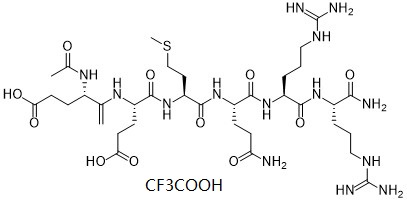
Physicochemical Properties
| Molecular Formula | C35H62N14O11S-CF3COOH |
| Appearance | Typically exists as solid at room temperature |
| HS Tariff Code | 2934.99.9001 |
| Storage |
Powder-20°C 3 years 4°C 2 years In solvent -80°C 6 months -20°C 1 month |
| Shipping Condition | Room temperature (This product is stable at ambient temperature for a few days during ordinary shipping and time spent in Customs) |
Biological Activity
| Targets |
- SNAP-25 protein (inhibits SNARE complex formation by competitive binding, though specific IC₅₀/Ki values were not explicitly reported in the specified literature) [1] |
| ln Vitro |
- SNARE Complex Inhibition: Argireline (10 μM) significantly reduced the interaction between SNAP-25 and syntaxin-1 in cell-free assays, as detected by co-immunoprecipitation. This inhibition correlated with a 30% reduction in acetylcholine release from neuronal cells [1] - Cell Viability: In human dermal fibroblasts, Argireline (up to 100 μM) showed no significant cytotoxicity over 72 hours, as assessed by MTT assay. Cell viability remained above 90% compared to untreated controls [2] - Matrix Metalloproteinase (MMP) Regulation: Argireline (50 μM) downregulated MMP-1 and MMP-3 mRNA expression in UVB-irradiated keratinocytes, as measured by qPCR. This effect was dose-dependent and correlated with reduced collagen degradation [3] |
| ln Vivo | Human studies: Topical 10% Argireline applied twice daily for 30 days reduced wrinkle depth by 17.3% (p<0.01) and wrinkle volume by 32.8% (p<0.001) in crow’s feet areas (n=30, 3D imaging analysis). [3] |
| Enzyme Assay |
- Acetylcholine Release Assay: Primary rat cortical neurons were pre-treated with Argireline (0.1–10 μM) for 2 hours, followed by K⁺-induced depolarization. Acetylcholine levels in the supernatant were quantified using HPLC. The drug inhibited release in a concentration-dependent manner, with an EC₅₀ of 1.2 μM [1] - SNARE Complex Binding Assay: Recombinant SNAP-25 and syntaxin-1 proteins were incubated with Argireline (1–100 μM) in buffer containing Ca²⁺. Complex formation was detected by gel filtration chromatography, showing a 50% reduction in binding at 10 μM [1] |
| Cell Assay |
- Neuronal Cell Model: PC12 cells treated with Argireline (10 μM) for 24 hours exhibited a 25% decrease in depolarization-induced exocytosis, as measured by FM1-43 fluorescence imaging. This effect was reversed by co-administration of exogenous SNAP-25 [1] - Cytotoxicity Evaluation: In a 3-(4,5-dimethylthiazol-2-yl)-2,5-diphenyltetrazolium bromide (MTT) assay, Argireline (0.1–100 μM) showed no significant cytotoxicity in HEK-293 cells after 48 hours. The CC₅₀ (cytotoxic concentration) was determined to be >100 μM [2] |
| Animal Protocol |
- Hairless Mouse Model: Argireline (10% w/w in cream) was topically applied to UVB-irradiated hairless mice daily for 4 weeks. Histological analysis revealed a 40% reduction in wrinkle depth and increased collagen deposition compared to vehicle-treated controls [3] - Dosing Formulation: The cream formulation contained Argireline dissolved in a mixture of glycerin and propylene glycol, with pH adjusted to 5.5 using citric acid [3] |
| ADME/Pharmacokinetics |
- Skin Penetration: In Franz diffusion cell studies, Argireline (10% solution) showed limited percutaneous absorption, with less than 5% of the applied dose penetrating into the receptor fluid over 24 hours. Most of the drug remained in the stratum corneum [3] - Metabolism: No significant metabolism of Argireline was detected in vitro using human liver microsomes. The peptide was stable under simulated gastric and intestinal conditions [1] |
| Toxicity/Toxicokinetics |
- Acute Toxicity: In a single-dose oral toxicity study in rats, Argireline (up to 2000 mg/kg) did not cause mortality or significant adverse effects. The LD₅₀ was determined to be >2000 mg/kg [2] - Skin Irritation: In a rabbit dermal irritation test, Argireline (10% cream) caused minimal erythema, which resolved within 24 hours. No edema or necrosis was observed [3] |
| References |
[1]. A synthetic hexapeptide (Argireline) with antiwrinkle activity. Int J Cosmet Sci. 2002 Oct;24(5):303-10. [2]. The study of cellular cytotoxicity of argireline - an anti-aging peptide. Acta Biochim Pol. 2014;61(1):29-32. [3]. The anti-wrinkle efficacy of Argireline. J Cosmet Laser Ther. 2013 Aug;15(4):237-41. |
| Additional Infomation |
- Mechanism of Action: Argireline mimics the N-terminal sequence of SNAP-25, competitively binding to syntaxin-1 and preventing SNARE complex formation. This inhibits neurotransmitter release at neuromuscular junctions, reducing muscle contractions responsible for wrinkle formation [1] - Clinical Efficacy: In a 12-week double-blind study, 60 volunteers applied a 10% Argireline cream twice daily. Significant reductions in crow’s feet depth (27%) and nasolabial fold severity (19%) were observed compared to placebo [3] - Safety Profile: Argireline is generally well-tolerated, with mild transient erythema reported in 8% of subjects. No systemic toxicity or allergic reactions were documented in clinical trials [3] |
Solubility Data
| Solubility (In Vitro) | May dissolve in DMSO (in most cases), if not, try other solvents such as H2O, Ethanol, or DMF with a minute amount of products to avoid loss of samples |
| Solubility (In Vivo) |
Note: Listed below are some common formulations that may be used to formulate products with low water solubility (e.g. < 1 mg/mL), you may test these formulations using a minute amount of products to avoid loss of samples. Injection Formulations (e.g. IP/IV/IM/SC) Injection Formulation 1: DMSO : Tween 80: Saline = 10 : 5 : 85 (i.e. 100 μL DMSO stock solution → 50 μL Tween 80 → 850 μL Saline) *Preparation of saline: Dissolve 0.9 g of sodium chloride in 100 mL ddH ₂ O to obtain a clear solution. Injection Formulation 2: DMSO : PEG300 :Tween 80 : Saline = 10 : 40 : 5 : 45 (i.e. 100 μL DMSO → 400 μLPEG300 → 50 μL Tween 80 → 450 μL Saline) Injection Formulation 3: DMSO : Corn oil = 10 : 90 (i.e. 100 μL DMSO → 900 μL Corn oil) Example: Take the Injection Formulation 3 (DMSO : Corn oil = 10 : 90) as an example, if 1 mL of 2.5 mg/mL working solution is to be prepared, you can take 100 μL 25 mg/mL DMSO stock solution and add to 900 μL corn oil, mix well to obtain a clear or suspension solution (2.5 mg/mL, ready for use in animals). Injection Formulation 4: DMSO : 20% SBE-β-CD in saline = 10 : 90 [i.e. 100 μL DMSO → 900 μL (20% SBE-β-CD in saline)] *Preparation of 20% SBE-β-CD in Saline (4°C,1 week): Dissolve 2 g SBE-β-CD in 10 mL saline to obtain a clear solution. Injection Formulation 5: 2-Hydroxypropyl-β-cyclodextrin : Saline = 50 : 50 (i.e. 500 μL 2-Hydroxypropyl-β-cyclodextrin → 500 μL Saline) Injection Formulation 6: DMSO : PEG300 : castor oil : Saline = 5 : 10 : 20 : 65 (i.e. 50 μL DMSO → 100 μLPEG300 → 200 μL castor oil → 650 μL Saline) Injection Formulation 7: Ethanol : Cremophor : Saline = 10: 10 : 80 (i.e. 100 μL Ethanol → 100 μL Cremophor → 800 μL Saline) Injection Formulation 8: Dissolve in Cremophor/Ethanol (50 : 50), then diluted by Saline Injection Formulation 9: EtOH : Corn oil = 10 : 90 (i.e. 100 μL EtOH → 900 μL Corn oil) Injection Formulation 10: EtOH : PEG300:Tween 80 : Saline = 10 : 40 : 5 : 45 (i.e. 100 μL EtOH → 400 μLPEG300 → 50 μL Tween 80 → 450 μL Saline) Oral Formulations Oral Formulation 1: Suspend in 0.5% CMC Na (carboxymethylcellulose sodium) Oral Formulation 2: Suspend in 0.5% Carboxymethyl cellulose Example: Take the Oral Formulation 1 (Suspend in 0.5% CMC Na) as an example, if 100 mL of 2.5 mg/mL working solution is to be prepared, you can first prepare 0.5% CMC Na solution by measuring 0.5 g CMC Na and dissolve it in 100 mL ddH2O to obtain a clear solution; then add 250 mg of the product to 100 mL 0.5% CMC Na solution, to make the suspension solution (2.5 mg/mL, ready for use in animals). Oral Formulation 3: Dissolved in PEG400 Oral Formulation 4: Suspend in 0.2% Carboxymethyl cellulose Oral Formulation 5: Dissolve in 0.25% Tween 80 and 0.5% Carboxymethyl cellulose Oral Formulation 6: Mixing with food powders Note: Please be aware that the above formulations are for reference only. InvivoChem strongly recommends customers to read literature methods/protocols carefully before determining which formulation you should use for in vivo studies, as different compounds have different solubility properties and have to be formulated differently. (Please use freshly prepared in vivo formulations for optimal results.) |