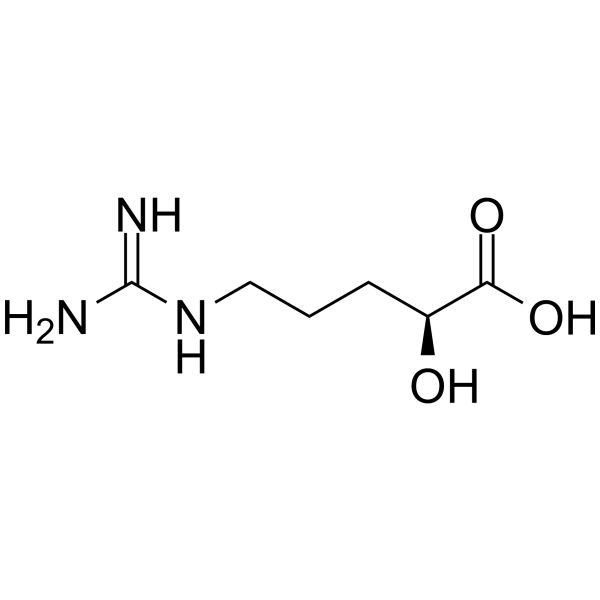
Physicochemical Properties
| Molecular Formula | C6H13N3O3 |
| Molecular Weight | 175.18572 |
| Exact Mass | 175.096 |
| CAS # | 157-07-3 |
| PubChem CID | 160437 |
| Appearance | Off-white to light yellow solid powder |
| Density | 1.46g/cm3 |
| Boiling Point | 443.8ºC at 760 mmHg |
| Flash Point | 222.2ºC |
| Vapour Pressure | 9.68E-10mmHg at 25°C |
| Index of Refraction | 1.579 |
| LogP | -1.7 |
| Hydrogen Bond Donor Count | 4 |
| Hydrogen Bond Acceptor Count | 4 |
| Rotatable Bond Count | 5 |
| Heavy Atom Count | 12 |
| Complexity | 177 |
| Defined Atom Stereocenter Count | 1 |
| SMILES | C(C[C@@H](C(=O)O)O)CN=C(N)N |
| InChi Key | BMFMQGXDDJALKQ-BYPYZUCNSA-N |
| InChi Code | InChI=1S/C6H13N3O3/c7-6(8)9-3-1-2-4(10)5(11)12/h4,10H,1-3H2,(H,11,12)(H4,7,8,9)/t4-/m0/s1 |
| Chemical Name | (2S)-5-(diaminomethylideneamino)-2-hydroxypentanoic acid |
| HS Tariff Code | 2934.99.9001 |
| Storage |
Powder-20°C 3 years 4°C 2 years In solvent -80°C 6 months -20°C 1 month Note: Please store this product in a sealed and protected environment, avoid exposure to moisture. |
| Shipping Condition | Room temperature (This product is stable at ambient temperature for a few days during ordinary shipping and time spent in Customs) |
Biological Activity
| ln Vitro | Arginine comprises α-amino group, α-carboxylic acid group and a side chain formed of a 3-carbon aliphatic straight chain ending with a guanidine group. In humans, arginine is classed as a semi-essential amino acid or a conditionally essential amino acid, depending on the individual's developmental stage and health situation. |
| ADME/Pharmacokinetics |
Metabolism / Metabolites Uremic toxins tend to accumulate in the blood either through dietary excess or through poor filtration by the kidneys. Most uremic toxins are metabolic waste products and are normally excreted in the urine or feces. |
| Toxicity/Toxicokinetics |
Toxicity Summary Uremic toxins such as arginic acid are actively transported into the kidneys via organic ion transporters (especially OAT3). Increased levels of uremic toxins can stimulate the production of reactive oxygen species. This seems to be mediated by the direct binding or inhibition by uremic toxins of the enzyme NADPH oxidase (especially NOX4 which is abundant in the kidneys and heart) (A7868). Reactive oxygen species can induce several different DNA methyltransferases (DNMTs) which are involved in the silencing of a protein known as KLOTHO. KLOTHO has been identified as having important roles in anti-aging, mineral metabolism, and vitamin D metabolism. A number of studies have indicated that KLOTHO mRNA and protein levels are reduced during acute or chronic kidney diseases in response to high local levels of reactive oxygen species (A7869). |
| Additional Infomation |
Argininic acid is an organonitrogen compound and an organooxygen compound. It is functionally related to a delta-amino acid. Arginic acid is a uremic toxin. Uremic toxins can be subdivided into three major groups based upon their chemical and physical characteristics: 1) small, water-soluble, non-protein-bound compounds, such as urea; 2) small, lipid-soluble and/or protein-bound compounds, such as the phenols and 3) larger so-called middle-molecules, such as beta2-microglobulin. Chronic exposure of uremic toxins can lead to a number of conditions including renal damage, chronic kidney disease and cardiovascular disease. Tissue accumulation of argininic acid (AA) occurs in hyperargininemia. Hyperargininemia, an inborn error of the urea cycle, is caused by a severe deficiency of liver arginase, resulting in elevated tissue levels of arginine (Arg) and other guanidino compounds (GC). Affected patients present a neurological syndrome consisting of a variable degree of mental retardation, epilepsy and progressive spasticity whose pathophysiology is far from understood. Guanidino compounds accumulate in other pathological conditions such as uremia and epilepsy and some evidence supports the hypothesis that these compounds contribute to the neurological dysfunction characteristic of these diseases. The increase of these compounds occurs by blockage of the arginase reaction, activating secondary biochemical pathways. Thus, Arg is converted to _-keto-_-guanidinovaleric acid by transamination, and this compound forms AA by hydrogenation. (A3288). |
Solubility Data
| Solubility (In Vitro) | May dissolve in DMSO (in most cases), if not, try other solvents such as H2O, Ethanol, or DMF with a minute amount of products to avoid loss of samples |
| Solubility (In Vivo) |
Note: Listed below are some common formulations that may be used to formulate products with low water solubility (e.g. < 1 mg/mL), you may test these formulations using a minute amount of products to avoid loss of samples. Injection Formulations (e.g. IP/IV/IM/SC) Injection Formulation 1: DMSO : Tween 80: Saline = 10 : 5 : 85 (i.e. 100 μL DMSO stock solution → 50 μL Tween 80 → 850 μL Saline) *Preparation of saline: Dissolve 0.9 g of sodium chloride in 100 mL ddH ₂ O to obtain a clear solution. Injection Formulation 2: DMSO : PEG300 :Tween 80 : Saline = 10 : 40 : 5 : 45 (i.e. 100 μL DMSO → 400 μLPEG300 → 50 μL Tween 80 → 450 μL Saline) Injection Formulation 3: DMSO : Corn oil = 10 : 90 (i.e. 100 μL DMSO → 900 μL Corn oil) Example: Take the Injection Formulation 3 (DMSO : Corn oil = 10 : 90) as an example, if 1 mL of 2.5 mg/mL working solution is to be prepared, you can take 100 μL 25 mg/mL DMSO stock solution and add to 900 μL corn oil, mix well to obtain a clear or suspension solution (2.5 mg/mL, ready for use in animals). Injection Formulation 4: DMSO : 20% SBE-β-CD in saline = 10 : 90 [i.e. 100 μL DMSO → 900 μL (20% SBE-β-CD in saline)] *Preparation of 20% SBE-β-CD in Saline (4°C,1 week): Dissolve 2 g SBE-β-CD in 10 mL saline to obtain a clear solution. Injection Formulation 5: 2-Hydroxypropyl-β-cyclodextrin : Saline = 50 : 50 (i.e. 500 μL 2-Hydroxypropyl-β-cyclodextrin → 500 μL Saline) Injection Formulation 6: DMSO : PEG300 : castor oil : Saline = 5 : 10 : 20 : 65 (i.e. 50 μL DMSO → 100 μLPEG300 → 200 μL castor oil → 650 μL Saline) Injection Formulation 7: Ethanol : Cremophor : Saline = 10: 10 : 80 (i.e. 100 μL Ethanol → 100 μL Cremophor → 800 μL Saline) Injection Formulation 8: Dissolve in Cremophor/Ethanol (50 : 50), then diluted by Saline Injection Formulation 9: EtOH : Corn oil = 10 : 90 (i.e. 100 μL EtOH → 900 μL Corn oil) Injection Formulation 10: EtOH : PEG300:Tween 80 : Saline = 10 : 40 : 5 : 45 (i.e. 100 μL EtOH → 400 μLPEG300 → 50 μL Tween 80 → 450 μL Saline) Oral Formulations Oral Formulation 1: Suspend in 0.5% CMC Na (carboxymethylcellulose sodium) Oral Formulation 2: Suspend in 0.5% Carboxymethyl cellulose Example: Take the Oral Formulation 1 (Suspend in 0.5% CMC Na) as an example, if 100 mL of 2.5 mg/mL working solution is to be prepared, you can first prepare 0.5% CMC Na solution by measuring 0.5 g CMC Na and dissolve it in 100 mL ddH2O to obtain a clear solution; then add 250 mg of the product to 100 mL 0.5% CMC Na solution, to make the suspension solution (2.5 mg/mL, ready for use in animals). Oral Formulation 3: Dissolved in PEG400 Oral Formulation 4: Suspend in 0.2% Carboxymethyl cellulose Oral Formulation 5: Dissolve in 0.25% Tween 80 and 0.5% Carboxymethyl cellulose Oral Formulation 6: Mixing with food powders Note: Please be aware that the above formulations are for reference only. InvivoChem strongly recommends customers to read literature methods/protocols carefully before determining which formulation you should use for in vivo studies, as different compounds have different solubility properties and have to be formulated differently. (Please use freshly prepared in vivo formulations for optimal results.) |
| Preparing Stock Solutions | 1 mg | 5 mg | 10 mg | |
| 1 mM | 5.7081 mL | 28.5404 mL | 57.0809 mL | |
| 5 mM | 1.1416 mL | 5.7081 mL | 11.4162 mL | |
| 10 mM | 0.5708 mL | 2.8540 mL | 5.7081 mL |