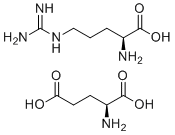
Physicochemical Properties
| Molecular Formula | C11H23N5O6 |
| Molecular Weight | 321.33 |
| Exact Mass | 321.164 |
| Elemental Analysis | C, 41.12; H, 7.21; N, 21.80; O, 29.87 |
| CAS # | 4320-30-3 |
| Related CAS # | DL-Arginine;7200-25-1;L-Arginine;74-79-3;L-Arginine butanoate;80407-72-3; 2485-55-4 (caprate); 4320-30-3 (glutamate); 1119-34-2 (HCl) |
| PubChem CID | 165268 |
| Appearance | White to off-white solid powder |
| Boiling Point | 409.1ºC at 760 mmHg |
| Melting Point | 191 - 192ºC |
| Flash Point | 201.2ºC |
| LogP | 0.516 |
| Hydrogen Bond Donor Count | 7 |
| Hydrogen Bond Acceptor Count | 9 |
| Rotatable Bond Count | 9 |
| Heavy Atom Count | 22 |
| Complexity | 321 |
| Defined Atom Stereocenter Count | 2 |
| SMILES | O([H])C([C@]([H])(C([H])([H])C([H])([H])C([H])([H])/N=C(\N([H])[H])/N([H])[H])N([H])[H])=O.O([H])C([C@]([H])(C([H])([H])C([H])([H])C(=O)O[H])N([H])[H])=O |
| InChi Key | RVEWUBJVAHOGKA-WOYAITHZSA-N |
| InChi Code | InChI=1S/C6H14N4O2.C5H9NO4/c7-4(5(11)12)2-1-3-10-6(8)9;6-3(5(9)10)1-2-4(7)8/h4H,1-3,7H2,(H,11,12)(H4,8,9,10);3H,1-2,6H2,(H,7,8)(H,9,10)/t4-;3-/m00/s1 |
| Chemical Name | (2S)-2-amino-5-(diaminomethylideneamino)pentanoic acid;(2S)-2-aminopentanedioic acid |
| Synonyms | Argimate Modumate; Arginine glutamate; NSC-122009; 4320-30-3; L-Arginine L-glutamate; Arginine glutamate; (S)-2-Amino-5-guanidinopentanoic acid compound with (S)-2-aminopentanedioic acid (1:1); L-ARGININE-L-GLUTAMATE; L-Arginine L-glutamate salt; Modumate; L-Arginine, L-glutamate; NSC122009; NCI-C02120; NSC 122009 |
| HS Tariff Code | 2934.99.9001 |
| Storage |
Powder-20°C 3 years 4°C 2 years In solvent -80°C 6 months -20°C 1 month |
| Shipping Condition | Room temperature (This product is stable at ambient temperature for a few days during ordinary shipping and time spent in Customs) |
Biological Activity
| Targets | Microbial Metabolite; Endogenous Metabolite |
| ln Vivo | In rats, oral administration of 10-30 mg/kg of L-arginine L-glutamic acid dose-dependently increases stomach emptying. The vagus nerve must be activated for this action to occur. Additionally, intragastric L-arginine L-glutamic acid (3–30 mg/kg) improves gastric adaptive relaxation in rats in a dose-dependent manner. |
| Animal Protocol | mino acids are not only constituents of proteins, but also have multiple physiologic functions. Recent findings have revealed that ingested amino acids either activate luminal receptors or are metabolized, causing physiologic reactions in the gastrointestinal (GI) tract. We examined the effect of oral L-arginine L-glutamate (ArgGlu), a pharmaceutical amino acid salt used i.v. for the treatment of hyperammonemia, on gastric motor function in rats and dogs. Gastric emptying was determined using phenol red and 13C-breath test methods, whereas gastric relaxation was determined using the barostat method. ArgGlu (10-30 mg/kg, p.o.) dose-dependently promoted gastric emptying in rats. This effect was dependent on vagus nerve activation and comparable to that of the prokinetic mosapride. Intragastric ArgGlu (3-30 mg/kg intragastrically) also dose-dependently enhanced adaptive relaxation of rat stomachs, which was negated not by vagotomy of gastric branches, but by pretreatment with N omega-nitro-L-arginine methyl ester (20 mg/kg i.v.), a nitric oxide synthase inhibitor. Its relaxing effect on the stomach was also confirmed in dogs and was equally as efficacious as treatment with sumatriptan (1-3 mg/kg s.c.). ArgGlu (30 mg/kg p.o.) significantly reduced the half gastric emptying time in clonidine-induced delayed gastric emptying of solids in dogs, and its effect was comparable to that of cisapride (3 mg/kg p.o.). This study demonstrated that the pharmaceutical ingredient ArgGlu, currently used i.v., enhanced gastric motor function when administered orally, suggesting that it could be a new oral medicine indicated for treatment of upper GI hypofunction or dysfunction like functional dyspepsia.[1] |
| References |
[1]. L-Arginine L-Glutamate Enhances Gastric Motor Function in Rats and Dogs and Improves Delayed Gastric Emptying in Dogs. J Pharmacol Exp Ther. 2016 Nov;359(2):238-246. |
| Additional Infomation | Arginine glutamate is a glutamic acid derivative. |
Solubility Data
| Solubility (In Vitro) | H2O : ~100 mg/mL (~311.21 mM) |
| Solubility (In Vivo) |
Note: Listed below are some common formulations that may be used to formulate products with low water solubility (e.g. < 1 mg/mL), you may test these formulations using a minute amount of products to avoid loss of samples. Injection Formulations (e.g. IP/IV/IM/SC) Injection Formulation 1: DMSO : Tween 80: Saline = 10 : 5 : 85 (i.e. 100 μL DMSO stock solution → 50 μL Tween 80 → 850 μL Saline) *Preparation of saline: Dissolve 0.9 g of sodium chloride in 100 mL ddH ₂ O to obtain a clear solution. Injection Formulation 2: DMSO : PEG300 :Tween 80 : Saline = 10 : 40 : 5 : 45 (i.e. 100 μL DMSO → 400 μLPEG300 → 50 μL Tween 80 → 450 μL Saline) Injection Formulation 3: DMSO : Corn oil = 10 : 90 (i.e. 100 μL DMSO → 900 μL Corn oil) Example: Take the Injection Formulation 3 (DMSO : Corn oil = 10 : 90) as an example, if 1 mL of 2.5 mg/mL working solution is to be prepared, you can take 100 μL 25 mg/mL DMSO stock solution and add to 900 μL corn oil, mix well to obtain a clear or suspension solution (2.5 mg/mL, ready for use in animals). Injection Formulation 4: DMSO : 20% SBE-β-CD in saline = 10 : 90 [i.e. 100 μL DMSO → 900 μL (20% SBE-β-CD in saline)] *Preparation of 20% SBE-β-CD in Saline (4°C,1 week): Dissolve 2 g SBE-β-CD in 10 mL saline to obtain a clear solution. Injection Formulation 5: 2-Hydroxypropyl-β-cyclodextrin : Saline = 50 : 50 (i.e. 500 μL 2-Hydroxypropyl-β-cyclodextrin → 500 μL Saline) Injection Formulation 6: DMSO : PEG300 : castor oil : Saline = 5 : 10 : 20 : 65 (i.e. 50 μL DMSO → 100 μLPEG300 → 200 μL castor oil → 650 μL Saline) Injection Formulation 7: Ethanol : Cremophor : Saline = 10: 10 : 80 (i.e. 100 μL Ethanol → 100 μL Cremophor → 800 μL Saline) Injection Formulation 8: Dissolve in Cremophor/Ethanol (50 : 50), then diluted by Saline Injection Formulation 9: EtOH : Corn oil = 10 : 90 (i.e. 100 μL EtOH → 900 μL Corn oil) Injection Formulation 10: EtOH : PEG300:Tween 80 : Saline = 10 : 40 : 5 : 45 (i.e. 100 μL EtOH → 400 μLPEG300 → 50 μL Tween 80 → 450 μL Saline) Oral Formulations Oral Formulation 1: Suspend in 0.5% CMC Na (carboxymethylcellulose sodium) Oral Formulation 2: Suspend in 0.5% Carboxymethyl cellulose Example: Take the Oral Formulation 1 (Suspend in 0.5% CMC Na) as an example, if 100 mL of 2.5 mg/mL working solution is to be prepared, you can first prepare 0.5% CMC Na solution by measuring 0.5 g CMC Na and dissolve it in 100 mL ddH2O to obtain a clear solution; then add 250 mg of the product to 100 mL 0.5% CMC Na solution, to make the suspension solution (2.5 mg/mL, ready for use in animals). Oral Formulation 3: Dissolved in PEG400 Oral Formulation 4: Suspend in 0.2% Carboxymethyl cellulose Oral Formulation 5: Dissolve in 0.25% Tween 80 and 0.5% Carboxymethyl cellulose Oral Formulation 6: Mixing with food powders Note: Please be aware that the above formulations are for reference only. InvivoChem strongly recommends customers to read literature methods/protocols carefully before determining which formulation you should use for in vivo studies, as different compounds have different solubility properties and have to be formulated differently. (Please use freshly prepared in vivo formulations for optimal results.) |
| Preparing Stock Solutions | 1 mg | 5 mg | 10 mg | |
| 1 mM | 3.1121 mL | 15.5603 mL | 31.1207 mL | |
| 5 mM | 0.6224 mL | 3.1121 mL | 6.2241 mL | |
| 10 mM | 0.3112 mL | 1.5560 mL | 3.1121 mL |