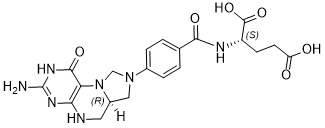
Arfolitixorin, an intravenously administered folate-
Physicochemical Properties
| Molecular Formula | C20H23N7O6 |
| Molecular Weight | 457.4399 |
| Exact Mass | 457.171 |
| CAS # | 31690-11-6 |
| Related CAS # | 31690-11-6 (free);149930-93-8 (sulfate);154705-24-5 (sodium); |
| PubChem CID | 135398645 |
| Appearance | Typically exists as solid at room temperature |
| LogP | 0.718 |
| Hydrogen Bond Donor Count | 6 |
| Hydrogen Bond Acceptor Count | 10 |
| Rotatable Bond Count | 7 |
| Heavy Atom Count | 33 |
| Complexity | 911 |
| Defined Atom Stereocenter Count | 2 |
| SMILES | O=C1C2=C(N=C(N([H])[H])N1[H])N([H])C([H])([H])[C@]1([H])C([H])([H])N(C3C([H])=C([H])C(C(N([H])[C@]([H])(C(=O)O[H])C([H])([H])C([H])([H])C(=O)O[H])=O)=C([H])C=3[H])C([H])([H])N12 |
| InChi Key | QYNUQALWYRSVHF-OLZOCXBDSA-N |
| InChi Code | InChI=1S/C20H23N7O6/c21-20-24-16-15(18(31)25-20)27-9-26(8-12(27)7-22-16)11-3-1-10(2-4-11)17(30)23-13(19(32)33)5-6-14(28)29/h1-4,12-13H,5-9H2,(H,23,30)(H,28,29)(H,32,33)(H4,21,22,24,25,31)/t12-,13+/m1/s1 |
| Chemical Name | (4-((R)-3-amino-1-oxo-1,2,5,6,6a,7-hexahydroimidazo[1,5-f]pteridin-8(9H)-yl)benzoyl)-L-glutamic acid |
| Synonyms | (6R)-5,10-Methylene-5,6,7,8-tetrahydrofolic acid; (6R)-5,10-Methylenetetrahydrofolate; 5,10-Methylene-(6R)-tetrahydrofolic acid; |
| HS Tariff Code | 2934.99.9001 |
| Storage |
Powder-20°C 3 years 4°C 2 years In solvent -80°C 6 months -20°C 1 month |
| Shipping Condition | Room temperature (This product is stable at ambient temperature for a few days during ordinary shipping and time spent in Customs) |
Biological Activity
| References | https://www.targetedonc.com/news/first-patient-enrolled-in-phase-iii-study-of-novel-agent-arfolitixorin-in-mcrc |
| Additional Infomation |
(6R)-5,10-methylenetetrahydrofolic acid is the (6R)-stereoisomer of 5,10-methylenetetrahydrofolic acid. It has a role as an Escherichia coli metabolite, a mouse metabolite and a cofactor. It is a conjugate acid of a (6R)-5,10-methylenetetrahydrofolate(2-). Modufolin is under investigation for the treatment of Osteosarcoma. 5,10-Methylene-THF is a metabolite found in or produced by Escherichia coli (strain K12, MG1655). (6R)-5,10-Methylenetetrahydrofolate has been reported in Homo sapiens with data available. Arfolitixorin is the R-isomer of folitixorin, a reduced folate-based biomodulator and active metabolite of folate drugs leucovorin (LV) and levoleucovorin (l-LV) that can be used to increase the efficacy of certain antimetabolites, such as the cytotoxic agent 5-fluorouracil (5-FU), and reduce as well as protect against certain antimetabolite-associated adverse effects, such as those seen with high-dose (HD) methotrexate. Upon administration of arfolitixorin, 5,10-methylenetetrahydrofolate (MTHF) is a reduced folate substrate for the enzyme thymidylate synthase (TS) and stabilizes, upon co-administration of 5-FU, the covalent binding of the 5-FU metabolite 5-fluoro-2'-deoxyuridine-5'-monophosphate (FdUMP), instead of deoxyuridine monophosphate (dUMP), to its target enzyme TS, which results in an inhibition of TS. This inhibits the synthesis of deoxythymidine monophosphate (dTMP) and leads to the depletion of thymidine triphosphate (TTP), which is a necessary constituent of DNA. This inhibits DNA synthesis, which leads to an inhibition of cellular proliferation and induces tumor cell death. As MTHF is able to stabilize and strengthen the ternary complex, co-administration of arfolitixorin enhances the inhibition of DNA synthesis and increases the cytotoxic effect of 5-FU. As MTHF is the active form of folate and the active metabolite of LV and l-LV, arfolitixorin does not need to be converted to an active metabolite to become activated. In DNA synthesis, a ternary complex is formed between the reduced folate substrate MTHF, the TS enzyme and dUMP in order to convert dUMP to the DNA building block dTMP, which is necessary for DNA synthesis. Drug Indication Treatment of colorectal cancer |
Solubility Data
| Solubility (In Vitro) | May dissolve in DMSO (in most cases), if not, try other solvents such as H2O, Ethanol, or DMF with a minute amount of products to avoid loss of samples |
| Solubility (In Vivo) |
Note: Listed below are some common formulations that may be used to formulate products with low water solubility (e.g. < 1 mg/mL), you may test these formulations using a minute amount of products to avoid loss of samples. Injection Formulations (e.g. IP/IV/IM/SC) Injection Formulation 1: DMSO : Tween 80: Saline = 10 : 5 : 85 (i.e. 100 μL DMSO stock solution → 50 μL Tween 80 → 850 μL Saline) *Preparation of saline: Dissolve 0.9 g of sodium chloride in 100 mL ddH ₂ O to obtain a clear solution. Injection Formulation 2: DMSO : PEG300 :Tween 80 : Saline = 10 : 40 : 5 : 45 (i.e. 100 μL DMSO → 400 μLPEG300 → 50 μL Tween 80 → 450 μL Saline) Injection Formulation 3: DMSO : Corn oil = 10 : 90 (i.e. 100 μL DMSO → 900 μL Corn oil) Example: Take the Injection Formulation 3 (DMSO : Corn oil = 10 : 90) as an example, if 1 mL of 2.5 mg/mL working solution is to be prepared, you can take 100 μL 25 mg/mL DMSO stock solution and add to 900 μL corn oil, mix well to obtain a clear or suspension solution (2.5 mg/mL, ready for use in animals). Injection Formulation 4: DMSO : 20% SBE-β-CD in saline = 10 : 90 [i.e. 100 μL DMSO → 900 μL (20% SBE-β-CD in saline)] *Preparation of 20% SBE-β-CD in Saline (4°C,1 week): Dissolve 2 g SBE-β-CD in 10 mL saline to obtain a clear solution. Injection Formulation 5: 2-Hydroxypropyl-β-cyclodextrin : Saline = 50 : 50 (i.e. 500 μL 2-Hydroxypropyl-β-cyclodextrin → 500 μL Saline) Injection Formulation 6: DMSO : PEG300 : castor oil : Saline = 5 : 10 : 20 : 65 (i.e. 50 μL DMSO → 100 μLPEG300 → 200 μL castor oil → 650 μL Saline) Injection Formulation 7: Ethanol : Cremophor : Saline = 10: 10 : 80 (i.e. 100 μL Ethanol → 100 μL Cremophor → 800 μL Saline) Injection Formulation 8: Dissolve in Cremophor/Ethanol (50 : 50), then diluted by Saline Injection Formulation 9: EtOH : Corn oil = 10 : 90 (i.e. 100 μL EtOH → 900 μL Corn oil) Injection Formulation 10: EtOH : PEG300:Tween 80 : Saline = 10 : 40 : 5 : 45 (i.e. 100 μL EtOH → 400 μLPEG300 → 50 μL Tween 80 → 450 μL Saline) Oral Formulations Oral Formulation 1: Suspend in 0.5% CMC Na (carboxymethylcellulose sodium) Oral Formulation 2: Suspend in 0.5% Carboxymethyl cellulose Example: Take the Oral Formulation 1 (Suspend in 0.5% CMC Na) as an example, if 100 mL of 2.5 mg/mL working solution is to be prepared, you can first prepare 0.5% CMC Na solution by measuring 0.5 g CMC Na and dissolve it in 100 mL ddH2O to obtain a clear solution; then add 250 mg of the product to 100 mL 0.5% CMC Na solution, to make the suspension solution (2.5 mg/mL, ready for use in animals). Oral Formulation 3: Dissolved in PEG400 Oral Formulation 4: Suspend in 0.2% Carboxymethyl cellulose Oral Formulation 5: Dissolve in 0.25% Tween 80 and 0.5% Carboxymethyl cellulose Oral Formulation 6: Mixing with food powders Note: Please be aware that the above formulations are for reference only. InvivoChem strongly recommends customers to read literature methods/protocols carefully before determining which formulation you should use for in vivo studies, as different compounds have different solubility properties and have to be formulated differently. (Please use freshly prepared in vivo formulations for optimal results.) |
| Preparing Stock Solutions | 1 mg | 5 mg | 10 mg | |
| 1 mM | 2.1861 mL | 10.9304 mL | 21.8608 mL | |
| 5 mM | 0.4372 mL | 2.1861 mL | 4.3722 mL | |
| 10 mM | 0.2186 mL | 1.0930 mL | 2.1861 mL |