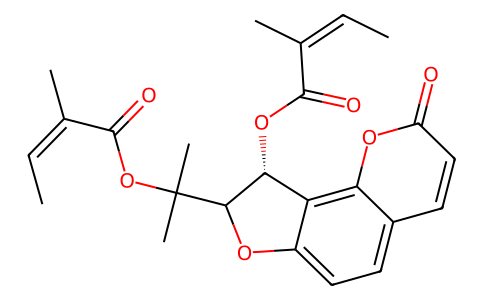
Physicochemical Properties
| Molecular Formula | C24H26O7 |
| Molecular Weight | 426.45904 |
| Exact Mass | 426.168 |
| Elemental Analysis | C, 67.59; H, 6.15; O, 26.26 |
| CAS # | 2607-56-9 |
| PubChem CID | 5281371 |
| Appearance | Typically exists as solid at room temperature |
| LogP | 4.392 |
| Hydrogen Bond Donor Count | 0 |
| Hydrogen Bond Acceptor Count | 7 |
| Rotatable Bond Count | 7 |
| Heavy Atom Count | 31 |
| Complexity | 835 |
| Defined Atom Stereocenter Count | 2 |
| SMILES | C/C=C(\C(O[C@H]1C(C(OC(/C(=C\C)/C)=O)(C)C)OC2C=CC3C=CC(=O)OC=3C1=2)=O)/C |
| InChi Key | RVGGCRQPGKFZDS-AKRYRNCVSA-N |
| InChi Code | InChI=1S/C24H26O7/c1-7-13(3)22(26)30-20-18-16(11-9-15-10-12-17(25)29-19(15)18)28-21(20)24(5,6)31-23(27)14(4)8-2/h7-12,20-21H,1-6H3/b13-7-,14-8-/t20-,21+/m1/s1 |
| Chemical Name | [(8S,9R)-8-[2-[(Z)-2-methylbut-2-enoyl]oxypropan-2-yl]-2-oxo-8,9-dihydrofuro[2,3-h]chromen-9-yl] (Z)-2-methylbut-2-enoate |
| HS Tariff Code | 2934.99.9001 |
| Storage |
Powder-20°C 3 years 4°C 2 years In solvent -80°C 6 months -20°C 1 month |
| Shipping Condition | Room temperature (This product is stable at ambient temperature for a few days during ordinary shipping and time spent in Customs) |
Biological Activity
| Targets | cAMP-phosphodiesterase (cAMP-PDE) (IC50 >400 μM); nuclear factor of activated T cell (NFAT) (IC50 = 9 μM) |
| ln Vitro | Potent anti-tumor promoter activity has been found in the nonpolar extracts of the root of "Ashita-Ba", Angelica keiskei Koidz. (Umbelliferae), which is eaten as a vegetable in Japan. From this active fraction, two angular furanocoumarins, archangelicin (1) and 8(S),9(R)-9-angeloyloxy-8,9-dihydrooroselol (2), three linear furanocoumarins, psoralen (3), bergapten (4) and xanthotoxin (5), and three chalcones, 4-hydroxyderricin (6), xanthoangelol (7) and a novel chalcone named ashitaba-chalcone (8), were isolated. Among these compounds, two angular type furanocoumarins, 1 and 2, and three chalcones, 6-8, suppressed 12-O-tetradecanoylphorbol-13-acetate (TPA)-stimulated 32Pi-incorporation into phospholipids of cultured cells, whereas coumarins 3-5 were less effective. In addition, chalcones 6 and 7 were proved to have anti-tumor-promoting activity in mouse skin carcinogenesis induced by 7,12-dimethylbenz[a]anthracene (DMBA) plus TPA. Since chalcones 6 and 7 showed calmodulin-interacting property, both chalcones may reveal anti-tumor-promoting activity via the modulation of calmodulin involved systems. These chalcones may be useful to develop the effective method for cancer prevention [1]. |
| References |
[1]. Anti-tumor-promotion by principles obtained from Angelica keiskei. Planta Med. 1991 Jun;57(3):242-6. [2]. Inhibition of human platelet aggregation by dihydropyrano- and dihydrofuranocoumarins, a new class of cAMP-phosphodiesterase inhibitors. Biochem Pharmacol. 1985 Jun 15;34(12):2137-40. [3]. Angular-type Furocoumarins from the Roots of Angelica atropurpurea and their Inhibitory Activity on the NFAT Signal Transduction Pathway. Natural Product Communications, 2014, 9(12): 1934578X1400901218. |
| Additional Infomation |
Archangelicin has been reported in Angelica archangelica, Angelica decurrens, and other organisms with data available. See also: Angelica archangelica root (part of). |
Solubility Data
| Solubility (In Vitro) | May dissolve in DMSO (in most cases), if not, try other solvents such as H2O, Ethanol, or DMF with a minute amount of products to avoid loss of samples |
| Solubility (In Vivo) |
Note: Listed below are some common formulations that may be used to formulate products with low water solubility (e.g. < 1 mg/mL), you may test these formulations using a minute amount of products to avoid loss of samples. Injection Formulations (e.g. IP/IV/IM/SC) Injection Formulation 1: DMSO : Tween 80: Saline = 10 : 5 : 85 (i.e. 100 μL DMSO stock solution → 50 μL Tween 80 → 850 μL Saline) *Preparation of saline: Dissolve 0.9 g of sodium chloride in 100 mL ddH ₂ O to obtain a clear solution. Injection Formulation 2: DMSO : PEG300 :Tween 80 : Saline = 10 : 40 : 5 : 45 (i.e. 100 μL DMSO → 400 μLPEG300 → 50 μL Tween 80 → 450 μL Saline) Injection Formulation 3: DMSO : Corn oil = 10 : 90 (i.e. 100 μL DMSO → 900 μL Corn oil) Example: Take the Injection Formulation 3 (DMSO : Corn oil = 10 : 90) as an example, if 1 mL of 2.5 mg/mL working solution is to be prepared, you can take 100 μL 25 mg/mL DMSO stock solution and add to 900 μL corn oil, mix well to obtain a clear or suspension solution (2.5 mg/mL, ready for use in animals). Injection Formulation 4: DMSO : 20% SBE-β-CD in saline = 10 : 90 [i.e. 100 μL DMSO → 900 μL (20% SBE-β-CD in saline)] *Preparation of 20% SBE-β-CD in Saline (4°C,1 week): Dissolve 2 g SBE-β-CD in 10 mL saline to obtain a clear solution. Injection Formulation 5: 2-Hydroxypropyl-β-cyclodextrin : Saline = 50 : 50 (i.e. 500 μL 2-Hydroxypropyl-β-cyclodextrin → 500 μL Saline) Injection Formulation 6: DMSO : PEG300 : castor oil : Saline = 5 : 10 : 20 : 65 (i.e. 50 μL DMSO → 100 μLPEG300 → 200 μL castor oil → 650 μL Saline) Injection Formulation 7: Ethanol : Cremophor : Saline = 10: 10 : 80 (i.e. 100 μL Ethanol → 100 μL Cremophor → 800 μL Saline) Injection Formulation 8: Dissolve in Cremophor/Ethanol (50 : 50), then diluted by Saline Injection Formulation 9: EtOH : Corn oil = 10 : 90 (i.e. 100 μL EtOH → 900 μL Corn oil) Injection Formulation 10: EtOH : PEG300:Tween 80 : Saline = 10 : 40 : 5 : 45 (i.e. 100 μL EtOH → 400 μLPEG300 → 50 μL Tween 80 → 450 μL Saline) Oral Formulations Oral Formulation 1: Suspend in 0.5% CMC Na (carboxymethylcellulose sodium) Oral Formulation 2: Suspend in 0.5% Carboxymethyl cellulose Example: Take the Oral Formulation 1 (Suspend in 0.5% CMC Na) as an example, if 100 mL of 2.5 mg/mL working solution is to be prepared, you can first prepare 0.5% CMC Na solution by measuring 0.5 g CMC Na and dissolve it in 100 mL ddH2O to obtain a clear solution; then add 250 mg of the product to 100 mL 0.5% CMC Na solution, to make the suspension solution (2.5 mg/mL, ready for use in animals). Oral Formulation 3: Dissolved in PEG400 Oral Formulation 4: Suspend in 0.2% Carboxymethyl cellulose Oral Formulation 5: Dissolve in 0.25% Tween 80 and 0.5% Carboxymethyl cellulose Oral Formulation 6: Mixing with food powders Note: Please be aware that the above formulations are for reference only. InvivoChem strongly recommends customers to read literature methods/protocols carefully before determining which formulation you should use for in vivo studies, as different compounds have different solubility properties and have to be formulated differently. (Please use freshly prepared in vivo formulations for optimal results.) |
| Preparing Stock Solutions | 1 mg | 5 mg | 10 mg | |
| 1 mM | 2.3449 mL | 11.7244 mL | 23.4489 mL | |
| 5 mM | 0.4690 mL | 2.3449 mL | 4.6898 mL | |
| 10 mM | 0.2345 mL | 1.1724 mL | 2.3449 mL |