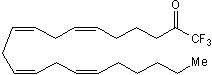
AACOCF3 (Arachidonyl Trifluoromethyl Ketone), an inhibitor of cytosolic phospholipase A2 (IC50 =15 μM), is arachidonic acid derivative where the carboxyl group is replaced by a trifluoromethyl ketone group. It inhibits the activity of the 85 kDa cPLA2 and the 80 kDa macrophage iPLA2 without altering the activity of the 14 kDa sPLA2s. ATK is useful for differentiating the effects of cPLA2 and iPLA2 from sPLA2.
Physicochemical Properties
| Molecular Formula | C21H31OF3 |
| Molecular Weight | 356.46544 |
| Exact Mass | 356.232 |
| CAS # | 149301-79-1 |
| PubChem CID | 5280436 |
| Appearance | Colorless to light yellow liquid |
| Density | 1.0±0.1 g/cm3 |
| Boiling Point | 421.7±45.0 °C at 760 mmHg |
| Flash Point | 288.7±20.2 °C |
| Vapour Pressure | 0.0±1.0 mmHg at 25°C |
| Index of Refraction | 1.463 |
| LogP | 7.78 |
| Hydrogen Bond Donor Count | 0 |
| Hydrogen Bond Acceptor Count | 4 |
| Rotatable Bond Count | 14 |
| Heavy Atom Count | 25 |
| Complexity | 443 |
| Defined Atom Stereocenter Count | 0 |
| SMILES | CCCCC/C=C\C/C=C\C/C=C\C/C=C\CCCC(=O)C(F)(F)F |
| InChi Key | PLWROONZUDKYKG-DOFZRALJSA-N |
| InChi Code | InChI=1S/C21H31F3O/c1-2-3-4-5-6-7-8-9-10-11-12-13-14-15-16-17-18-19-20(25)21(22,23)24/h6-7,9-10,12-13,15-16H,2-5,8,11,14,17-19H2,1H3/b7-6-,10-9-,13-12-,16-15- |
| Chemical Name | (6Z,9Z,12Z,15Z)-1,1,1-trifluorohenicosa-6,9,12,15-tetraen-2-one |
| HS Tariff Code | 2934.99.9001 |
| Storage |
Powder-20°C 3 years 4°C 2 years In solvent -80°C 6 months -20°C 1 month |
| Shipping Condition | Room temperature (This product is stable at ambient temperature for a few days during ordinary shipping and time spent in Customs) |
Biological Activity
| ln Vitro | In calcium-challenged U937 cells, AACOCF3 suppresses the release of arachidonic acid (IC50 = 8 μM, 2 x 10⁶ cells ml-1) and sustains (IC50 = 2 μM, 4 x 10⁷ cells ml-1) [1]. In HAoSMC, 10 μM) suppresses phosphate-induced calcification and produces bone/chondrogenic signals. PLA2 activity results in the release of arachidonic acid, which is strongly inhibited by AACOCF3 both at basal and Pi-induced levels [2]. |
| ln Vivo | AACOCF3 (10 mg/kg; gavage; 5 days per week; ApoE–/– mice (6-week-old raccoons) fed a high-cholesterol diet) significantly reduced type III collagen plaque expression but had no effect on total collagen accumulation There is no significant influence [3]. |
| References |
[1]. Arachidonyl trifluoromethyl ketone, a potent inhibitor of 85-kDa phospholipase A2, blocks production of arachidonate and 12-hydroxyeicosatetraenoic acid by calcium ionophore-challenged platelets. J Biol Chem. 1994;269(22):15619-15624. [2]. Systems biology identifies cytosolic PLA2 as a target in vascular calcification treatment. JCI Insight. 2019;4(10):e125638. Published 2019 May 16. [3]. A specific inhibitor of cytosolic phospholipase A2 activity, AACOCF3, inhibits glucose-induced insulin secretion from isolated rat islets. Biochem Biophys Res Commun. 1996;218(2):423-427. |
| Additional Infomation |
AACOCF3 is a fatty acid derivative that is arachidonic acid in which the OH part of the carboxy group has been replaced by a trifluoromethyl group It has a role as an EC 3.1.1.4 (phospholipase A2) inhibitor. It is an organofluorine compound, a ketone, an olefinic compound and a fatty acid derivative. It is functionally related to an arachidonic acid. Specific inhibitor of phospholipase A2. |
Solubility Data
| Solubility (In Vitro) | May dissolve in DMSO (in most cases), if not, try other solvents such as H2O, Ethanol, or DMF with a minute amount of products to avoid loss of samples |
| Solubility (In Vivo) |
Note: Listed below are some common formulations that may be used to formulate products with low water solubility (e.g. < 1 mg/mL), you may test these formulations using a minute amount of products to avoid loss of samples. Injection Formulations (e.g. IP/IV/IM/SC) Injection Formulation 1: DMSO : Tween 80: Saline = 10 : 5 : 85 (i.e. 100 μL DMSO stock solution → 50 μL Tween 80 → 850 μL Saline) *Preparation of saline: Dissolve 0.9 g of sodium chloride in 100 mL ddH ₂ O to obtain a clear solution. Injection Formulation 2: DMSO : PEG300 :Tween 80 : Saline = 10 : 40 : 5 : 45 (i.e. 100 μL DMSO → 400 μLPEG300 → 50 μL Tween 80 → 450 μL Saline) Injection Formulation 3: DMSO : Corn oil = 10 : 90 (i.e. 100 μL DMSO → 900 μL Corn oil) Example: Take the Injection Formulation 3 (DMSO : Corn oil = 10 : 90) as an example, if 1 mL of 2.5 mg/mL working solution is to be prepared, you can take 100 μL 25 mg/mL DMSO stock solution and add to 900 μL corn oil, mix well to obtain a clear or suspension solution (2.5 mg/mL, ready for use in animals). Injection Formulation 4: DMSO : 20% SBE-β-CD in saline = 10 : 90 [i.e. 100 μL DMSO → 900 μL (20% SBE-β-CD in saline)] *Preparation of 20% SBE-β-CD in Saline (4°C,1 week): Dissolve 2 g SBE-β-CD in 10 mL saline to obtain a clear solution. Injection Formulation 5: 2-Hydroxypropyl-β-cyclodextrin : Saline = 50 : 50 (i.e. 500 μL 2-Hydroxypropyl-β-cyclodextrin → 500 μL Saline) Injection Formulation 6: DMSO : PEG300 : castor oil : Saline = 5 : 10 : 20 : 65 (i.e. 50 μL DMSO → 100 μLPEG300 → 200 μL castor oil → 650 μL Saline) Injection Formulation 7: Ethanol : Cremophor : Saline = 10: 10 : 80 (i.e. 100 μL Ethanol → 100 μL Cremophor → 800 μL Saline) Injection Formulation 8: Dissolve in Cremophor/Ethanol (50 : 50), then diluted by Saline Injection Formulation 9: EtOH : Corn oil = 10 : 90 (i.e. 100 μL EtOH → 900 μL Corn oil) Injection Formulation 10: EtOH : PEG300:Tween 80 : Saline = 10 : 40 : 5 : 45 (i.e. 100 μL EtOH → 400 μLPEG300 → 50 μL Tween 80 → 450 μL Saline) Oral Formulations Oral Formulation 1: Suspend in 0.5% CMC Na (carboxymethylcellulose sodium) Oral Formulation 2: Suspend in 0.5% Carboxymethyl cellulose Example: Take the Oral Formulation 1 (Suspend in 0.5% CMC Na) as an example, if 100 mL of 2.5 mg/mL working solution is to be prepared, you can first prepare 0.5% CMC Na solution by measuring 0.5 g CMC Na and dissolve it in 100 mL ddH2O to obtain a clear solution; then add 250 mg of the product to 100 mL 0.5% CMC Na solution, to make the suspension solution (2.5 mg/mL, ready for use in animals). Oral Formulation 3: Dissolved in PEG400 Oral Formulation 4: Suspend in 0.2% Carboxymethyl cellulose Oral Formulation 5: Dissolve in 0.25% Tween 80 and 0.5% Carboxymethyl cellulose Oral Formulation 6: Mixing with food powders Note: Please be aware that the above formulations are for reference only. InvivoChem strongly recommends customers to read literature methods/protocols carefully before determining which formulation you should use for in vivo studies, as different compounds have different solubility properties and have to be formulated differently. (Please use freshly prepared in vivo formulations for optimal results.) |
| Preparing Stock Solutions | 1 mg | 5 mg | 10 mg | |
| 1 mM | 2.8053 mL | 14.0264 mL | 28.0529 mL | |
| 5 mM | 0.5611 mL | 2.8053 mL | 5.6106 mL | |
| 10 mM | 0.2805 mL | 1.4026 mL | 2.8053 mL |