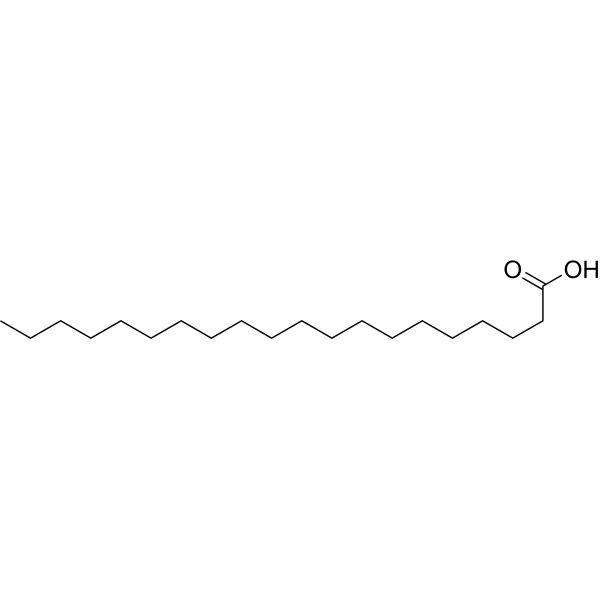
Physicochemical Properties
| Molecular Formula | C20H40O2 |
| Molecular Weight | 312.5304 |
| Exact Mass | 312.302 |
| CAS # | 506-30-9 |
| Related CAS # | Arachidic acid-d2;232600-70-3;Arachidic acid-d39;39756-32-6;Arachidic acid-d3;202480-70-4;Arachidic acid-13C;335080-96-1;Arachidic acid-d4;1219803-69-6;Arachidic acid-d4-1;2483831-15-6 |
| PubChem CID | 10467 |
| Appearance | White to off-white solid powder |
| Density | 0.9±0.1 g/cm3 |
| Boiling Point | 376.4±5.0 °C at 760 mmHg |
| Melting Point | 74-76 °C(lit.) |
| Flash Point | 169.7±12.5 °C |
| Vapour Pressure | 0.0±0.9 mmHg at 25°C |
| Index of Refraction | 1.457 |
| LogP | 9.28 |
| Hydrogen Bond Donor Count | 1 |
| Hydrogen Bond Acceptor Count | 2 |
| Rotatable Bond Count | 18 |
| Heavy Atom Count | 22 |
| Complexity | 226 |
| Defined Atom Stereocenter Count | 0 |
| InChi Key | VKOBVWXKNCXXDE-UHFFFAOYSA-N |
| InChi Code | InChI=1S/C20H40O2/c1-2-3-4-5-6-7-8-9-10-11-12-13-14-15-16-17-18-19-20(21)22/h2-19H2,1H3,(H,21,22) |
| Chemical Name | icosanoic acid |
| HS Tariff Code | 2934.99.9001 |
| Storage |
Powder-20°C 3 years 4°C 2 years In solvent -80°C 6 months -20°C 1 month |
| Shipping Condition | Room temperature (This product is stable at ambient temperature for a few days during ordinary shipping and time spent in Customs) |
Biological Activity
| References |
[1]. Analysis of fatty acid composition of anaerobic rumen fungi. Folia Microbiol (Praha). 2008;53(3):217-20. [2]. The discovery and early structural studies of arachidonic acid. J Lipid Res. 2016 Jul;57(7):1126-32. [3]. Arachidonic acid cytotoxicity in leukocytes: implications of oxidative stress and eicosanoid synthesis. Biol Cell. 2002 Sep;94(4-5):251-65. [4]. Effect of long-term administration of arachidonic acid on n-3 fatty acid deficient mice. Prostaglandins Leukot Essent Fatty Acids. 2015 Apr;95:41-5. |
| Additional Infomation |
Icosanoic acid is a C20 striaght-chain saturated fatty acid which forms a minor constituent of peanut (L. arachis) and corn oils. Used as an organic thin film in the production of liquid crystals for a wide variety of technical applications. It has a role as a plant metabolite. It is a straight-chain saturated fatty acid and a long-chain fatty acid. It is a conjugate acid of an icosanoate. Arachidic acid has been reported in Calodendrum capense, Amaranthus hybridus, and other organisms with data available. Arachidic Acid is a saturated long-chain fatty acid with a 20-carbon backbone. Arachidic acid is found naturally as a minor component of peanut oil. - Arachidic acid (C20:0, a saturated long-chain fatty acid) was detected in the fatty acid composition analysis of anaerobic rumen fungi (e.g., Neocallimastix frontalis , Piromyces communis ) in [1]. Its relative content accounted for 2.1%-3.5% of the total fatty acids in the tested fungal strains, lower than that of unsaturated fatty acids (e.g., linoleic acid, oleic acid) [1] - Literatures [2], [3], and [4] focused on arachidonic acid (C20:4, an unsaturated polyunsaturated fatty acid), which is a different compound from Arachidic acid (C20:0). - Arachidic acid is naturally present in small amounts in some plant oils (e.g., peanut oil, palm oil) and animal fats [1] |
Solubility Data
| Solubility (In Vitro) | DMSO : ~4.76 mg/mL (~15.23 mM) |
| Solubility (In Vivo) |
Solubility in Formulation 1: ≥ 1 mg/mL (3.20 mM) (saturation unknown) in 10% DMSO + 40% PEG300 + 5% Tween80 + 45% Saline (add these co-solvents sequentially from left to right, and one by one), clear solution. For example, if 1 mL of working solution is to be prepared, you can add 100 μL of 10.0 mg/mL clear DMSO stock solution to 400 μL of PEG300 and mix evenly; then add 50 μL of Tween-80 to the above solution and mix evenly; then add 450 μL of normal saline to adjust the volume to 1 mL. Preparation of saline: Dissolve 0.9 g of sodium chloride in 100 mL ddH₂ O to obtain a clear solution. Solubility in Formulation 2: ≥ 1 mg/mL (3.20 mM) (saturation unknown) in 10% DMSO + 90% (20% SBE-β-CD in Saline) (add these co-solvents sequentially from left to right, and one by one), clear solution. For example, if 1 mL of working solution is to be prepared, you can add 100 μL of 10.0 mg/mL clear DMSO stock solution to 900 μL of 20% SBE-β-CD physiological saline solution and mix evenly. Preparation of 20% SBE-β-CD in Saline (4°C,1 week): Dissolve 2 g SBE-β-CD in 10 mL saline to obtain a clear solution. Solubility in Formulation 3: ≥ 1 mg/mL (3.20 mM) (saturation unknown) in 10% DMSO + 90% Corn Oil (add these co-solvents sequentially from left to right, and one by one), clear solution. For example, if 1 mL of working solution is to be prepared, you can add 100 μL of 10.0 mg/mL clear DMSO stock solution to 900 μL of corn oil and mix evenly. (Please use freshly prepared in vivo formulations for optimal results.) |
| Preparing Stock Solutions | 1 mg | 5 mg | 10 mg | |
| 1 mM | 3.1997 mL | 15.9985 mL | 31.9969 mL | |
| 5 mM | 0.6399 mL | 3.1997 mL | 6.3994 mL | |
| 10 mM | 0.3200 mL | 1.5998 mL | 3.1997 mL |