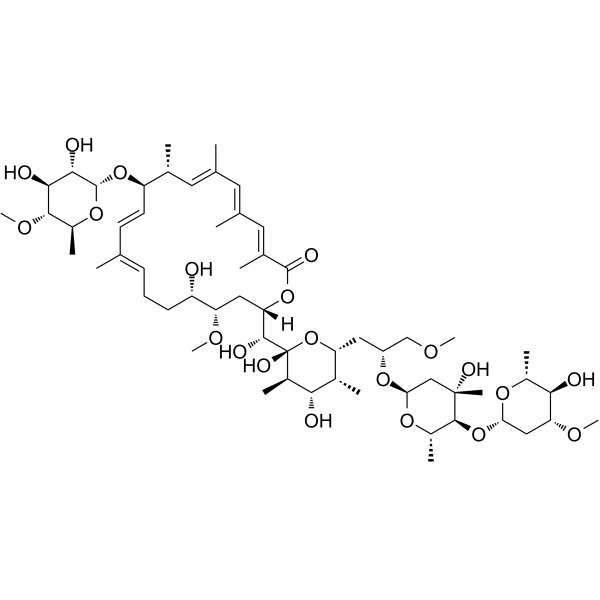
Physicochemical Properties
| Molecular Formula | C51H78NO13-.NA+ |
| Molecular Weight | 1129.37 |
| Exact Mass | 1128.64 |
| Elemental Analysis | C, 61.68; H, 8.57; O, 29.75 |
| CAS # | 194874-06-1 |
| PubChem CID | 11297771 |
| Appearance | White to off-white solid powder |
| LogP | 3.587 |
| Hydrogen Bond Donor Count | 8 |
| Hydrogen Bond Acceptor Count | 21 |
| Rotatable Bond Count | 15 |
| Heavy Atom Count | 79 |
| Complexity | 2080 |
| Defined Atom Stereocenter Count | 25 |
| SMILES | C[C@@H]1/C=C(/C=C(/C=C(/C(=O)O[C@@H](C[C@@H]([C@H](CC/C=C(/C=C/[C@H]1O[C@H]2[C@H]([C@@H]([C@H]([C@@H](O2)C)OC)O)O)\C)O)OC)[C@H]([C@]3([C@@H]([C@H]([C@H]([C@H](O3)C[C@H](COC)O[C@H]4C[C@]([C@H]([C@@H](O4)C)O[C@H]5C[C@H]([C@@H]([C@H](O5)C)O)OC)(C)O)C)O)C)O)O)\C)\C)\C |
| InChi Key | WILMROCKORZEMQ-AIUMZUNXSA-N |
| InChi Code | InChI=1S/C58H96O21/c1-29-17-16-18-40(59)43(69-13)25-45(76-55(65)33(5)23-31(3)21-30(2)22-32(4)41(20-19-29)77-56-51(63)50(62)52(71-15)37(9)74-56)53(64)58(67)35(7)48(60)34(6)42(79-58)24-39(28-68-12)75-47-27-57(11,66)54(38(10)73-47)78-46-26-44(70-14)49(61)36(8)72-46/h17,19-23,32,34-54,56,59-64,66-67H,16,18,24-28H2,1-15H3/b20-19+,29-17+,30-22+,31-21+,33-23+/t32-,34+,35-,36-,37+,38+,39-,40+,41-,42-,43+,44-,45+,46+,47+,48+,49-,50+,51+,52+,53-,54+,56+,57+,58-/m1/s1 |
| Chemical Name | (3E,5E,7E,9R,10R,11E,13E,17S,18S,20S)-20-[(R)-[(2R,3R,4S,5R,6R)-2,4-dihydroxy-6-[(2R)-2-[(2R,4S,5S,6S)-4-hydroxy-5-[(2S,4R,5R,6R)-5-hydroxy-4-methoxy-6-methyloxan-2-yl]oxy-4,6-dimethyloxan-2-yl]oxy-3-methoxypropyl]-3,5-dimethyloxan-2-yl]-hydroxymethyl]-10-[(2R,3S,4S,5R,6S)-3,4-dihydroxy-5-methoxy-6-methyloxan-2-yl]oxy-17-hydroxy-18-methoxy-3,5,7,9,13-pentamethyl-1-oxacycloicosa-3,5,7,11,13-pentaen-2-one |
| Synonyms | Apoptolidin; Apoptolidin A; FU-40A; 194874-06-1; UNII-SAO6WVQ23I; SAO6WVQ23I; (3~{E},5~{E},7~{E},9~{R},10~{R},11~{E},13~{E},17~{S},18~{S},20~{S})-18-methoxy-20-[(~{R})-[(2~{R},3~{R},4~{S},5~{R},6~{R})-6-[(2~{R})-3-methoxy-2-[(2~{R},4~{S},5~{S},6~{S})-5-[(2~{S},4~{R},5~{R},6~{R})-4-methoxy-6-methyl-5-oxidanyl-oxan-2-yl]oxy-4,6-dimethyl-4-oxidanyl-oxan-2-yl]oxy-propyl]-3,5-dimethyl-2,4-bis(oxidanyl)oxan-2-yl]-oxidanyl-methyl]-10-[(2~{R},3~{S},4~{S},5~{R},6~{S})-5-methoxy-6-methyl-3,4-bis(oxidanyl)oxan-2-yl]oxy-3,5,7,9,13-pentamethyl-17-oxidanyl-1-oxacycloicosa-3,5,7,11,13-pentaen-2-one; APOPTOLIDIN [MI]; |
| HS Tariff Code | 2934.99.9001 |
| Storage |
Powder-20°C 3 years 4°C 2 years In solvent -80°C 6 months -20°C 1 month |
| Shipping Condition | Room temperature (This product is stable at ambient temperature for a few days during ordinary shipping and time spent in Customs) |
Biological Activity
| Targets | F1FO ATPase |
| ln Vitro | Apoptolidin possesses cytotoxic properties against both normal and transformed cells. Its IC50 values against RG-E1A-7, RG-E1A19K-2, RG-E1A54K-9, RG-E1-4, and Adl2-3Y1 are 11 ng/ml, 10 ng/ml, 13 ng/ml, 10 ng/ml, and 17 ng/ml, in that order[1]. |
| Enzyme Assay | Background: Apoptolidin is a macrolide originally identified on the basis of its ability to selectively kill E1A and E1A/E1B19K transformed rat glial cells while not killing untransformed glial cells. The goal of this study was to identify the molecular target of this newly discovered natural product. Results: Our approach to uncovering the mechanism of action of apoptolidin utilized a combination of molecular and cell-based pharmacological assays as well as structural comparisons between apoptolidin and other macrocyclic polyketides with known mechanism of action. Cell killing induced by apoptolidin was independent of p53 status, inhibited by BCL-2, and dependent on the action of caspase-9. PARP was completely cleaved in the presence of 1 microM apoptolidin within 6 h in a mouse lymphoma cell line. Together these results suggested that apoptolidin might target a mitochondrial protein. Structural comparisons between apoptolidin and other macrolides revealed significant similarity between the apoptolidin aglycone and oligomycin, a known inhibitor of mitochondrial F0F1-ATP synthase. The relevance of this similarity was established by demonstrating that apoptolidin is a potent inhibitor of the F0F1-ATPase activity in intact yeast mitochondria as well as Triton X-100-solubilized ATPase preparations. The K(i) for apoptolidin was 4-5 microM. The selectivity of apoptolidin in the NCI-60 cell line panel was found to correlate well with that of several known anti-fungal natural products that inhibit the eukaryotic mitochondrial F0F1-ATP synthase. Significance: Although the anti-fungal activities of macrolide inhibitors of the mitochondrial F0F1-ATP synthase such as oligomycin, ossamycin and cytovaricin are well-documented, their unusual selectivity toward certain cell types is not widely appreciated. The recent discovery of apoptolidin, followed by the demonstration that it is an inhibitor of the mitochondrial F0F1-ATP synthase, highlights the potential relevance of these natural products as small molecules to modulate apoptotic pathways. The mechanistic basis for selective cytotoxicity of mitochondrial ATP synthase inhibitors is discussed. Chem Biol. 2001 Jan;8(1):71-80. |
| Cell Assay | Recently, a family of polyketide inhibitors of F(0)F(1)-ATPase, including apoptolidin, ossamycin, and oligomycin, were shown to be among the top 0.1% most cell line selective cytotoxic agents of 37, 000 molecules tested against the 60 human cancer cell lines of the National Cancer Institute. Many cancer cells maintain a high level of anaerobic carbon metabolism even in the presence of oxygen, a phenomenon that is historically known as the Warburg effect. A mechanism-based strategy to sensitize such cells to this class of potent small molecule cytotoxic agents is presented. These natural products inhibit oxidative phosphorylation by targeting the mitochondrial F(0)F(1) ATP synthase. Evaluation of gene expression profiles in a panel of leukemias revealed a strong correlation between the expression level of the gene encoding subunit 6 of the mitochondrial F(0)F(1) ATP synthase (known to be the binding site of members of this class of macrolides) and their sensitivity to these natural products. Within the same set of leukemia cell lines, comparably strong drug-gene correlations were also observed for the genes encoding two key enzymes involved in central carbon metabolism, pyruvate kinase, and aspartate aminotransferase. We propose a simple model in which the mitochondrial apoptotic pathway is activated in response to a shift in balance between aerobic and anaerobic ATP biosynthesis. Inhibitors of both lactate formation and carbon flux through the Embden-Meyerhof pathway significantly sensitized apoptolidin-resistant tumors to this drug. Nine different cell lines derived from human leukemias and melanomas, and colon, renal, central nervous system, and ovarian tumors are also sensitized to killing by apoptolidin.[1] |
| References |
[1]. Apoptolidin, a new apoptosis inducer in transformed cells from Nocardiopsis sp. J Antibiot (Tokyo). 1997 Jul;50(7):628-30. [2]. Understanding and exploiting the mechanistic basis for selectivity of polyketide inhibitors of F(0)F(1)-ATPase. Proc Natl Acad Sci U S A. 2000 Dec 19;97(26):14766-71. |
| Additional Infomation |
Apoptolidin is a macrolide. Apoptolidin has been reported in Nocardiopsis with data available. |
Solubility Data
| Solubility (In Vitro) | May dissolve in DMSO (in most cases), if not, try other solvents such as H2O, Ethanol, or DMF with a minute amount of products to avoid loss of samples |
| Solubility (In Vivo) |
Note: Listed below are some common formulations that may be used to formulate products with low water solubility (e.g. < 1 mg/mL), you may test these formulations using a minute amount of products to avoid loss of samples. Injection Formulations (e.g. IP/IV/IM/SC) Injection Formulation 1: DMSO : Tween 80: Saline = 10 : 5 : 85 (i.e. 100 μL DMSO stock solution → 50 μL Tween 80 → 850 μL Saline) *Preparation of saline: Dissolve 0.9 g of sodium chloride in 100 mL ddH ₂ O to obtain a clear solution. Injection Formulation 2: DMSO : PEG300 :Tween 80 : Saline = 10 : 40 : 5 : 45 (i.e. 100 μL DMSO → 400 μLPEG300 → 50 μL Tween 80 → 450 μL Saline) Injection Formulation 3: DMSO : Corn oil = 10 : 90 (i.e. 100 μL DMSO → 900 μL Corn oil) Example: Take the Injection Formulation 3 (DMSO : Corn oil = 10 : 90) as an example, if 1 mL of 2.5 mg/mL working solution is to be prepared, you can take 100 μL 25 mg/mL DMSO stock solution and add to 900 μL corn oil, mix well to obtain a clear or suspension solution (2.5 mg/mL, ready for use in animals). Injection Formulation 4: DMSO : 20% SBE-β-CD in saline = 10 : 90 [i.e. 100 μL DMSO → 900 μL (20% SBE-β-CD in saline)] *Preparation of 20% SBE-β-CD in Saline (4°C,1 week): Dissolve 2 g SBE-β-CD in 10 mL saline to obtain a clear solution. Injection Formulation 5: 2-Hydroxypropyl-β-cyclodextrin : Saline = 50 : 50 (i.e. 500 μL 2-Hydroxypropyl-β-cyclodextrin → 500 μL Saline) Injection Formulation 6: DMSO : PEG300 : castor oil : Saline = 5 : 10 : 20 : 65 (i.e. 50 μL DMSO → 100 μLPEG300 → 200 μL castor oil → 650 μL Saline) Injection Formulation 7: Ethanol : Cremophor : Saline = 10: 10 : 80 (i.e. 100 μL Ethanol → 100 μL Cremophor → 800 μL Saline) Injection Formulation 8: Dissolve in Cremophor/Ethanol (50 : 50), then diluted by Saline Injection Formulation 9: EtOH : Corn oil = 10 : 90 (i.e. 100 μL EtOH → 900 μL Corn oil) Injection Formulation 10: EtOH : PEG300:Tween 80 : Saline = 10 : 40 : 5 : 45 (i.e. 100 μL EtOH → 400 μLPEG300 → 50 μL Tween 80 → 450 μL Saline) Oral Formulations Oral Formulation 1: Suspend in 0.5% CMC Na (carboxymethylcellulose sodium) Oral Formulation 2: Suspend in 0.5% Carboxymethyl cellulose Example: Take the Oral Formulation 1 (Suspend in 0.5% CMC Na) as an example, if 100 mL of 2.5 mg/mL working solution is to be prepared, you can first prepare 0.5% CMC Na solution by measuring 0.5 g CMC Na and dissolve it in 100 mL ddH2O to obtain a clear solution; then add 250 mg of the product to 100 mL 0.5% CMC Na solution, to make the suspension solution (2.5 mg/mL, ready for use in animals). Oral Formulation 3: Dissolved in PEG400 Oral Formulation 4: Suspend in 0.2% Carboxymethyl cellulose Oral Formulation 5: Dissolve in 0.25% Tween 80 and 0.5% Carboxymethyl cellulose Oral Formulation 6: Mixing with food powders Note: Please be aware that the above formulations are for reference only. InvivoChem strongly recommends customers to read literature methods/protocols carefully before determining which formulation you should use for in vivo studies, as different compounds have different solubility properties and have to be formulated differently. (Please use freshly prepared in vivo formulations for optimal results.) |
| Preparing Stock Solutions | 1 mg | 5 mg | 10 mg | |
| 1 mM | 0.8854 mL | 4.4272 mL | 8.8545 mL | |
| 5 mM | 0.1771 mL | 0.8854 mL | 1.7709 mL | |
| 10 mM | 0.0885 mL | 0.4427 mL | 0.8854 mL |