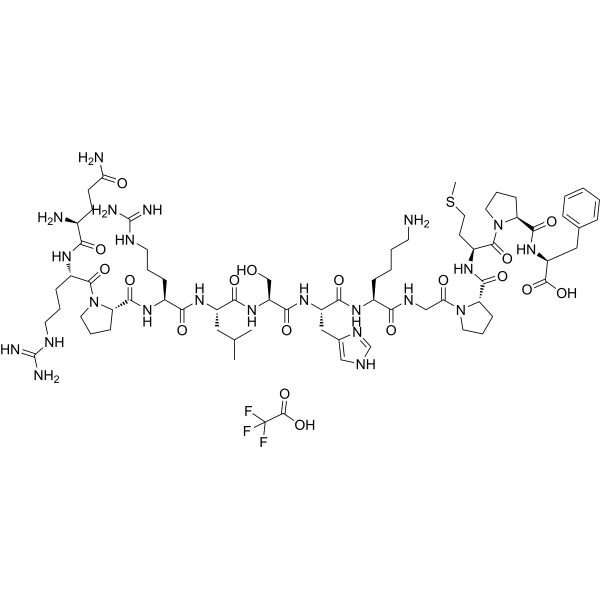
Physicochemical Properties
| Molecular Formula | C71H112F3N23O18S |
| Molecular Weight | 1664.85 |
| Related CAS # | Apelin-13;217082-58-1 |
| Appearance | White to off-white solid powder |
| HS Tariff Code | 2934.99.9001 |
| Storage |
Powder-20°C 3 years 4°C 2 years In solvent -80°C 6 months -20°C 1 month Note: Please store this product in a sealed and protected environment, avoid exposure to moisture. |
| Shipping Condition | Room temperature (This product is stable at ambient temperature for a few days during ordinary shipping and time spent in Customs) |
Biological Activity
| Targets | IC50: 0.37 nM (APJ)[1] |
| ln Vivo | Apelin-13 (200 μg/kg; IP, once day for 4 weeks) dramatically lowers serum levels of TNF-α and leptin, enhances lipid metabolism, strengthens cardiac function, and reduces insulin resistance. increases the levels of GLUT4 and p-AMPKα2 and stimulates the expression of Apelin-12 in serum[2]. ?Most pallidal neurons exhibit an increase in spontaneous discharges when exposed to a single dosage of Apelin-13 (10 and 100 μM; ICV)[4]. |
| Animal Protocol |
Animal/Disease Models: Goto-Kakizaki (GK) rats (12 weeks old; 240-280 g; fed with a high-fat diet: 66.5% standard chow, 10% lard, 20% sucrose, 2.5% cholesterol and 1% pig bile salt)[2] Doses: 200 µg/kg Route of Administration: IP, daily for 4 weeks Experimental Results: Dramatically diminished heart rate; lowered the levels of fasting plasma glucose (FPG), fasting insulin (FINS) and homeostasis model assessment for insulin resistance (HOMA-IR); diminished serum levels of total cholesterol (TC), triglyceride (TG) and low density lipoprotein-cholesterol (LDL-C) and increased high density lipoprotein-cholesterol (HDL-C); diminished NO level, cNOS activity, TNF-α and leptin in serum; induced the expression of Apelin-12. Animal/Disease Models: Adult Wistar rats (SPF, 8-10 weeks, 240-280 g)[4] Doses: 10 and 100 μM Route of Administration: ICV, single dosage Experimental Results: Increased the spontaneous discharges in the majority of pallidal neurons. |
| References |
[1]. Isolation and characterizaton of a novel endogenous peptide ligand for the human APJ receptor. Biochemical and Biophysical Research Communications 251, 471-476 (1998). [2]. Apelin 13 ameliorates metabolic and cardiovascular disorders in a rat model of type 2 diabetes with a high fat diet. Mol Med Rep. 2018 Dec;18(6):5784-5790. [3]. Apelin-13 in blood pressure regulation and cardiovascular disease. Curr Opin Nephrol Hypertens. 2016 Sep;25(5):396-403. [4]. Apelin-13 regulates electrical activity in the globus pallidus and induces postural changes in rats. Neural Regen Res. 2021 Nov;16(11):2264-2268. |
Solubility Data
| Solubility (In Vitro) | H2O :~50 mg/mL (~30.03 mM) |
| Solubility (In Vivo) |
Solubility in Formulation 1: 100 mg/mL (60.07 mM) in PBS (add these co-solvents sequentially from left to right, and one by one), clear solution; with sonication. (Please use freshly prepared in vivo formulations for optimal results.) |
| Preparing Stock Solutions | 1 mg | 5 mg | 10 mg | |
| 1 mM | 0.6007 mL | 3.0033 mL | 6.0065 mL | |
| 5 mM | 0.1201 mL | 0.6007 mL | 1.2013 mL | |
| 10 mM | 0.0601 mL | 0.3003 mL | 0.6007 mL |