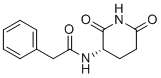
Physicochemical Properties
| Molecular Formula | C13H14N2O3 |
| Molecular Weight | 246.27 |
| Exact Mass | 246.1 |
| Elemental Analysis | C, 68.74; H, 6.29; O, 24.97 |
| CAS # | 91531-30-5 |
| Related CAS # | (Rac)-Antineoplaston A10;77658-84-5 |
| PubChem CID | 56260 |
| Appearance | White to off-white solid powder |
| LogP | 1.266 |
| Hydrogen Bond Donor Count | 2 |
| Hydrogen Bond Acceptor Count | 3 |
| Rotatable Bond Count | 3 |
| Heavy Atom Count | 18 |
| Complexity | 348 |
| Defined Atom Stereocenter Count | 1 |
| SMILES | N([C@H]1CCC(=O)NC1=O)C(=O)CC1C=CC=CC=1 |
| InChi Key | OQGRFQCUGLKSAV-JTQLQIEISA-N |
| InChi Code | InChI=1S/C13H14N2O3/c16-11-7-6-10(13(18)15-11)14-12(17)8-9-4-2-1-3-5-9/h1-5,10H,6-8H2,(H,14,17)(H,15,16,18)/t10-/m0/s1 |
| Chemical Name | N-[(3S)-2,6-dioxopiperidin-3-yl]-2-phenylacetamide |
| Synonyms | ANP-A-10; ANPA-10; ANP A 10; ANPA 10 |
| HS Tariff Code | 2934.99.03.00 |
| Storage |
Powder-20°C 3 years 4°C 2 years In solvent -80°C 6 months -20°C 1 month |
| Shipping Condition | Room temperature (This product is stable at ambient temperature for a few days during ordinary shipping and time spent in Customs) |
Biological Activity
| Targets | Ras |
| References |
[1]. Induction of apoptosis in human hepatocellular carcinoma cells by synthetic antineoplaston A10. Anticancer Res. 2007 Jul-Aug;27(4B):2427-31. |
| Additional Infomation |
Antineoplaston A10 has been used in trials studying the treatment of Sarcoma, Lymphoma, Lung Cancer, Liver Cancer, and Kidney Cancer, among others. Antineoplaston A10 is a piperidinedione antineoplaston with potential antineoplastic activity. Antineoplaston A10 was originally isolated from human urine but is now synthetically derived. This agent intercalates into DNA, resulting in cell cycle arrest in G1 phase, reduction of mitosis, and decreased protein synthesis. Antineoplaston A10 may also inhibit ras-oncogene expression and activate tumor suppressor gene p53, leading to cell differentiation and apoptosis. (NCI04) |
Solubility Data
| Solubility (In Vitro) | DMSO: 49~250 mg/mL (199.0~1015.2 mM) |
| Solubility (In Vivo) |
Solubility in Formulation 1: ≥ 2.08 mg/mL (8.45 mM) (saturation unknown) in 10% DMSO + 40% PEG300 + 5% Tween80 + 45% Saline (add these co-solvents sequentially from left to right, and one by one), clear solution. For example, if 1 mL of working solution is to be prepared, you can add 100 μL of 20.8 mg/mL clear DMSO stock solution to 400 μL PEG300 and mix evenly; then add 50 μL Tween-80 to the above solution and mix evenly; then add 450 μL normal saline to adjust the volume to 1 mL. Preparation of saline: Dissolve 0.9 g of sodium chloride in 100 mL ddH₂ O to obtain a clear solution. Solubility in Formulation 2: ≥ 2.08 mg/mL (8.45 mM) (saturation unknown) in 10% DMSO + 90% (20% SBE-β-CD in Saline) (add these co-solvents sequentially from left to right, and one by one), clear solution. For example, if 1 mL of working solution is to be prepared, you can add 100 μL of 20.8 mg/mL clear DMSO stock solution to 900 μL of 20% SBE-β-CD physiological saline solution and mix evenly. Preparation of 20% SBE-β-CD in Saline (4°C,1 week): Dissolve 2 g SBE-β-CD in 10 mL saline to obtain a clear solution. Solubility in Formulation 3: ≥ 2.08 mg/mL (8.45 mM) (saturation unknown) in 10% DMSO + 90% Corn Oil (add these co-solvents sequentially from left to right, and one by one), clear solution. For example, if 1 mL of working solution is to be prepared, you can add 100 μL of 20.8 mg/mL clear DMSO stock solution to 900 μL of corn oil and mix evenly. (Please use freshly prepared in vivo formulations for optimal results.) |
| Preparing Stock Solutions | 1 mg | 5 mg | 10 mg | |
| 1 mM | 4.0606 mL | 20.3029 mL | 40.6058 mL | |
| 5 mM | 0.8121 mL | 4.0606 mL | 8.1212 mL | |
| 10 mM | 0.4061 mL | 2.0303 mL | 4.0606 mL |