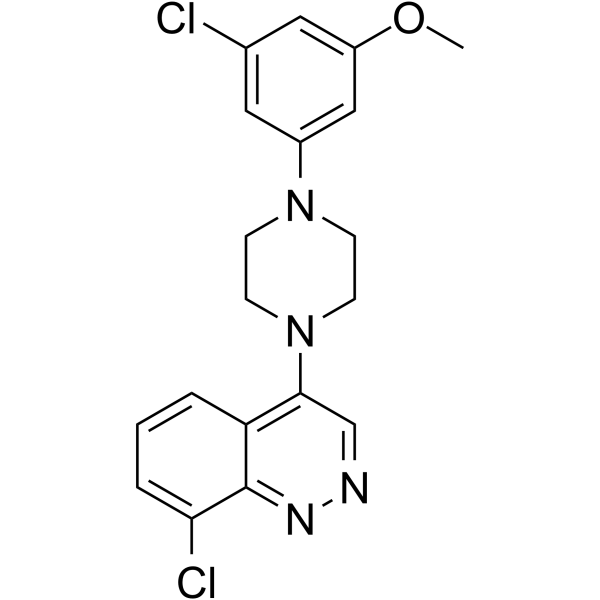
Physicochemical Properties
| Molecular Formula | C19H18CL2N4O |
| Molecular Weight | 389.278421878815 |
| Exact Mass | 388.085 |
| CAS # | 2319587-80-7 |
| PubChem CID | 156552418 |
| Appearance | Light yellow to orange solid powder |
| LogP | 4.1 |
| Hydrogen Bond Donor Count | 0 |
| Hydrogen Bond Acceptor Count | 5 |
| Rotatable Bond Count | 3 |
| Heavy Atom Count | 26 |
| Complexity | 463 |
| Defined Atom Stereocenter Count | 0 |
| InChi Key | JWIRSMDIIXNJAU-UHFFFAOYSA-N |
| InChi Code | InChI=1S/C19H18Cl2N4O/c1-26-15-10-13(20)9-14(11-15)24-5-7-25(8-6-24)18-12-22-23-19-16(18)3-2-4-17(19)21/h2-4,9-12H,5-8H2,1H3 |
| Chemical Name | 8-chloro-4-[4-(3-chloro-5-methoxyphenyl)piperazin-1-yl]cinnoline |
| HS Tariff Code | 2934.99.9001 |
| Storage |
Powder-20°C 3 years 4°C 2 years In solvent -80°C 6 months -20°C 1 month |
| Shipping Condition | Room temperature (This product is stable at ambient temperature for a few days during ordinary shipping and time spent in Customs) |
Biological Activity
| ln Vitro | Vimentin-IN-1 (compound 4e) (0-10 mM; 72 h) is much more potent than FiVe1 (IC50=1.6 μM, HT-1080) at inhibiting HT-1080 fibrosarcoma, with an IC50 value of 44 nM [1]. Phosphorylation of VIM Ser56 is induced by venterin-IN-1 (0.1 μM; 24 hours) [1]. In mouse liver microsomes, ventin-IN-1 (100 μM) is less stable; after 60 minutes of incubation, 0.0% is still present [1]. Samples are taken at 0, 5, 15, 30, 45, and 60 minutes. |
| ln Vivo | The oral pharmacokinetic properties of Vimentin-IN-1 (Compound 4e) (10 mg/kg; single dose) are superior to those of Five1 [1]. Vimentin-IN-1's pharmacokinetic characteristics in mice [1] The dosage by route (mg/kg) AUC0-last (ng·h/mL) AUC0-inf (ng·h/mL) T1/2 (hour) Tmax (h), Cmax (ng/mL), and Final (h) 4e PO 25 309.78 339.21 4.57 0. 5 18 110.43 PO 10 371.33 534.33 4.68 0.67 8 154.67 4e IP 1 208.33 211.33 0.59 0.25 4 197.00 Five1 |
| Cell Assay |
Cell Viability Assay[1] Cell Types: HT-1080, RD and MCF-7 Cell Tested Concentrations: 0-10 mM Incubation Duration: 72 hrs (hours) Experimental Results: Inhibition of HT-1080, RD and MCF-7 cells with IC50 of 44 nM, 61 nM and 49 nM respectively. |
| References |
[1]. Synthesis and biological evaluation of novel FiVe1 derivatives as potent and selective agents for the treatment of mesenchymal cancers. Eur J Med Chem. 2022 Nov 15;242:114638. |
Solubility Data
| Solubility (In Vitro) | DMSO : ~25 mg/mL (~64.22 mM) |
| Solubility (In Vivo) |
Solubility in Formulation 1: 2.5 mg/mL (6.42 mM) in 10% DMSO + 40% PEG300 +5% Tween-80 + 45% Saline (add these co-solvents sequentially from left to right, and one by one), suspension solution; with sonication. For example, if 1 mL of working solution is to be prepared, you can add 100 μL of 25.0 mg/mL clear DMSO stock solution to 400 μL PEG300 and mix evenly; then add 50 μL Tween-80 + to the above solution and mix evenly; then add 450 μL normal saline to adjust the volume to 1 mL. Preparation of saline: Dissolve 0.9 g of sodium chloride in 100 mL ddH₂ O to obtain a clear solution. (Please use freshly prepared in vivo formulations for optimal results.) |
| Preparing Stock Solutions | 1 mg | 5 mg | 10 mg | |
| 1 mM | 2.5688 mL | 12.8442 mL | 25.6885 mL | |
| 5 mM | 0.5138 mL | 2.5688 mL | 5.1377 mL | |
| 10 mM | 0.2569 mL | 1.2844 mL | 2.5688 mL |