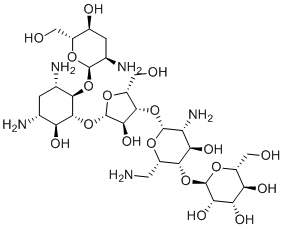
Antibiotic SF 767 A is a novel and potent antibiotic
Physicochemical Properties
| Molecular Formula | C29H55N5O18 |
| Molecular Weight | 761.77 |
| Exact Mass | 761.354 |
| Elemental Analysis | C, 45.72; H, 7.28; N, 9.19; O, 37.80 |
| CAS # | 36441-41-5 |
| PubChem CID | 72394 |
| Appearance | Typically exists as solid at room temperature |
| Density | 1.65g/cm3 |
| Boiling Point | 1068.2ºC at 760mmHg |
| Flash Point | 599.8ºC |
| LogP | -9.9 |
| Hydrogen Bond Donor Count | 15 |
| Hydrogen Bond Acceptor Count | 23 |
| Rotatable Bond Count | 12 |
| Heavy Atom Count | 52 |
| Complexity | 1130 |
| Defined Atom Stereocenter Count | 23 |
| SMILES | OC[C@@H]1[C@@H](O)C[C@@H](N)[C@@H](O[C@@H]2[C@@H](N)C[C@@H](N)[C@H](O)[C@H]2O[C@@H]2O[C@H](CO)[C@@H](O[C@H]3O[C@@H](CN)[C@@H](O[C@H]4O[C@H](CO)[C@@H](O)[C@H](O)[C@@H]4O)[C@H](O)[C@H]3N)[C@H]2O)O1 |
| InChi Key | DBLVDAUGBTYDFR-SWMBIRFSSA-N |
| InChi Code | InChI=1S/C29H55N5O18/c30-3-11-23(51-28-20(43)19(42)17(40)13(5-36)47-28)18(41)15(34)27(45-11)50-24-14(6-37)48-29(21(24)44)52-25-16(39)7(31)1-8(32)22(25)49-26-9(33)2-10(38)12(4-35)46-26/h7-29,35-44H,1-6,30-34H2/t7-,8+,9-,10+,11+,12-,13-,14-,15-,16+,17-,18-,19+,20+,21-,22-,23-,24-,25-,26-,27-,28-,29+/m1/s1 |
| Chemical Name | (2R,3S,4S,5S,6R)-2-[(2S,3S,4R,5R,6R)-5-amino-2-(aminomethyl)-6-[(2R,3S,4R,5S)-5-[(1R,2R,3S,5R,6S)-3,5-diamino-2-[(2S,3R,5S,6R)-3-amino-5-hydroxy-6-(hydroxymethyl)oxan-2-yl]oxy-6-hydroxycyclohexyl]oxy-4-hydroxy-2-(hydroxymethyl)oxolan-3-yl]oxy-4-hydroxyoxan-3-yl]oxy-6-(hydroxymethyl)oxane-3,4,5-triol |
| Synonyms | Lividomycin; SF 767 A; Antibiotic SF 767 A |
| HS Tariff Code | 2934.99.9001 |
| Storage |
Powder-20°C 3 years 4°C 2 years In solvent -80°C 6 months -20°C 1 month |
| Shipping Condition | Room temperature (This product is stable at ambient temperature for a few days during ordinary shipping and time spent in Customs) |
Biological Activity
| Targets | Antibiotic |
| ln Vitro | The in vitro antimicrobial activity of lividomycin A was the greatest in media of pH 7.8. The minimum inhibitory concentration (MIC) was affected by inoculum size, but the addition of serum caused only slight fluctuation of MIC. In vitro development of resistance to lividomycin A in P. aeruginosa and M. tuberculosis was much slower than that to kanamycin, but was comparable in Staphylococcus aureus. In resistant mutants developed in vitro, cross resistance was observed among lividomycin A, kanamycin and gentamicin [1]. |
| ln Vivo | In clinical isolates, however, no distinct cross resistance was found among these three antibiotics. Lividomycin A showed a positive protecting effect for the experimental infections in mice with several bacteria such as S. aureus, P. aeruginosa, Klebsiella pneumoniae and Escherichia coli. It was fairly effective for the experimental infection with the kanamycin-resistant strains of E. coli and P. aeruginosa producing the kanamycin-phosphorylating enzyme [1]. |
| References |
[1]. Studies on new antibiotic lividomycins. V. In vitro and in vivo antimicrobial activity of lividomycin A. J Antibiot (Tokyo). 1972 Feb;25(2):128-36. |
| Additional Infomation |
Lividomycin A is a member of the class of lividomycins that is lividomycin B in which position 4 of the diamino-L-idopyranosyl moiety has been converted into its alpha-D-mannopyranoside. It has a role as a metabolite. It is functionally related to a paromomycin and a lividomycin B. lividomycin A has been reported in Streptomyces lividus with data available. In vitro and in vivo antimicrobial activities of lividomycin A were investigated. This substance showed a wide range of antimicrobial activity against most of Gram-positive bacteria including Mycobacterium tuberculosis and was also effective against Gram-negative bacteria including Pseudomonas aeruginosa, but was ineffective for streptococci, diplococci and fungi. [1] |
Solubility Data
| Solubility (In Vitro) | May dissolve in DMSO (in most cases), if not, try other solvents such as H2O, Ethanol, or DMF with a minute amount of products to avoid loss of samples |
| Solubility (In Vivo) |
Note: Listed below are some common formulations that may be used to formulate products with low water solubility (e.g. < 1 mg/mL), you may test these formulations using a minute amount of products to avoid loss of samples. Injection Formulations (e.g. IP/IV/IM/SC) Injection Formulation 1: DMSO : Tween 80: Saline = 10 : 5 : 85 (i.e. 100 μL DMSO stock solution → 50 μL Tween 80 → 850 μL Saline) *Preparation of saline: Dissolve 0.9 g of sodium chloride in 100 mL ddH ₂ O to obtain a clear solution. Injection Formulation 2: DMSO : PEG300 :Tween 80 : Saline = 10 : 40 : 5 : 45 (i.e. 100 μL DMSO → 400 μLPEG300 → 50 μL Tween 80 → 450 μL Saline) Injection Formulation 3: DMSO : Corn oil = 10 : 90 (i.e. 100 μL DMSO → 900 μL Corn oil) Example: Take the Injection Formulation 3 (DMSO : Corn oil = 10 : 90) as an example, if 1 mL of 2.5 mg/mL working solution is to be prepared, you can take 100 μL 25 mg/mL DMSO stock solution and add to 900 μL corn oil, mix well to obtain a clear or suspension solution (2.5 mg/mL, ready for use in animals). Injection Formulation 4: DMSO : 20% SBE-β-CD in saline = 10 : 90 [i.e. 100 μL DMSO → 900 μL (20% SBE-β-CD in saline)] *Preparation of 20% SBE-β-CD in Saline (4°C,1 week): Dissolve 2 g SBE-β-CD in 10 mL saline to obtain a clear solution. Injection Formulation 5: 2-Hydroxypropyl-β-cyclodextrin : Saline = 50 : 50 (i.e. 500 μL 2-Hydroxypropyl-β-cyclodextrin → 500 μL Saline) Injection Formulation 6: DMSO : PEG300 : castor oil : Saline = 5 : 10 : 20 : 65 (i.e. 50 μL DMSO → 100 μLPEG300 → 200 μL castor oil → 650 μL Saline) Injection Formulation 7: Ethanol : Cremophor : Saline = 10: 10 : 80 (i.e. 100 μL Ethanol → 100 μL Cremophor → 800 μL Saline) Injection Formulation 8: Dissolve in Cremophor/Ethanol (50 : 50), then diluted by Saline Injection Formulation 9: EtOH : Corn oil = 10 : 90 (i.e. 100 μL EtOH → 900 μL Corn oil) Injection Formulation 10: EtOH : PEG300:Tween 80 : Saline = 10 : 40 : 5 : 45 (i.e. 100 μL EtOH → 400 μLPEG300 → 50 μL Tween 80 → 450 μL Saline) Oral Formulations Oral Formulation 1: Suspend in 0.5% CMC Na (carboxymethylcellulose sodium) Oral Formulation 2: Suspend in 0.5% Carboxymethyl cellulose Example: Take the Oral Formulation 1 (Suspend in 0.5% CMC Na) as an example, if 100 mL of 2.5 mg/mL working solution is to be prepared, you can first prepare 0.5% CMC Na solution by measuring 0.5 g CMC Na and dissolve it in 100 mL ddH2O to obtain a clear solution; then add 250 mg of the product to 100 mL 0.5% CMC Na solution, to make the suspension solution (2.5 mg/mL, ready for use in animals). Oral Formulation 3: Dissolved in PEG400 Oral Formulation 4: Suspend in 0.2% Carboxymethyl cellulose Oral Formulation 5: Dissolve in 0.25% Tween 80 and 0.5% Carboxymethyl cellulose Oral Formulation 6: Mixing with food powders Note: Please be aware that the above formulations are for reference only. InvivoChem strongly recommends customers to read literature methods/protocols carefully before determining which formulation you should use for in vivo studies, as different compounds have different solubility properties and have to be formulated differently. (Please use freshly prepared in vivo formulations for optimal results.) |
| Preparing Stock Solutions | 1 mg | 5 mg | 10 mg | |
| 1 mM | 1.3127 mL | 6.5637 mL | 13.1273 mL | |
| 5 mM | 0.2625 mL | 1.3127 mL | 2.6255 mL | |
| 10 mM | 0.1313 mL | 0.6564 mL | 1.3127 mL |