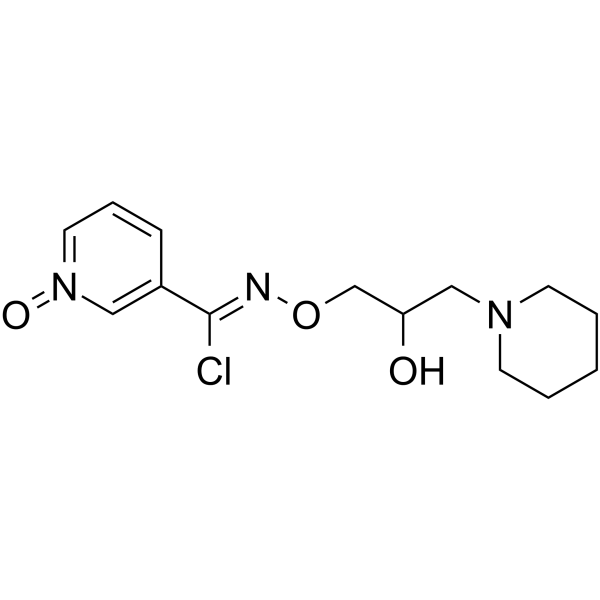
Physicochemical Properties
| Molecular Formula | C14H20CLN3O3 |
| Molecular Weight | 313.779902458191 |
| Exact Mass | 313.119 |
| CAS # | 289893-23-8 |
| PubChem CID | 208924 |
| Appearance | Typically exists as solid at room temperature |
| LogP | 1.2 |
| Hydrogen Bond Donor Count | 1 |
| Hydrogen Bond Acceptor Count | 5 |
| Rotatable Bond Count | 6 |
| Heavy Atom Count | 21 |
| Complexity | 337 |
| Defined Atom Stereocenter Count | 1 |
| SMILES | C1CCN(CC1)C[C@H](CON=C(C2=C[N+](=CC=C2)[O-])Cl)O |
| InChi Key | SGEIEGAXKLMUIZ-CYBMUJFWSA-N |
| InChi Code | InChI=1S/C14H20ClN3O3/c15-14(12-5-4-8-18(20)9-12)16-21-11-13(19)10-17-6-2-1-3-7-17/h4-5,8-9,13,19H,1-3,6-7,10-11H2/t13-/m1/s1 |
| Chemical Name | N-[(2R)-2-hydroxy-3-piperidin-1-ylpropoxy]-1-oxidopyridin-1-ium-3-carboximidoyl chloride |
| HS Tariff Code | 2934.99.9001 |
| Storage |
Powder-20°C 3 years 4°C 2 years In solvent -80°C 6 months -20°C 1 month |
| Shipping Condition | Room temperature (This product is stable at ambient temperature for a few days during ordinary shipping and time spent in Customs) |
Biological Activity
| ln Vivo | Western blot study of mSOD1(G93A) mice treated with anti-neurodegenerative drug 1 (Compound I) showed a detectable “band shift” of HSF-1, suggesting that hyperphosphorylation activation causes stress-induced HSF-1. Immunostaining revealed that, at 120 days of age, the lumbar spinal cords of both untreated and anti-neurodegenerate 1 (G93A)-treated SOD1 (G93A) mice had increased expression of Hsp70 and Hsp90, although the intensity of Hsp70 and Hsp90 immunoreactivity in the motor neurons of neurodegenerative agent 1-treated mSOD1(G93A) mice was significantly higher. Mice treated with antineurodegenerate I lived an average of 153 days (±2.6 SEM, n = 7). This indicates a noteworthy rise in longevity of over 22% (p=<0.001). When the first indications of motor impairments appeared, at 70 days of age, the impact of starting antineurodegenerative agent 1 treatment at the commencement of the disease was also investigated. The mean lifespan of mSOD1(G93A) mice was increased by 23 days with antineurodegenerative agent 1 treatment starting at 70 days of age. This difference was shown from 125 days (±1.8 SEM, n=18) in the untreated group to 148 days (±1.5 SEM, n) = 5 in the treatment group. This indicates a lifetime increase of 18% (p=<0.001)[1]. |
| References | [1]. BARBER, Jack R. PHARMACEUTICAL COMPOSITIONS AND METHODS FOR TREATING DISEASES ASSOCIATED WITH NEURODEGENERATION. WO2008039514A1 |
| Additional Infomation |
Arimoclomol is an experimental drug compound developed by CytRx Corporation, a biopharmaceutical company based in Los Angeles, California. The orally administered drug is intended to treat amyotrophic lateral sclerosis (ALS), also known as Lou Gehrig's disease, a neurodegenerative disease with no effective treatment. Drug Indication Investigated for use/treatment in amyotrophic lateral sclerosis (ALS), diabetes mellitus type 2, neurologic disorders, and neuropathy (diabetic). Mechanism of Action Arimoclomol is designed to stimulate a natural cellular repair pathway by activating compounds called “molecular chaperones.” Arimoclomol uses a unique 'molecular chaperone' co-induction mechanism. The small molecule drug candidate is believed to function by stimulating a normal cellular protein repair pathway through the activation of "molecular chaperones." Since damaged proteins called aggregates are thought to play a role in many diseases, CytRx believes that activation of molecular chaperones could have therapeutic efficacy for a broad range of diseases. |
Solubility Data
| Solubility (In Vitro) | May dissolve in DMSO (in most cases), if not, try other solvents such as H2O, Ethanol, or DMF with a minute amount of products to avoid loss of samples |
| Solubility (In Vivo) |
Note: Listed below are some common formulations that may be used to formulate products with low water solubility (e.g. < 1 mg/mL), you may test these formulations using a minute amount of products to avoid loss of samples. Injection Formulations (e.g. IP/IV/IM/SC) Injection Formulation 1: DMSO : Tween 80: Saline = 10 : 5 : 85 (i.e. 100 μL DMSO stock solution → 50 μL Tween 80 → 850 μL Saline) *Preparation of saline: Dissolve 0.9 g of sodium chloride in 100 mL ddH ₂ O to obtain a clear solution. Injection Formulation 2: DMSO : PEG300 :Tween 80 : Saline = 10 : 40 : 5 : 45 (i.e. 100 μL DMSO → 400 μLPEG300 → 50 μL Tween 80 → 450 μL Saline) Injection Formulation 3: DMSO : Corn oil = 10 : 90 (i.e. 100 μL DMSO → 900 μL Corn oil) Example: Take the Injection Formulation 3 (DMSO : Corn oil = 10 : 90) as an example, if 1 mL of 2.5 mg/mL working solution is to be prepared, you can take 100 μL 25 mg/mL DMSO stock solution and add to 900 μL corn oil, mix well to obtain a clear or suspension solution (2.5 mg/mL, ready for use in animals). Injection Formulation 4: DMSO : 20% SBE-β-CD in saline = 10 : 90 [i.e. 100 μL DMSO → 900 μL (20% SBE-β-CD in saline)] *Preparation of 20% SBE-β-CD in Saline (4°C,1 week): Dissolve 2 g SBE-β-CD in 10 mL saline to obtain a clear solution. Injection Formulation 5: 2-Hydroxypropyl-β-cyclodextrin : Saline = 50 : 50 (i.e. 500 μL 2-Hydroxypropyl-β-cyclodextrin → 500 μL Saline) Injection Formulation 6: DMSO : PEG300 : castor oil : Saline = 5 : 10 : 20 : 65 (i.e. 50 μL DMSO → 100 μLPEG300 → 200 μL castor oil → 650 μL Saline) Injection Formulation 7: Ethanol : Cremophor : Saline = 10: 10 : 80 (i.e. 100 μL Ethanol → 100 μL Cremophor → 800 μL Saline) Injection Formulation 8: Dissolve in Cremophor/Ethanol (50 : 50), then diluted by Saline Injection Formulation 9: EtOH : Corn oil = 10 : 90 (i.e. 100 μL EtOH → 900 μL Corn oil) Injection Formulation 10: EtOH : PEG300:Tween 80 : Saline = 10 : 40 : 5 : 45 (i.e. 100 μL EtOH → 400 μLPEG300 → 50 μL Tween 80 → 450 μL Saline) Oral Formulations Oral Formulation 1: Suspend in 0.5% CMC Na (carboxymethylcellulose sodium) Oral Formulation 2: Suspend in 0.5% Carboxymethyl cellulose Example: Take the Oral Formulation 1 (Suspend in 0.5% CMC Na) as an example, if 100 mL of 2.5 mg/mL working solution is to be prepared, you can first prepare 0.5% CMC Na solution by measuring 0.5 g CMC Na and dissolve it in 100 mL ddH2O to obtain a clear solution; then add 250 mg of the product to 100 mL 0.5% CMC Na solution, to make the suspension solution (2.5 mg/mL, ready for use in animals). Oral Formulation 3: Dissolved in PEG400 Oral Formulation 4: Suspend in 0.2% Carboxymethyl cellulose Oral Formulation 5: Dissolve in 0.25% Tween 80 and 0.5% Carboxymethyl cellulose Oral Formulation 6: Mixing with food powders Note: Please be aware that the above formulations are for reference only. InvivoChem strongly recommends customers to read literature methods/protocols carefully before determining which formulation you should use for in vivo studies, as different compounds have different solubility properties and have to be formulated differently. (Please use freshly prepared in vivo formulations for optimal results.) |
| Preparing Stock Solutions | 1 mg | 5 mg | 10 mg | |
| 1 mM | 3.1869 mL | 15.9347 mL | 31.8695 mL | |
| 5 mM | 0.6374 mL | 3.1869 mL | 6.3739 mL | |
| 10 mM | 0.3187 mL | 1.5935 mL | 3.1869 mL |