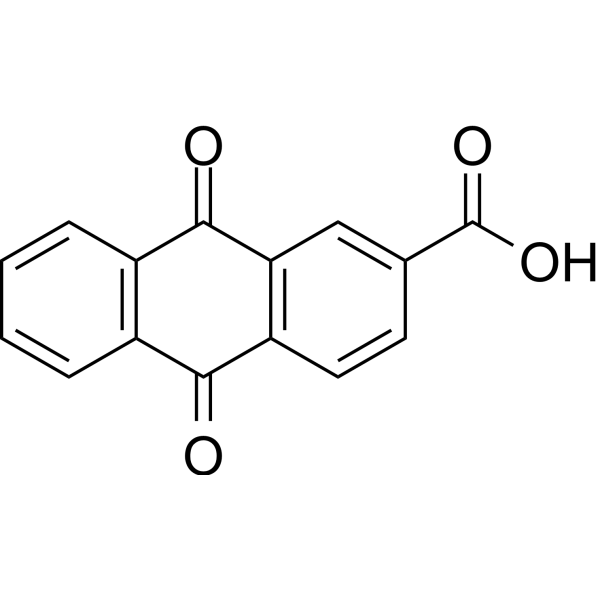
Physicochemical Properties
| Molecular Formula | C15H8O4 |
| Molecular Weight | 252.22162 |
| Exact Mass | 252.042 |
| CAS # | 117-78-2 |
| PubChem CID | 67030 |
| Appearance | Off-white to light yellow solid powder |
| Density | 1.5±0.1 g/cm3 |
| Boiling Point | 518.3±39.0 °C at 760 mmHg |
| Melting Point | 287-289 |
| Flash Point | 281.3±23.6 °C |
| Vapour Pressure | 0.0±1.4 mmHg at 25°C |
| Index of Refraction | 1.690 |
| LogP | 3.06 |
| Hydrogen Bond Donor Count | 1 |
| Hydrogen Bond Acceptor Count | 4 |
| Rotatable Bond Count | 1 |
| Heavy Atom Count | 19 |
| Complexity | 428 |
| Defined Atom Stereocenter Count | 0 |
| InChi Key | ASDLSKCKYGVMAI-UHFFFAOYSA-N |
| InChi Code | InChI=1S/C15H8O4/c16-13-9-3-1-2-4-10(9)14(17)12-7-8(15(18)19)5-6-11(12)13/h1-7H,(H,18,19) |
| Chemical Name | 9,10-dioxoanthracene-2-carboxylic acid |
| HS Tariff Code | 2934.99.9001 |
| Storage |
Powder-20°C 3 years 4°C 2 years In solvent -80°C 6 months -20°C 1 month |
| Shipping Condition | Room temperature (This product is stable at ambient temperature for a few days during ordinary shipping and time spent in Customs) |
Biological Activity
| Targets |
Nuclear factor-κB (NF-κB) and Activator protein-1 (AP-1) pathways (by reporter gene assay at 50 µM AQCA). [1] Upstream signaling enzymes: p38 (phosphorylation), Src (phosphorylation), Spleen tyrosine kinase (Syk) (phosphorylation), c-Jun N-terminal kinase (JNK) (phosphorylation), and Interleukin-1 receptor-associated kinase 4 (IRAK1) (degradation). [1] |
| ln Vitro |
In lipopolysaccharide (LPS)-treated RAW264.7 murine macrophage cells, Anthraquinone-2-carboxylic acid (AQCA) (at 25 and 50 µM) significantly suppressed the mRNA expression of inflammatory genes inducible nitric oxide synthase (iNOS), tumor necrosis factor-α (TNF-α), and cyclooxygenase-2 (COX-2), as determined by real-time RT-PCR. [1] AQCA (at 25 and 50 µM) also suppressed the protein level of COX-2 in LPS-treated RAW264.7 cells, as shown by immunoblotting. [1] In a reporter gene assay using HEK293 cells transfected with NF-κB-Luc or AP-1-Luc constructs, AQCA (at 50 µM) significantly inhibited the promoter activities of NF-κB and AP-1 induced by phorbol-12-myristate (PMA). [1] Immunoblotting analysis showed that AQCA (at 25 and 50 µM) inhibited the phosphorylation of p38, Src, and Syk, and the degradation of IRAK1 in LPS-treated RAW264.7 cells. The phosphorylation of JNK was also inhibited. [1] |
| ln Vivo |
Oral administration of AQCA (at 3 and 30 mg/kg, three times every 8 hours in a day) significantly ameliorated gastric lesions induced by EtOH/HCl in ICR mice, with 30 mg/kg reducing lesions by up to 73%. [1] Oral administration of AQCA (at 3 and 30 mg/kg) significantly ameliorated gastric lesions induced by acetylsalicylic acid (aspirin, 600 mg/kg) in ICR mice, with 30 mg/kg reducing lesions by up to 78%. It also significantly reduced myeloperoxidase (MPO) activity (indicative of neutrophil infiltration) in the stomach tissue and improved histological damage. [1] Oral administration of AQCA (at 3 and 30 mg/kg, for 7 days) significantly suppressed ear edema induced by topical application of arachidonic acid (2% w/v) in ICR mice. [1] Oral administration of AQCA (at 30 and 60 mg/kg) significantly inhibited acetic acid-induced abdominal writhing in ICR mice, with inhibition rates of 57% and 72%, respectively. [1] Immunoblotting analysis of stomach tissues from HCl/EtOH-treated or aspirin-treated mice showed that oral AQCA (3 and 30 mg/kg) inhibited the phosphorylation of p38, Src, and Syk, and the degradation of IRAK1. [1] Semiquantitative RT-PCR and immunoblotting analysis of stomach tissues from HCl/EtOH-treated mice showed that oral AQCA (3 and 30 mg/kg) reduced the increased level of COX-2 mRNA and protein. [1] |
| Cell Assay |
For inflammatory gene expression analysis, RAW264.7 cells were treated with LPS in the presence or absence of AQCA (25 and 50 µM). Total RNA was isolated using TRIzol Reagent. mRNA levels of iNOS, TNF-α, and COX-2 were quantified by real-time RT-PCR using SYBR Premix Ex Taq and a real-time thermal cycler. GAPDH was used as a reference gene. [1] For protein analysis by immunoblotting, RAW264.7 cells treated with LPS and AQCA were lysed in lysis buffer. Lysates were clarified by centrifugation. Proteins were separated by SDS-PAGE, transferred to a PVDF membrane, and blocked. Membranes were incubated with primary antibodies against COX-2, p38, phospho-p38, Src, phospho-Src, Syk, phospho-Syk, JNK, phospho-JNK, IRAK1, and β-actin overnight at 4°C, followed by incubation with HRP-conjugated secondary antibodies. Signals were visualized using an enhanced chemiluminescence (ECL) system. [1] For the reporter gene assay, HEK293 cells were transfected with NF-κB-Luc or AP-1-Luc plasmids along with a β-galactosidase plasmid using the polyethyleneimine (PEI) method. Transfected cells were treated with AQCA (50 µM) in the presence or absence of PMA. Cells were lysed, and luciferase activity in the supernatant was measured using a luciferase substrate and a luminometer. Luciferase activity was normalized to β-galactosidase activity. [1] |
| Animal Protocol |
For EtOH/HCl-induced gastritis, fasted ICR mice were orally treated with AQCA (3 and 30 mg/kg) or ranitidine (40 mg/kg) three times every 8 hours in a day. Thirty minutes after the last administration, 400 µL of 60% ethanol in 150 mM HCl was administered orally. Mice were sacrificed 1 hour later, stomachs were excised, and the area of mucosal erosive lesions was measured. [1] For aspirin-induced gastritis, fasted ICR mice were orally treated with AQCA (3 and 30 mg/kg). After 30 minutes, mice were given aspirin (600 mg/kg) orally and sacrificed 3 hours later. Stomachs were excised for lesion measurement and MPO activity assay. For MPO assay, stomach tissues were homogenized in PBS with 0.1% NP40, centrifuged, and the supernatant was incubated with MPO substrate. Absorbance was measured at 412 nm. [1] For arachidonic acid-induced ear edema, ICR mice were orally pretreated with AQCA (3 and 30 mg/kg) or indomethacin (5 mg/kg) for 7 days. After the final treatment, arachidonic acid (2% w/v, 25 µL/ear) was applied topically to the left ear. Ear thickness was measured 1 hour later using a thickness gauge. [1] For acetic acid-induced abdominal writhing, ICR mice were orally treated with AQCA (3, 30, and 60 mg/kg) or indomethacin (10 mg/kg). Sixty minutes later, mice were intraperitoneally injected with 5% acetic acid. The number of abdominal writhes was recorded over a 20-minute period starting 5 minutes after injection. [1] For all in vivo studies, AQCA was prepared as a stock solution in 0.5% sodium carboxymethylcellulose (Na CMC) and administered orally by gavage. Control groups received 0.5% Na CMC alone. [1] |
| Toxicity/Toxicokinetics | In an acute toxicity test, ICR mice were orally administered AQCA at a high dose of 1 g/kg for 7 days. No mortality was observed. There were no significant alterations in body weight or organ weights (liver, spleen, kidney, heart, lung). No gastric irritation (ulcer formation) was observed, unlike in aspirin (300 mg/kg)-treated mice. Serum parameters for liver toxicity, including aspartate aminotransferase (AST), alanine aminotransferase (ALT), and cholesterol levels, showed no significant changes compared to the control group. [1] |
| References |
[1]. Anti-Inflammatory and Antinociceptive Activities of Anthraquinone-2-Carboxylic Acid. Mediators Inflamm. 2016;2016:1903849. |
| Additional Infomation |
Anthraquinone-2-carboxylic acid has been reported in Handroanthus impetiginosus with data available. Anthraquinone-2-carboxylic acid (AQCA) is an anthraquinone compound identified as a major component from Brazilian taheebo. [1] The proposed anti-inflammatory and antinociceptive mechanism of AQCA involves the suppression of upstream signaling enzymes (p38, Src, Syk, JNK, IRAK1), leading to the inhibition of NF-κB and AP-1 activation pathways, and subsequent downregulation of inflammatory genes such as COX-2, iNOS, and TNF-α. [1] The study suggests that AQCA has potential as a safe and effective natural product for ameliorating inflammatory and pain-related conditions. [1] |
Solubility Data
| Solubility (In Vitro) | DMSO : ~25 mg/mL (~99.12 mM) |
| Solubility (In Vivo) |
Note: Listed below are some common formulations that may be used to formulate products with low water solubility (e.g. < 1 mg/mL), you may test these formulations using a minute amount of products to avoid loss of samples. Injection Formulations (e.g. IP/IV/IM/SC) Injection Formulation 1: DMSO : Tween 80: Saline = 10 : 5 : 85 (i.e. 100 μL DMSO stock solution → 50 μL Tween 80 → 850 μL Saline) *Preparation of saline: Dissolve 0.9 g of sodium chloride in 100 mL ddH ₂ O to obtain a clear solution. Injection Formulation 2: DMSO : PEG300 :Tween 80 : Saline = 10 : 40 : 5 : 45 (i.e. 100 μL DMSO → 400 μLPEG300 → 50 μL Tween 80 → 450 μL Saline) Injection Formulation 3: DMSO : Corn oil = 10 : 90 (i.e. 100 μL DMSO → 900 μL Corn oil) Example: Take the Injection Formulation 3 (DMSO : Corn oil = 10 : 90) as an example, if 1 mL of 2.5 mg/mL working solution is to be prepared, you can take 100 μL 25 mg/mL DMSO stock solution and add to 900 μL corn oil, mix well to obtain a clear or suspension solution (2.5 mg/mL, ready for use in animals). Injection Formulation 4: DMSO : 20% SBE-β-CD in saline = 10 : 90 [i.e. 100 μL DMSO → 900 μL (20% SBE-β-CD in saline)] *Preparation of 20% SBE-β-CD in Saline (4°C,1 week): Dissolve 2 g SBE-β-CD in 10 mL saline to obtain a clear solution. Injection Formulation 5: 2-Hydroxypropyl-β-cyclodextrin : Saline = 50 : 50 (i.e. 500 μL 2-Hydroxypropyl-β-cyclodextrin → 500 μL Saline) Injection Formulation 6: DMSO : PEG300 : castor oil : Saline = 5 : 10 : 20 : 65 (i.e. 50 μL DMSO → 100 μLPEG300 → 200 μL castor oil → 650 μL Saline) Injection Formulation 7: Ethanol : Cremophor : Saline = 10: 10 : 80 (i.e. 100 μL Ethanol → 100 μL Cremophor → 800 μL Saline) Injection Formulation 8: Dissolve in Cremophor/Ethanol (50 : 50), then diluted by Saline Injection Formulation 9: EtOH : Corn oil = 10 : 90 (i.e. 100 μL EtOH → 900 μL Corn oil) Injection Formulation 10: EtOH : PEG300:Tween 80 : Saline = 10 : 40 : 5 : 45 (i.e. 100 μL EtOH → 400 μLPEG300 → 50 μL Tween 80 → 450 μL Saline) Oral Formulations Oral Formulation 1: Suspend in 0.5% CMC Na (carboxymethylcellulose sodium) Oral Formulation 2: Suspend in 0.5% Carboxymethyl cellulose Example: Take the Oral Formulation 1 (Suspend in 0.5% CMC Na) as an example, if 100 mL of 2.5 mg/mL working solution is to be prepared, you can first prepare 0.5% CMC Na solution by measuring 0.5 g CMC Na and dissolve it in 100 mL ddH2O to obtain a clear solution; then add 250 mg of the product to 100 mL 0.5% CMC Na solution, to make the suspension solution (2.5 mg/mL, ready for use in animals). Oral Formulation 3: Dissolved in PEG400 Oral Formulation 4: Suspend in 0.2% Carboxymethyl cellulose Oral Formulation 5: Dissolve in 0.25% Tween 80 and 0.5% Carboxymethyl cellulose Oral Formulation 6: Mixing with food powders Note: Please be aware that the above formulations are for reference only. InvivoChem strongly recommends customers to read literature methods/protocols carefully before determining which formulation you should use for in vivo studies, as different compounds have different solubility properties and have to be formulated differently. (Please use freshly prepared in vivo formulations for optimal results.) |
| Preparing Stock Solutions | 1 mg | 5 mg | 10 mg | |
| 1 mM | 3.9648 mL | 19.8240 mL | 39.6479 mL | |
| 5 mM | 0.7930 mL | 3.9648 mL | 7.9296 mL | |
| 10 mM | 0.3965 mL | 1.9824 mL | 3.9648 mL |