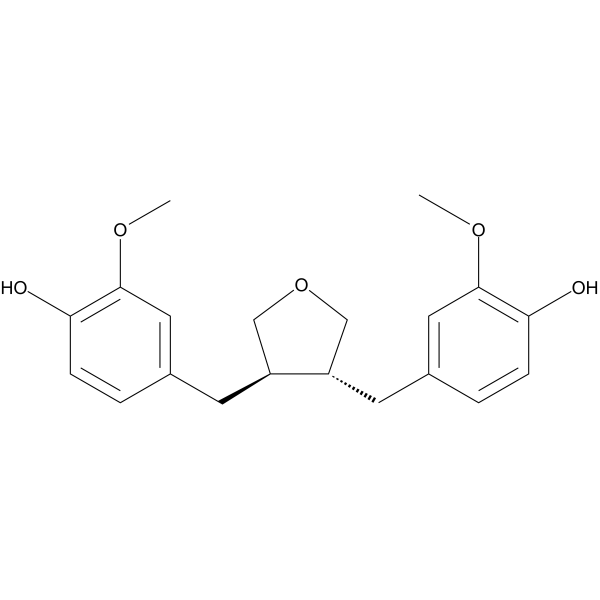
Physicochemical Properties
| Molecular Formula | C20H24O5 |
| Molecular Weight | 344.401566505432 |
| Exact Mass | 344.162 |
| CAS # | 29388-33-8 |
| PubChem CID | 9974771 |
| Appearance | White to off-white solid powder |
| LogP | 3.162 |
| Hydrogen Bond Donor Count | 2 |
| Hydrogen Bond Acceptor Count | 5 |
| Rotatable Bond Count | 6 |
| Heavy Atom Count | 25 |
| Complexity | 368 |
| Defined Atom Stereocenter Count | 2 |
| SMILES | COC1=C(C=CC(=C1)C[C@H]2COC[C@@H]2CC3=CC(=C(C=C3)O)OC)O |
| InChi Key | ROGUIJKVZZROIQ-HOTGVXAUSA-N |
| InChi Code | InChI=1S/C20H24O5/c1-23-19-9-13(3-5-17(19)21)7-15-11-25-12-16(15)8-14-4-6-18(22)20(10-14)24-2/h3-6,9-10,15-16,21-22H,7-8,11-12H2,1-2H3/t15-,16-/m0/s1 |
| Chemical Name | 4-[[(3R,4R)-4-[(4-hydroxy-3-methoxyphenyl)methyl]oxolan-3-yl]methyl]-2-methoxyphenol |
| HS Tariff Code | 2934.99.9001 |
| Storage |
Powder-20°C 3 years 4°C 2 years In solvent -80°C 6 months -20°C 1 month Note: This product requires protection from light (avoid light exposure) during transportation and storage. |
| Shipping Condition | Room temperature (This product is stable at ambient temperature for a few days during ordinary shipping and time spent in Customs) |
Biological Activity
| ln Vitro |
- Anhydrosecoisolariciresinol exhibited cytotoxic activity against HL-60 (human promyelocytic leukemia) cells with an IC50 value of 32.5 ± 2.1 μM [1] - Against A549 (human lung adenocarcinoma) cells, Anhydrosecoisolariciresinol showed moderate cytotoxicity with an IC50 value of 48.3 ± 3.2 μM [1] - For MCF-7 (human breast cancer, estrogen receptor-positive) cells, Anhydrosecoisolariciresinol inhibited cell proliferation in a dose-dependent manner, with an IC50 value of 52.7 ± 4.1 μM after 72 h of incubation [2] - Against MDA-MB-231 (human breast cancer, triple-negative) cells, Anhydrosecoisolariciresinol displayed weak to moderate antiproliferative activity, with an IC50 value of 68.9 ± 5.3 μM after 72 h of incubation [2] |
| Cell Assay |
- Cytotoxicity assay (HL-60 and A549 cells): Cancer cells were seeded in 96-well plates at a density of 5×10³ cells/well and incubated overnight. Serial dilutions of Anhydrosecoisolariciresinol (10–100 μM) were added, and the cells were cultured for 48 h. A cell viability assay reagent was added, and absorbance was measured at 450 nm to calculate IC50 values [1] - Antiproliferative assay (MCF-7 and MDA-MB-231 cells): Breast cancer cells were plated in 96-well plates at 4×10³ cells/well and allowed to adhere for 24 h. Anhydrosecoisolariciresinol was added at concentrations ranging from 20–100 μM, and incubation continued for 72 h. Cell viability was determined by a colorimetric assay, and the percentage of viable cells relative to the control group was calculated to obtain IC50 values [2] |
| References |
[1]. Six new phenolic glycosides and a new ceramide from the flowers of Wedelia biflora and their cytotoxicity against some cancer cell lines. Nat Prod Commun. 2013 Mar;8(3):367-72. [2]. Extraction of lignans from flaxseed and evaluation of their biological effects on breast cancer MCF-7 and MDA-MB-231 cell lines. J Med Food. 2010 Aug;13(4):834-41. |
| Additional Infomation |
Anhydrosecoisolariciresinol has been reported in Calocedrus formosana, Urtica dioica, and other organisms with data available. - Anhydrosecoisolariciresinol is a lignan compound isolated from the flowers of Wedelia biflora [1] - Anhydrosecoisolariciresinol is also a natural constituent of flaxseed (Linum usitatissimum) lignan extracts [2] - The antiproliferative activity of Anhydrosecoisolariciresinol was more potent against estrogen receptor-positive MCF-7 cells than triple-negative MDA-MB-231 cells [2] |
Solubility Data
| Solubility (In Vitro) | May dissolve in DMSO (in most cases), if not, try other solvents such as H2O, Ethanol, or DMF with a minute amount of products to avoid loss of samples |
| Solubility (In Vivo) |
Note: Listed below are some common formulations that may be used to formulate products with low water solubility (e.g. < 1 mg/mL), you may test these formulations using a minute amount of products to avoid loss of samples. Injection Formulations (e.g. IP/IV/IM/SC) Injection Formulation 1: DMSO : Tween 80: Saline = 10 : 5 : 85 (i.e. 100 μL DMSO stock solution → 50 μL Tween 80 → 850 μL Saline) *Preparation of saline: Dissolve 0.9 g of sodium chloride in 100 mL ddH ₂ O to obtain a clear solution. Injection Formulation 2: DMSO : PEG300 :Tween 80 : Saline = 10 : 40 : 5 : 45 (i.e. 100 μL DMSO → 400 μLPEG300 → 50 μL Tween 80 → 450 μL Saline) Injection Formulation 3: DMSO : Corn oil = 10 : 90 (i.e. 100 μL DMSO → 900 μL Corn oil) Example: Take the Injection Formulation 3 (DMSO : Corn oil = 10 : 90) as an example, if 1 mL of 2.5 mg/mL working solution is to be prepared, you can take 100 μL 25 mg/mL DMSO stock solution and add to 900 μL corn oil, mix well to obtain a clear or suspension solution (2.5 mg/mL, ready for use in animals). Injection Formulation 4: DMSO : 20% SBE-β-CD in saline = 10 : 90 [i.e. 100 μL DMSO → 900 μL (20% SBE-β-CD in saline)] *Preparation of 20% SBE-β-CD in Saline (4°C,1 week): Dissolve 2 g SBE-β-CD in 10 mL saline to obtain a clear solution. Injection Formulation 5: 2-Hydroxypropyl-β-cyclodextrin : Saline = 50 : 50 (i.e. 500 μL 2-Hydroxypropyl-β-cyclodextrin → 500 μL Saline) Injection Formulation 6: DMSO : PEG300 : castor oil : Saline = 5 : 10 : 20 : 65 (i.e. 50 μL DMSO → 100 μLPEG300 → 200 μL castor oil → 650 μL Saline) Injection Formulation 7: Ethanol : Cremophor : Saline = 10: 10 : 80 (i.e. 100 μL Ethanol → 100 μL Cremophor → 800 μL Saline) Injection Formulation 8: Dissolve in Cremophor/Ethanol (50 : 50), then diluted by Saline Injection Formulation 9: EtOH : Corn oil = 10 : 90 (i.e. 100 μL EtOH → 900 μL Corn oil) Injection Formulation 10: EtOH : PEG300:Tween 80 : Saline = 10 : 40 : 5 : 45 (i.e. 100 μL EtOH → 400 μLPEG300 → 50 μL Tween 80 → 450 μL Saline) Oral Formulations Oral Formulation 1: Suspend in 0.5% CMC Na (carboxymethylcellulose sodium) Oral Formulation 2: Suspend in 0.5% Carboxymethyl cellulose Example: Take the Oral Formulation 1 (Suspend in 0.5% CMC Na) as an example, if 100 mL of 2.5 mg/mL working solution is to be prepared, you can first prepare 0.5% CMC Na solution by measuring 0.5 g CMC Na and dissolve it in 100 mL ddH2O to obtain a clear solution; then add 250 mg of the product to 100 mL 0.5% CMC Na solution, to make the suspension solution (2.5 mg/mL, ready for use in animals). Oral Formulation 3: Dissolved in PEG400 Oral Formulation 4: Suspend in 0.2% Carboxymethyl cellulose Oral Formulation 5: Dissolve in 0.25% Tween 80 and 0.5% Carboxymethyl cellulose Oral Formulation 6: Mixing with food powders Note: Please be aware that the above formulations are for reference only. InvivoChem strongly recommends customers to read literature methods/protocols carefully before determining which formulation you should use for in vivo studies, as different compounds have different solubility properties and have to be formulated differently. (Please use freshly prepared in vivo formulations for optimal results.) |
| Preparing Stock Solutions | 1 mg | 5 mg | 10 mg | |
| 1 mM | 2.9036 mL | 14.5180 mL | 29.0360 mL | |
| 5 mM | 0.5807 mL | 2.9036 mL | 5.8072 mL | |
| 10 mM | 0.2904 mL | 1.4518 mL | 2.9036 mL |