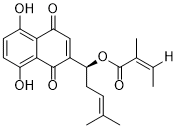
Angelylalkannin is a novel and potent naphthoquinone
Physicochemical Properties
| Molecular Formula | C21H22O6 |
| Molecular Weight | 370.396 |
| Exact Mass | 370.141 |
| Elemental Analysis | C, 68.10; H, 5.99; O, 25.92 |
| CAS # | 69175-72-0 |
| PubChem CID | 71587240 |
| Appearance | Typically exists as solid at room temperature |
| LogP | 4.7 |
| Hydrogen Bond Donor Count | 2 |
| Hydrogen Bond Acceptor Count | 6 |
| Rotatable Bond Count | 6 |
| Heavy Atom Count | 27 |
| Complexity | 710 |
| Defined Atom Stereocenter Count | 1 |
| SMILES | C/C=C(/C)\C(=O)O[C@@H](CC=C(C)C)C1=CC(=O)C2=C(C=CC(=C2C1=O)O)O |
| InChi Key | ZGQONWTUIANWFM-AVHYGJPMSA-N |
| InChi Code | InChI=1S/C21H22O6/c1-5-12(4)21(26)27-17(9-6-11(2)3)13-10-16(24)18-14(22)7-8-15(23)19(18)20(13)25/h5-8,10,17,22-23H,9H2,1-4H3/b12-5-/t17-/m0/s1 |
| Chemical Name | [(1S)-1-(5,8-dihydroxy-1,4-dioxonaphthalen-2-yl)-4-methylpent-3-enyl] (Z)-2-methylbut-2-enoate |
| Synonyms | Angelylalkannin; UNII-AD71CY9O13; AD71CY9O13; Alkannin angelate; 69175-72-0; DTXSID90219220; [(1S)-1-(5,8-dihydroxy-1,4-dioxonaphthalen-2-yl)-4-methylpent-3-enyl] (Z)-2-methylbut-2-enoate; 2-BUTENOIC ACID, 2-METHYL-, (1S)-1-(1,4-DIHYDRO-5,8-DIHYDROXY-1,4-DIOXO-2-NAPHTHALENYL)-4-METHYL-3-PENTEN-1-YL ESTER, (2Z)-; |
| HS Tariff Code | 2934.99.9001 |
| Storage |
Powder-20°C 3 years 4°C 2 years In solvent -80°C 6 months -20°C 1 month |
| Shipping Condition | Room temperature (This product is stable at ambient temperature for a few days during ordinary shipping and time spent in Customs) |
Biological Activity
| Targets | Natural naphthoquinone |
| ln Vitro | Our research to seek active compounds against human colorectal cancer from the root of Alkanna tinctoria (L.) Tausch led to the isolation of two naphthoquinones, alkannin (1) and angelylalkannin (2). The antiproliferative effects of the two compounds on human colon cancer cells HCT-116 and SW-480 were determined by MTS method. Cell cycle profile and cell apoptosis were determined using flow cytometry. Both of the two compounds showed significant inhibitory effects on the cancer cells. For alkannin (1) and angelylalkannin (2), the IC50 values were 2.38 and 4.76 µM for HCT-116 cells, while for SW-480 cells, they were 4.53 and 7.03 µM, respectively. The potential antiproliferative mechanisms were also explored. At concentrations between 1–10 µM, both compounds arrested the cell cycle at the G1 phase and induced cell apoptosis [1]. |
| Cell Assay |
Cell proliferation analysis [1] The effects of alkannin (1) and Angelylalkannin (2) on the proliferation of colorectal cancer cells were determined using an MTS assay. Cancer cells were plated into a 96-well plate at a density of 1×10⁴ cells/well. After seeding for 24 h, the cells were treated with alkannin (1) or angelylalkannin (2) at various concentrations. Data from this study were then compared to our previous reports using 5-FU in the same experimental condition to serve as a positive control. All experiments were performed in triplicate. At the end of the sample exposure period, the medium of each well was discarded and 100 µL of fresh medium and 20 µL of CellTiter 96 aqueous solution were added. The plate was returned to the incubator where it remained for 1–4 h in a humidified atmosphere at 37°C. Then, 60 µL of medium from each well was transferred to an ELISA 96-well plate, and the absorbance of the formazan product was measured at 490 nm. The blank control was recorded by measuring the absorbance at 490 nm with wells containing medium mixed with Cell Titer 96 aqueous solution but no cells. Results were expressed as a percentage of control (vehicle set at 100%). Cell cycle analysis [1] The cell cycle profile was assayed by flow cytometry after staining with PI/RNase, and the assay data from alkannin (1) and Angelylalkannin (2) were compared. HCT-116 cells were seeded in 24-well tissue culture plates. On the second day, the medium was changed, and cells were treated with alkannin (1) or angelylalkannin (2) at different concentrations. Cells were incubated for 48 h before harvesting. The cells were fixed gently with 80% ethanol before being placed in a freezer for 2 h. They were then treated with 0.25% Triton X-100 for 5 min in an ice bath. The cells were resuspended in 30 µL of phosphate buffered saline (PBS) containing 40 µg/mL propidium iodide and 0.1 mg/mL RNase. Cells were incubated in a dark room for 20 min at room temperature before cell cycle analysis with a FACScan flow cytometer and FlowJo software. For each measurement, at least 10,000 cells were counted. Apoptotic analysis [1] HCT-116 cells were seeded in 24-well tissue culture plates. After 24 h, the medium was changed and alkannin (1) or Angelylalkannin (2) were added. After treatment for 48 h, cells floating in the medium were collected. The adherent cells were detached with 0.05% trypsin. Then culture medium containing 10% FBS (and floating cells) was added to inactivate trypsin. When gentle pipetting was completed, the cells were centrifuged for 5 min at 1500g. The supernatant was removed and cells were stained with annexin V-fluorescein isothiocyanate (FITC) and propidium iodide (PI) according to the manufacturer's instructions. Untreated cells were used as control for double staining. Immediately after staining, the cells were analyzed by a FACScan flow cytometer. For each measurement, at least 20,000 cells were counted. |
| References |
[1]. Naphthoquinone Components from Alkanna tinctoria (L.) Tausch Show Significant Antiproliferative Effects on Human Colorectal Cancer Cells. Phytother Res. 2013 Jan;27(1):66-70 |
| Additional Infomation |
Angelylalkannin has been reported in Alkanna hirsutissima with data available. Alkannin (1) and angelylalkannin (2) are principle components of the red pigments from the roots of A. tinctoria along with some minor derivatives reported to date. Previous studies have shown that alkannin derivatives possess antiproliferative effects on several cancer cell lines, e.g. K562, GLC-82, CNE2, and Bel-7402 (Wu et al., 2005; Deng, 2010; Bogurcu et al., 2011). Recently, there have been reports on molecular mechanisms of their cytotoxic actions regarding apoptosis induction in K562 leukemia, GLC-82 adenocarcinoma, and Hep3B hepatocarcinoma cell lines, respectively (Deng, 2010; Bogurcu et al., 2011). The present study was the first to evaluate the therapeutic potential of the components from A. tinctoria against the human colorectal cancer. In summary, two naphthoquinone compounds, namely alkannin (1) and angelylalkannin (2), were isolated and identified from the root of A. tinctoria. Both of these compounds presented significant inhibitory effects on the proliferation of the human colon cancer cell lines HCT-116 and SW-480. A cell cycle assay showed that they arrested the cell cycle at the G1 phase. They also showed apoptotic induction activity. Thus, the observed anticancer activities of these two compounds were related to cell cycle arrest and induction of apoptosis. These results provide promising information for the potential use of A. tinctoria, as well as some of the isolated compounds, in the treatment of colorectal cancer. [1] |
Solubility Data
| Solubility (In Vitro) | May dissolve in DMSO (in most cases), if not, try other solvents such as H2O, Ethanol, or DMF with a minute amount of products to avoid loss of samples |
| Solubility (In Vivo) |
Note: Listed below are some common formulations that may be used to formulate products with low water solubility (e.g. < 1 mg/mL), you may test these formulations using a minute amount of products to avoid loss of samples. Injection Formulations (e.g. IP/IV/IM/SC) Injection Formulation 1: DMSO : Tween 80: Saline = 10 : 5 : 85 (i.e. 100 μL DMSO stock solution → 50 μL Tween 80 → 850 μL Saline) *Preparation of saline: Dissolve 0.9 g of sodium chloride in 100 mL ddH ₂ O to obtain a clear solution. Injection Formulation 2: DMSO : PEG300 :Tween 80 : Saline = 10 : 40 : 5 : 45 (i.e. 100 μL DMSO → 400 μLPEG300 → 50 μL Tween 80 → 450 μL Saline) Injection Formulation 3: DMSO : Corn oil = 10 : 90 (i.e. 100 μL DMSO → 900 μL Corn oil) Example: Take the Injection Formulation 3 (DMSO : Corn oil = 10 : 90) as an example, if 1 mL of 2.5 mg/mL working solution is to be prepared, you can take 100 μL 25 mg/mL DMSO stock solution and add to 900 μL corn oil, mix well to obtain a clear or suspension solution (2.5 mg/mL, ready for use in animals). Injection Formulation 4: DMSO : 20% SBE-β-CD in saline = 10 : 90 [i.e. 100 μL DMSO → 900 μL (20% SBE-β-CD in saline)] *Preparation of 20% SBE-β-CD in Saline (4°C,1 week): Dissolve 2 g SBE-β-CD in 10 mL saline to obtain a clear solution. Injection Formulation 5: 2-Hydroxypropyl-β-cyclodextrin : Saline = 50 : 50 (i.e. 500 μL 2-Hydroxypropyl-β-cyclodextrin → 500 μL Saline) Injection Formulation 6: DMSO : PEG300 : castor oil : Saline = 5 : 10 : 20 : 65 (i.e. 50 μL DMSO → 100 μLPEG300 → 200 μL castor oil → 650 μL Saline) Injection Formulation 7: Ethanol : Cremophor : Saline = 10: 10 : 80 (i.e. 100 μL Ethanol → 100 μL Cremophor → 800 μL Saline) Injection Formulation 8: Dissolve in Cremophor/Ethanol (50 : 50), then diluted by Saline Injection Formulation 9: EtOH : Corn oil = 10 : 90 (i.e. 100 μL EtOH → 900 μL Corn oil) Injection Formulation 10: EtOH : PEG300:Tween 80 : Saline = 10 : 40 : 5 : 45 (i.e. 100 μL EtOH → 400 μLPEG300 → 50 μL Tween 80 → 450 μL Saline) Oral Formulations Oral Formulation 1: Suspend in 0.5% CMC Na (carboxymethylcellulose sodium) Oral Formulation 2: Suspend in 0.5% Carboxymethyl cellulose Example: Take the Oral Formulation 1 (Suspend in 0.5% CMC Na) as an example, if 100 mL of 2.5 mg/mL working solution is to be prepared, you can first prepare 0.5% CMC Na solution by measuring 0.5 g CMC Na and dissolve it in 100 mL ddH2O to obtain a clear solution; then add 250 mg of the product to 100 mL 0.5% CMC Na solution, to make the suspension solution (2.5 mg/mL, ready for use in animals). Oral Formulation 3: Dissolved in PEG400 Oral Formulation 4: Suspend in 0.2% Carboxymethyl cellulose Oral Formulation 5: Dissolve in 0.25% Tween 80 and 0.5% Carboxymethyl cellulose Oral Formulation 6: Mixing with food powders Note: Please be aware that the above formulations are for reference only. InvivoChem strongly recommends customers to read literature methods/protocols carefully before determining which formulation you should use for in vivo studies, as different compounds have different solubility properties and have to be formulated differently. (Please use freshly prepared in vivo formulations for optimal results.) |
| Preparing Stock Solutions | 1 mg | 5 mg | 10 mg | |
| 1 mM | 2.6998 mL | 13.4989 mL | 26.9978 mL | |
| 5 mM | 0.5400 mL | 2.6998 mL | 5.3996 mL | |
| 10 mM | 0.2700 mL | 1.3499 mL | 2.6998 mL |