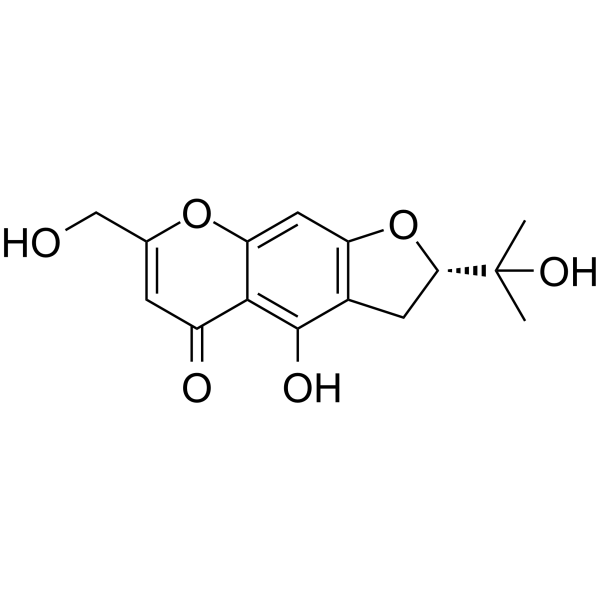
Physicochemical Properties
| Molecular Formula | C15H16O6 |
| Molecular Weight | 292.28394 |
| Exact Mass | 292.094 |
| CAS # | 49624-66-0 |
| PubChem CID | 46240156 |
| Appearance | White to off-white solid powder |
| Density | 1.5±0.1 g/cm3 |
| Boiling Point | 534.1±50.0 °C at 760 mmHg |
| Flash Point | 203.4±23.6 °C |
| Vapour Pressure | 0.0±1.5 mmHg at 25°C |
| Index of Refraction | 1.643 |
| LogP | 1.69 |
| Hydrogen Bond Donor Count | 3 |
| Hydrogen Bond Acceptor Count | 6 |
| Rotatable Bond Count | 2 |
| Heavy Atom Count | 21 |
| Complexity | 471 |
| Defined Atom Stereocenter Count | 1 |
| SMILES | CC(C)([C@@H]1CC2=C(O1)C=C3C(=C2O)C(=O)C=C(O3)CO)O |
| InChi Key | FHCHSXPHLRBEBR-LBPRGKRZSA-N |
| InChi Code | InChI=1S/C15H16O6/c1-15(2,19)12-4-8-10(21-12)5-11-13(14(8)18)9(17)3-7(6-16)20-11/h3,5,12,16,18-19H,4,6H2,1-2H3/t12-/m0/s1 |
| Chemical Name | (2S)-4-hydroxy-7-(hydroxymethyl)-2-(2-hydroxypropan-2-yl)-2,3-dihydrofuro[3,2-g]chromen-5-one |
| HS Tariff Code | 2934.99.9001 |
| Storage |
Powder-20°C 3 years 4°C 2 years In solvent -80°C 6 months -20°C 1 month Note: This product requires protection from light (avoid light exposure) during transportation and storage. |
| Shipping Condition | Room temperature (This product is stable at ambient temperature for a few days during ordinary shipping and time spent in Customs) |
Biological Activity
| ln Vitro |
- Angelicain exhibited cytotoxic activity against several human cancer cell lines. In MTT assays, it inhibited the viability of A549 (human lung adenocarcinoma), HepG2 (human hepatocellular carcinoma), MCF-7 (human breast adenocarcinoma), and HCT116 (human colon carcinoma) cells with IC50 values of 28.5 μM, 35.2 μM, 42.7 μM, and 38.9 μM, respectively. No significant cytotoxicity was observed against normal human lung fibroblast MRC-5 cells (IC50 > 100 μM) [1] - At concentrations of 20–60 μM, Angelicain dose-dependently reduced the colony formation capacity of A549 and HepG2 cells. For A549 cells, 60 μM Angelicain decreased the colony formation rate by ~65% compared to the untreated control; for HepG2 cells, the reduction was ~58% at the same concentration [1] |
| Cell Assay |
- For MTT-based cytotoxicity assay: Human cancer cells (A549, HepG2, MCF-7, HCT116) and normal MRC-5 cells were seeded in 96-well plates at a density of 5×10³ cells/well and cultured overnight. Angelicain was dissolved in dimethyl sulfoxide (DMSO, final concentration < 0.1%) and added to the wells at concentrations of 10–100 μM. After incubation for 48 h, MTT reagent was added to each well, and the mixture was incubated for another 4 h. The formazan crystals were dissolved with DMSO, and the absorbance at 570 nm was measured using a microplate reader. IC50 values were calculated by fitting the dose-response curves with a linear regression model [1] - For colony formation assay: A549 and HepG2 cells were seeded in 6-well plates at a density of 2×10³ cells/well. After 24 h of attachment, Angelicain (20, 40, 60 μM) was added, and the cells were cultured for 14 days. The medium was changed every 3 days. At the end of culture, cells were fixed with 4% paraformaldehyde for 15 minutes, stained with 0.1% crystal violet for 30 minutes, and washed with distilled water. Visible colonies (≥50 cells) were counted under a light microscope, and the colony formation rate was calculated as (number of colonies in treatment group / number of colonies in control group) × 100% [1] |
| References |
[1]. Studies on the constituents of Cimicifuga foetida collected in Guizhou Province and their cytotoxic activities. Chem Pharm Bull (Tokyo). 2012;60(5):571-7. |
| Additional Infomation |
- Angelicain is a triterpenoid compound isolated from the roots of Cimicifuga foetida (Guizhou Province, China), a traditional Chinese medicinal plant used for anti-inflammatory and antipyretic purposes [1] - The cytotoxic activity of Angelicain against cancer cells (with low toxicity to normal cells) suggests its potential as a lead compound for the development of anticancer agents. However, the underlying mechanism (e.g., induction of apoptosis, cell cycle arrest) was not investigated in this study [1] |
Solubility Data
| Solubility (In Vitro) | DMSO : ~100 mg/mL (~342.14 mM) |
| Solubility (In Vivo) |
Solubility in Formulation 1: ≥ 2.5 mg/mL (8.55 mM) (saturation unknown) in 10% DMSO + 40% PEG300 + 5% Tween80 + 45% Saline (add these co-solvents sequentially from left to right, and one by one), clear solution. For example, if 1 mL of working solution is to be prepared, you can add 100 μL of 25.0 mg/mL clear DMSO stock solution to 400 μL PEG300 and mix evenly; then add 50 μL Tween-80 to the above solution and mix evenly; then add 450 μL normal saline to adjust the volume to 1 mL. Preparation of saline: Dissolve 0.9 g of sodium chloride in 100 mL ddH₂ O to obtain a clear solution. Solubility in Formulation 2: ≥ 2.5 mg/mL (8.55 mM) (saturation unknown) in 10% DMSO + 90% (20% SBE-β-CD in Saline) (add these co-solvents sequentially from left to right, and one by one), clear solution. For example, if 1 mL of working solution is to be prepared, you can add 100 μL of 25.0 mg/mL clear DMSO stock solution to 900 μL of 20% SBE-β-CD physiological saline solution and mix evenly. Preparation of 20% SBE-β-CD in Saline (4°C,1 week): Dissolve 2 g SBE-β-CD in 10 mL saline to obtain a clear solution. Solubility in Formulation 3: ≥ 2.5 mg/mL (8.55 mM) (saturation unknown) in 10% DMSO + 90% Corn Oil (add these co-solvents sequentially from left to right, and one by one), clear solution. For example, if 1 mL of working solution is to be prepared, you can add 100 μL of 25.0 mg/mL clear DMSO stock solution to 900 μL of corn oil and mix evenly. (Please use freshly prepared in vivo formulations for optimal results.) |
| Preparing Stock Solutions | 1 mg | 5 mg | 10 mg | |
| 1 mM | 3.4214 mL | 17.1069 mL | 34.2138 mL | |
| 5 mM | 0.6843 mL | 3.4214 mL | 6.8428 mL | |
| 10 mM | 0.3421 mL | 1.7107 mL | 3.4214 mL |