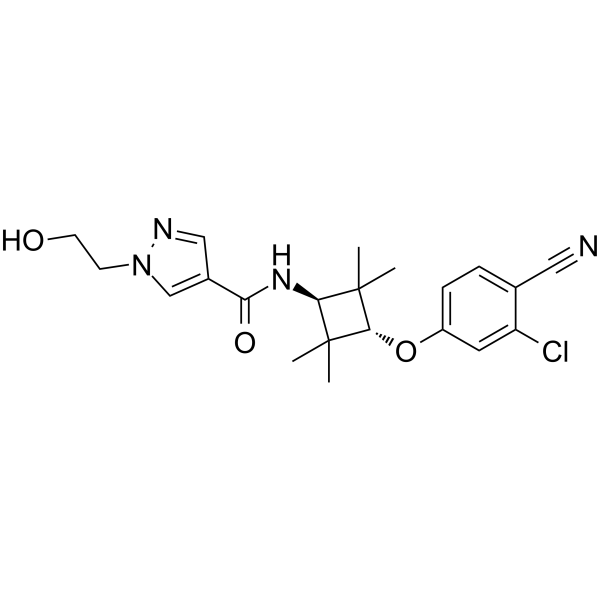
Physicochemical Properties
| Molecular Formula | C21H25CLN4O3 |
| Molecular Weight | 416.901203870773 |
| Exact Mass | 416.161 |
| CAS # | 1338812-36-4 |
| PubChem CID | 56643472 |
| Appearance | White to off-white solid powder |
| LogP | 3.1 |
| Hydrogen Bond Donor Count | 2 |
| Hydrogen Bond Acceptor Count | 5 |
| Rotatable Bond Count | 6 |
| Heavy Atom Count | 29 |
| Complexity | 646 |
| Defined Atom Stereocenter Count | 0 |
| SMILES | ClC1=C(C#N)C=CC(=C1)OC1C(C)(C)C(C1(C)C)NC(C1C=NN(CCO)C=1)=O |
| InChi Key | HJJNHDLYWZTKGQ-UHFFFAOYSA-N |
| InChi Code | InChI=1S/C21H25ClN4O3/c1-20(2)18(25-17(28)14-11-24-26(12-14)7-8-27)21(3,4)19(20)29-15-6-5-13(10-23)16(22)9-15/h5-6,9,11-12,18-19,27H,7-8H2,1-4H3,(H,25,28) |
| Chemical Name | N-[3-(3-chloro-4-cyanophenoxy)-2,2,4,4-tetramethylcyclobutyl]-1-(2-hydroxyethyl)pyrazole-4-carboxamide |
| Synonyms | Androgen receptor antagonist 1; Androgen receptor antagonist 1 |
| HS Tariff Code | 2934.99.9001 |
| Storage |
Powder-20°C 3 years 4°C 2 years In solvent -80°C 6 months -20°C 1 month |
| Shipping Condition | Room temperature (This product is stable at ambient temperature for a few days during ordinary shipping and time spent in Customs) |
Biological Activity
| ln Vitro | Androgen receptor antagonist 1 (compound 26) had notable cytostatic effects on LNCaP and LNAR cells, while having no effect on DU145 cells [1]. |
| ln Vivo | In an animal model of castration-resistant prostate cancer (CRPC), androgen receptor antagonist 1 (Compound 26; 100 mg/kg once daily for 5 weeks) showed good in vivo tumor growth reduction following oral administration [ 1]. |
| Cell Assay |
Cell proliferation assay[1] Cell Types: Prostate cancer (CaP) cells (LNCAP, LNAR and DU145) Tested Concentrations: 1 nM, 10 nM, 100 nM, 1 μM, 10 μM, 100 μM Incubation Duration: 7 days Experimental Results: Anti-proliferation Effects on LNCAP and LNAR cells. |
| Animal Protocol |
Animal/Disease Models: Male athymic nude mouse LNCaP CRPC xenograft model [1] Doses: 100 mg/kg Route of Administration: Orally administered one time/day for 5 weeks. Experimental Results: It has a significant effect in inhibiting tumor growth. At the given dose (100 mg/kg one time/day), tumor growth (90% inhibition) and PSA levels (78%) were almost completely inhibited after 5 weeks, and no weight loss was detected in the animals during treatment. |
| References |
[1]. Discovery of aryloxy tetramethylcyclobutanes as novel androgen receptor antagonists. J Med Chem. 2011 Nov 10;54(21):7693-704. [2]. Discovery of ARD-69 as a Highly Potent Proteolysis Targeting Chimera (PROTAC) Degrader of Androgen Receptor (AR) for the Treatment of Prostate Cancer. J Med Chem. 2019 Jan 24;62(2):941-964. |
Solubility Data
| Solubility (In Vitro) | DMSO : ~100 mg/mL (~239.87 mM) |
| Solubility (In Vivo) |
Solubility in Formulation 1: ≥ 2.5 mg/mL (6.00 mM) (saturation unknown) in 10% DMSO + 90% Corn Oil (add these co-solvents sequentially from left to right, and one by one), clear solution. For example, if 1 mL of working solution is to be prepared, you can add 100 μL of 25.0 mg/mL clear DMSO stock solution to 900 μL of corn oil and mix evenly. (Please use freshly prepared in vivo formulations for optimal results.) |
| Preparing Stock Solutions | 1 mg | 5 mg | 10 mg | |
| 1 mM | 2.3987 mL | 11.9933 mL | 23.9866 mL | |
| 5 mM | 0.4797 mL | 2.3987 mL | 4.7973 mL | |
| 10 mM | 0.2399 mL | 1.1993 mL | 2.3987 mL |