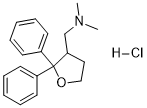
Anavex2-73 (Anavex-273; AE-37) HCl is a novel and potent muscarinic/σ1 ( Sigma-1) ligand/agonist (IC50 = 860 nM) with therapeutic potential for treating Alzheimer's disease.
Physicochemical Properties
| Molecular Formula | C19H24CLNO |
| Molecular Weight | 317.857 |
| Exact Mass | 317.154 |
| Elemental Analysis | C, 71.80; H, 7.61; Cl, 11.15; N, 4.41; O, 5.03 |
| CAS # | 195615-84-0 |
| Related CAS # | Blarcamesine; 195615-83-9; 195615-84-0 (HCl) |
| PubChem CID | 46932299 |
| Appearance | White to off-white solid powder |
| Hydrogen Bond Donor Count | 1 |
| Hydrogen Bond Acceptor Count | 2 |
| Rotatable Bond Count | 4 |
| Heavy Atom Count | 22 |
| Complexity | 298 |
| Defined Atom Stereocenter Count | 0 |
| SMILES | Cl[H].O1C([H])([H])C([H])([H])C([H])(C([H])([H])N(C([H])([H])[H])C([H])([H])[H])C1(C1C([H])=C([H])C([H])=C([H])C=1[H])C1C([H])=C([H])C([H])=C([H])C=1[H] |
| InChi Key | FEQOLYDPQKHFTD-UHFFFAOYSA-N |
| InChi Code | InChI=1S/C19H23NO.ClH/c1-20(2)15-18-13-14-21-19(18,16-9-5-3-6-10-16)17-11-7-4-8-12-17;/h3-12,18H,13-15H2,1-2H3;1H |
| Chemical Name | 1-(2,2-diphenyloxolan-3-yl)-N,N-dimethylmethanamine;hydrochloride |
| Synonyms | Anavex2-73; Anavex 2-73; Anavex-2-73; Anavex-273; AE-37 hydrochloride; Anavex273; Anavex 273 |
| HS Tariff Code | 2934.99.9001 |
| Storage |
Powder-20°C 3 years 4°C 2 years In solvent -80°C 6 months -20°C 1 month Note: Please store this product in a sealed and protected environment, avoid exposure to moisture. |
| Shipping Condition | Room temperature (This product is stable at ambient temperature for a few days during ordinary shipping and time spent in Customs) |
Biological Activity
| Targets | sigma-1 receptor ( IC50 = 0.86 μM ); muscarinic | |
| ln Vitro | The pre-administration of AVex-73 hydrochloride (ANAVEX2-73) leads to a dose-dependent attenuation of the scopolamine induced alternation deficit, significant at 1 and 3 mg/kg. The step-through latency impairments are significantly reduced, dose-dependently, at doses greater than 0.3 mg/kg, by pre-treating with AVex-73 hydrochloride[1]. Significant improvement in recognition memory deficit is observed at 1 mg/kg of AVex-73 hydrochloride treatment, which is administered in a dose-dependent manner. AVex-73 hydrochloride, at doses of 0.1 and 1 mg/kg, significantly attenuates the significant Aβ25-35-induced decrease in Akt phosphorylation one day after injections. The reduction in Ser9 phosphorylation caused by the peptide at 0.3 and 1 mg/kg is lessened seven days after injections by AVex-73 hydrochloride. The administration of AVex-73 hydrochloride treatment inhibits the rise in Aβ1-42 content induced by Aβ25-35 in a dose-dependent manner, exhibiting a noteworthy impact at the maximum dosage examined[2]. | |
| ln Vivo |
|
|
| Animal Protocol | We use male mice that weigh 32±2 g and are 7–9 weeks old. Substances, such as brahmenesine hydrochloride, are diluted to the appropriate dose and injected at a 100 μL/20 g body weight volume. Animals are used for behavioral testing from day 1 to day 9 following intravenous injections, or they are killed prior to biochemical measures. | |
| References |
[1]. Anti-amnesic and neuroprotective potentials of the mixed muscarinic receptor/sigma 1 (σ1) ligand ANAVEX2-73, a novel aminotetrahydrofuran derivative. J Psychopharmacol. 2011 Aug;25(8):1101-17. [2]. Blockade of Tau Hyperphosphorylation and Aβ1-42 Generation by the Aminotetrahydrofuran Derivative ANAVEX2-73, a Mixed Muscarinic andσ1 Receptor Agonist, in a Nontransgenic Mouse Model of Alzheimer's Disease. Neuropsychopharmacology. 2013 Aug; 38(9): 1706-1723. |
|
| Additional Infomation | See also: Blarcamesine (annotation moved to). |
Solubility Data
| Solubility (In Vitro) |
DMSO: 25~64 mg/mL (78.7~201.4 mM) Water: ~64 mg/mL Ethanol: ~3 mg/mL |
| Solubility (In Vivo) |
Solubility in Formulation 1: ≥ 2.5 mg/mL (7.87 mM) (saturation unknown) in 10% DMSO + 40% PEG300 + 5% Tween80 + 45% Saline (add these co-solvents sequentially from left to right, and one by one), clear solution. For example, if 1 mL of working solution is to be prepared, you can add 100 μL of 25.0 mg/mL clear DMSO stock solution to 400 μL PEG300 and mix evenly; then add 50 μL Tween-80 to the above solution and mix evenly; then add 450 μL normal saline to adjust the volume to 1 mL. Preparation of saline: Dissolve 0.9 g of sodium chloride in 100 mL ddH₂ O to obtain a clear solution. Solubility in Formulation 2: ≥ 2.5 mg/mL (7.87 mM) (saturation unknown) in 10% DMSO + 90% (20% SBE-β-CD in Saline) (add these co-solvents sequentially from left to right, and one by one), clear solution. For example, if 1 mL of working solution is to be prepared, you can add 100 μL of 25.0 mg/mL clear DMSO stock solution to 900 μL of 20% SBE-β-CD physiological saline solution and mix evenly. Preparation of 20% SBE-β-CD in Saline (4°C,1 week): Dissolve 2 g SBE-β-CD in 10 mL saline to obtain a clear solution. Solubility in Formulation 3: ≥ 2.5 mg/mL (7.87 mM) (saturation unknown) in 10% DMSO + 90% Corn Oil (add these co-solvents sequentially from left to right, and one by one), clear solution. For example, if 1 mL of working solution is to be prepared, you can add 100 μL of 25.0 mg/mL clear DMSO stock solution to 900 μL of corn oil and mix evenly. Solubility in Formulation 4: 100 mg/mL (314.61 mM) in PBS (add these co-solvents sequentially from left to right, and one by one), clear solution; with ultrasonication. (Please use freshly prepared in vivo formulations for optimal results.) |
| Preparing Stock Solutions | 1 mg | 5 mg | 10 mg | |
| 1 mM | 3.1460 mL | 15.7302 mL | 31.4604 mL | |
| 5 mM | 0.6292 mL | 3.1460 mL | 6.2921 mL | |
| 10 mM | 0.3146 mL | 1.5730 mL | 3.1460 mL |