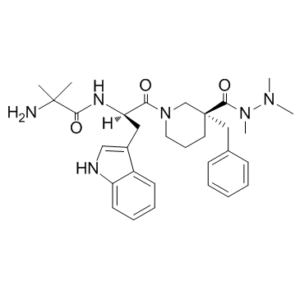
Anamorelin (formerly also known as RC-1291 and ONO-7643) is a novel, potent, and orally bioavailable ghrelin receptor agonist with EC50 value of 0.74 nM in the FLIPR assay. It is a small-molecule ghrelin mimetic that has both anabolic and appetite-stimulating properties. Anamorelin mimics the appetite-stimulating and growth hormone-releasing properties of grhelin by binding to and stimulating the growth hormone secretagogue receptor (GHSR) centrally. In addition to potentially reducing the production of pro-inflammatory cytokines TNF-alpha and interleukin-6, stimulation of GHSR may also directly contribute to appetite loss associated with cancer.
Physicochemical Properties
| Molecular Formula | C31H42N6O3 |
| Molecular Weight | 546.70359 |
| Exact Mass | 546.331 |
| Elemental Analysis | C, 63.85; H, 7.43; Cl, 6.08; N, 14.41; O, 8.23 |
| CAS # | 249921-19-5 |
| Related CAS # | Anamorelin hydrochloride; 861998-00-7; Anamorelin Fumarate; 339539-92-3; 249921-19-5 |
| PubChem CID | 9828911 |
| Appearance | white to off-white solid powder |
| Density | 1.2±0.1 g/cm3 |
| Index of Refraction | 1.619 |
| LogP | 2.98 |
| Hydrogen Bond Donor Count | 3 |
| Hydrogen Bond Acceptor Count | 5 |
| Rotatable Bond Count | 9 |
| Heavy Atom Count | 40 |
| Complexity | 904 |
| Defined Atom Stereocenter Count | 2 |
| SMILES | [H][C@](CC1=CNC2=CC=CC=C21)(NC(C(C)(C)N)=O)C(N3CCC[C@@](C(N(C)N(C)C)=O)(CC4=CC=CC=C4)C3)=O |
| InChi Key | VQPFSIRUEPQQPP-MXBOTTGLSA-N |
| InChi Code | InChI=1S/C31H42N6O3/c1-30(2,32)28(39)34-26(18-23-20-33-25-15-10-9-14-24(23)25)27(38)37-17-11-16-31(21-37,29(40)36(5)35(3)4)19-22-12-7-6-8-13-22/h6-10,12-15,20,26,33H,11,16-19,21,32H2,1-5H3,(H,34,39)/t26-,31-/m1/s1 |
| Chemical Name | 2-amino-N-[(2R)-1-[(3R)-3-benzyl-3-[dimethylamino(methyl)carbamoyl]piperidin-1-yl]-3-(1H-indol-3-yl)-1-oxopropan-2-yl]-2-methylpropanamide |
| Synonyms | ONO7643; ONO-7643; ONO 7643; RC 1291; RC1291; RC-1291 |
| HS Tariff Code | 2934.99.9001 |
| Storage |
Powder-20°C 3 years 4°C 2 years In solvent -80°C 6 months -20°C 1 month |
| Shipping Condition | Room temperature (This product is stable at ambient temperature for a few days during ordinary shipping and time spent in Customs) |
Biological Activity
| Targets | ghrelin receptor ( Ki = 0.7 nM ); ghrelin receptor ( EC50 = 0.74 nM ) |
| ln Vitro | Anamorelin (ANAM) exhibits strong agonist activity on the ghrelin receptor in the FLIPR assay, with an EC50 value of 0.74 nM. Anamorelin exhibits negligible antagonistic effects at 1,000 nM and higher concentrations. Anamorelin exhibits a binding affinity constant (Ki) of 0.70 nM for the ghrelin receptor in the binding experiments. Anamorelin (ANAM) is also shown to bind to the ghrelin receptor with a high affinity in the competition assay using radiolabeled ibutamoren (IC50=0.69 nM). Anamorelin has a dose-dependent stimulatory effect on GH release in rat pituitary cells, and its potency (EC50) is 1.5 nM. Anamorelin is tested for its ability to bind to more than 100 different receptors, ion channels, transporters, and enzymes. An NK2 functional assay shows no functional activity, despite anamorelin's demonstrated binding to the tachykinin neurokinin 2 (NK2) site (IC50=0.021 μM). |
| ln Vivo | Anamorelin (ANAM) increases food intake and body weight in rats from Day 2 to Day 7 of treatment significantly when given orally at a dose of 3, 10, or 30 mg/kg once daily, in comparison to the vehicle control. Each dose level causes a dose-dependent cumulative change in food intake and weight gain, which is significant (P<0.05) when compared to the control at all dose levels. A dose-dependent rise in plasma GH levels and GH AUC0-6h is observed in rats administered a single oral dose of 3, 10, or 30 mg/kg of anamorelin[1]. |
| Enzyme Assay | In the competition assay, membranes are supplemented with 35S-MK-677 and anamorelin (ANAM) concentrations ranging from 1 pM to 10 μM. To ascertain nonspecific binding, 10 μM nonlabeled MK-677 is added. The samples are applied to GF/B filters, which have been pretreated with 0.5% PEI, and the mixture is incubated at 30°C for 60 minutes. The filters are then counted using an OptiPhase counter after being cleaned in 0.9% NaCl[1]. |
| Animal Protocol |
Rats: Rats are separated into four groups for the purpose of assessing food intake and body weight: Anamorelin 3 mg/kg (n = 7), 10 mg/kg (n = 7), or 30 mg/kg (n = 7), or vehicle control (n = 8). 100 μL blood samples are taken prior to and 0.25, 0.5, 1, 2, 3, 4, 5, and 6 hours following a single dose. Rats are put to sleep using a 64.8 mg/kg dose of sodium pentobarbital. In order to collect blood, a catheter equipped with a three-way cock to allow extra blood to return, an extension tube, and a 1 mL sampling syringe is placed inside the left femoral artery and filled with heparinized saline solution. A Rat Growth Hormone EIA kit and microplate reader are used to immunochemically measure the levels of growth hormone in plasma. There are two measurement takes place. The time course of GH plasma concentrations is assessed, as well as the area under the GH concentration curve from 0 to 6 hours (AUC0-6h) postdose. Pig: Anamorelin is administered intraperitoneally (IDI) using a dosing catheter to six groups of pigs each. Blood is drawn for the GH stimulation profile at 15, 30, 45, 60, and 120 minutes after dosing, as well as at 30 and 15 minutes before. The animals were given either a single dose (3.5 mg/kg) or a once-daily administration (1 mg/kg) of anamorelin for seven days. Following the first and seventh doses, stimulation profiles were taken. In order to measure IGF-1 levels, pigs are given either a placebo or anamorelin (1 mg/kg/day) for seven days, after which they switch between the two treatments for an additional seven days. Every day, right before the dose, a single blood sample is obtained. |
| References |
[1]. Anamorelin HCl (ONO-7643), a novel ghrelin receptor agonist, for the treatment of cancer anorexia-cachexiasyndrome: preclinical profile. J Cachexia Sarcopenia Muscle. 2014 Dec;5(4):329-37. |
| Additional Infomation |
Anamorelin is a synthetic, orally bioavailable, small-molecule ghrelin mimetic with appetite-stimulating and anabolic activities. Anamorelin binds to and stimulates the growth hormone secretagogue receptor (GHSR) centrally, thereby mimicking the appetite-stimulating and growth hormone-releasing effects of ghrelin. Stimulation of GHSR may also reduce the production of the pro-inflammatory cytokines TNF-alpha and interleukin-6, which may play a direct role in cancer-related loss of appetite. Drug Indication Investigated for use/treatment in cachexia and anorexia. Treatment of anorexia, cachexia or unintended weight loss in adult patients with non-small cell lung cancer (NSCLC) |
Solubility Data
| Solubility (In Vitro) |
DMSO: ~100 mg/mL (~182.9 mM) Ethanol: ~50 mg/mL |
| Solubility (In Vivo) |
Solubility in Formulation 1: ≥ 2.5 mg/mL (4.57 mM) (saturation unknown) in 10% DMSO + 40% PEG300 + 5% Tween80 + 45% Saline (add these co-solvents sequentially from left to right, and one by one), clear solution. For example, if 1 mL of working solution is to be prepared, you can add 100 μL of 25.0 mg/mL clear DMSO stock solution to 400 μL PEG300 and mix evenly; then add 50 μL Tween-80 to the above solution and mix evenly; then add 450 μL normal saline to adjust the volume to 1 mL. Preparation of saline: Dissolve 0.9 g of sodium chloride in 100 mL ddH₂ O to obtain a clear solution. Solubility in Formulation 2: ≥ 2.5 mg/mL (4.57 mM) (saturation unknown) in 10% DMSO + 90% (20% SBE-β-CD in Saline) (add these co-solvents sequentially from left to right, and one by one), clear solution. For example, if 1 mL of working solution is to be prepared, you can add 100 μL of 25.0 mg/mL clear DMSO stock solution to 900 μL of 20% SBE-β-CD physiological saline solution and mix evenly. Preparation of 20% SBE-β-CD in Saline (4°C,1 week): Dissolve 2 g SBE-β-CD in 10 mL saline to obtain a clear solution. Solubility in Formulation 3: ≥ 2.5 mg/mL (4.57 mM) (saturation unknown) in 10% DMSO + 90% Corn Oil (add these co-solvents sequentially from left to right, and one by one), clear solution. For example, if 1 mL of working solution is to be prepared, you can add 100 μL of 25.0 mg/mL clear DMSO stock solution to 900 μL of corn oil and mix evenly. (Please use freshly prepared in vivo formulations for optimal results.) |
| Preparing Stock Solutions | 1 mg | 5 mg | 10 mg | |
| 1 mM | 1.8292 mL | 9.1458 mL | 18.2916 mL | |
| 5 mM | 0.3658 mL | 1.8292 mL | 3.6583 mL | |
| 10 mM | 0.1829 mL | 0.9146 mL | 1.8292 mL |