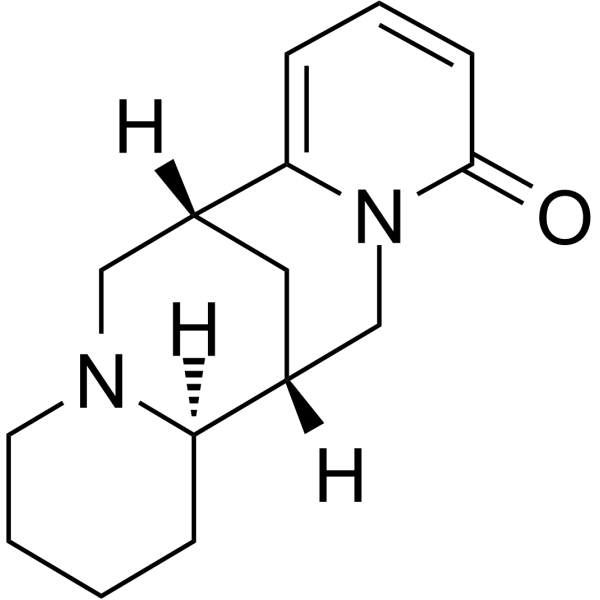
Physicochemical Properties
| Molecular Formula | C15H20N2O |
| Molecular Weight | 244.33200 |
| Exact Mass | 244.158 |
| CAS # | 486-89-5 |
| Related CAS # | Anagyrine hydrochloride;74195-83-8 |
| PubChem CID | 5351589 |
| Appearance | Colorless to light yellow ointment |
| Density | 1.22 g/cm3 |
| Boiling Point | 455.6ºC at 760 mmHg |
| Flash Point | 216.3ºC |
| Vapour Pressure | 1.73E-08mmHg at 25°C |
| Index of Refraction | 1.628 |
| LogP | 1.757 |
| Hydrogen Bond Donor Count | 0 |
| Hydrogen Bond Acceptor Count | 2 |
| Rotatable Bond Count | 0 |
| Heavy Atom Count | 18 |
| Complexity | 440 |
| Defined Atom Stereocenter Count | 3 |
| SMILES | O=C1=N2C(=CC=C1)C3CC(C2)C4N(CCCC4)C3 |
| InChi Key | FQEQMASDZFXSJI-JHJVBQTASA-N |
| InChi Code | InChI=1S/C15H20N2O/c18-15-6-3-5-14-11-8-12(10-17(14)15)13-4-1-2-7-16(13)9-11/h3,5-6,11-13H,1-2,4,7-10H2/t11-,12-,13-/m1/s1 |
| Chemical Name | (1R,9R,10R)-7,15-diazatetracyclo[7.7.1.02,7.010,15]heptadeca-2,4-dien-6-one |
| HS Tariff Code | 2934.99.9001 |
| Storage |
Powder-20°C 3 years 4°C 2 years In solvent -80°C 6 months -20°C 1 month Note: This product requires protection from light (avoid light exposure) during transportation and storage. |
| Shipping Condition | Room temperature (This product is stable at ambient temperature for a few days during ordinary shipping and time spent in Customs) |
Biological Activity
| ln Vitro | Anagyrine has EC50 values of 4.2 and 231 μM, respectively, and functions as a partial coagulant in the SH-SY5Y and TE-671 cell lines. With DC50 values of 6.9 and 139 μM in SH-SY5Y and TE-671 cells, respectively, anagogrine is a desensitizer of nAChR [3]. |
| References |
[1]. Binding of quinolizidine alkaloids to nicotinic and muscarinic acetylcholine receptors. J Nat Prod. 1994 Sep;57(9):1316-9. [2]. Nematicidal activities of (–)-N-methylcytisine and (–)-anagyrine from Sophora flavescens against pine wood nematodes. Agr. BioI. Chem. 53(8), 2287-2288 (1989). [3]. Anagyrine desensitization of peripheral nicotinic acetylcholine receptors. A potential biomarker of quinolizidine alkaloid teratogenesis in cattle. Res Vet Sci. 2017 Dec;115:195-200. |
| Additional Infomation |
Monolupine has been reported in Maackia tenuifolia, Thermopsis lanceolata, and other organisms with data available. See also: Caulophyllum thalictroides Root (part of). |
Solubility Data
| Solubility (In Vitro) |
H2O : ~25 mg/mL (~102.32 mM) DMSO : ~25 mg/mL (~102.32 mM) |
| Solubility (In Vivo) |
Solubility in Formulation 1: ≥ 2 mg/mL (8.19 mM) (saturation unknown) in 10% DMSO + 40% PEG300 + 5% Tween80 + 45% Saline (add these co-solvents sequentially from left to right, and one by one), clear solution. For example, if 1 mL of working solution is to be prepared, you can add 100 μL of 20.0 mg/mL clear DMSO stock solution to 400 μL PEG300 and mix evenly; then add 50 μL Tween-80 to the above solution and mix evenly; then add 450 μL normal saline to adjust the volume to 1 mL. Preparation of saline: Dissolve 0.9 g of sodium chloride in 100 mL ddH₂ O to obtain a clear solution. Solubility in Formulation 2: ≥ 2 mg/mL (8.19 mM) (saturation unknown) in 10% DMSO + 90% Corn Oil (add these co-solvents sequentially from left to right, and one by one), clear solution. For example, if 1 mL of working solution is to be prepared, you can add 100 μL of 20.0 mg/mL clear DMSO stock solution to 900 μL of corn oil and mix evenly. Solubility in Formulation 3: ≥ 2 mg/mL (8.19 mM) (saturation unknown) in 10% DMSO + 90% Saline (add these co-solvents sequentially from left to right, and one by one), clear solution. Preparation of saline: Dissolve 0.9 g of sodium chloride in 100 mL ddH₂ O to obtain a clear solution. (Please use freshly prepared in vivo formulations for optimal results.) |
| Preparing Stock Solutions | 1 mg | 5 mg | 10 mg | |
| 1 mM | 4.0928 mL | 20.4641 mL | 40.9283 mL | |
| 5 mM | 0.8186 mL | 4.0928 mL | 8.1857 mL | |
| 10 mM | 0.4093 mL | 2.0464 mL | 4.0928 mL |