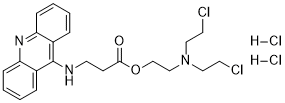
Amustaline 2HCl (S-303 dihydrochloride) is a nucleic acid-targeted alkylator for treatment Zika virus. It is an efficient pathogen inactivation agent for blood components containing red blood cells. Amustaline is composed of three parts: an acridine anchor (an intercalator that targets nucleic acids non-covalently), an effector (a bis-alkylator group that reacts with nucleophiles), and a linker (a small flexible carbon chain containing a labile ester bond that hydrolyzes at neutral pH to yield non-reactive breakdown products).
Physicochemical Properties
| Molecular Formula | C22H27CL4N3O2 |
| Molecular Weight | 507.28 |
| Exact Mass | 505.086 |
| CAS # | 210584-54-6 |
| Related CAS # | 210584-54-6 (HCl);220180-88-1;212335-58-5 878189-87-8; |
| PubChem CID | 6433103 |
| Appearance | Yellow to brown solid powder |
| Boiling Point | 575.2ºC at 760 mmHg |
| Flash Point | 301.7ºC |
| Vapour Pressure | 3.1E-13mmHg at 25°C |
| LogP | 5.538 |
| Hydrogen Bond Donor Count | 3 |
| Hydrogen Bond Acceptor Count | 5 |
| Rotatable Bond Count | 12 |
| Heavy Atom Count | 31 |
| Complexity | 469 |
| Defined Atom Stereocenter Count | 0 |
| InChi Key | WEOLKSYHLNAIRH-UHFFFAOYSA-N |
| InChi Code | InChI=1S/C22H25Cl2N3O2.2ClH/c23-10-13-27(14-11-24)15-16-29-21(28)9-12-25-22-17-5-1-3-7-19(17)26-20-8-4-2-6-18(20)22/h1-8H,9-16H2,(H,25,26)2*1H |
| Chemical Name | beta-Alanine, N-9-acridinyl-, 2-(bis(2-chloroethyl)amino)ethyl ester, dihydrochloride |
| Synonyms | S 303 dihydrochloride S 303 HClS-303 S303 S303. |
| HS Tariff Code | 2934.99.9001 |
| Storage |
Powder-20°C 3 years 4°C 2 years In solvent -80°C 6 months -20°C 1 month Note: Please store this product in a sealed and protected environment, avoid exposure to moisture. |
| Shipping Condition | Room temperature (This product is stable at ambient temperature for a few days during ordinary shipping and time spent in Customs) |
Biological Activity
| ln Vitro | S-303 (200 μM; 20 h) and glutathione (GSH; 20 mM) inhibit high levels of Chikungunya virus (CHIKV) in RBCs [1]. In whole blood studies, S-303 (200 μM; 20 h) and GSH (2 mM) inhibited >6.5 logs of HIV, >5.7 logs of Bluetongue virus, >7.0 logs of Yersinia enterocolitica, 4.2 logs of Serratia marcescens, and 7.5 logs of Staphylococcus epidermidis [2]. S-303 (200 μM; 20 h) and GSH (20 mM) inhibit the growth of Y. enterocolitica, E. coli, S. marcescens, S. aureus, HIV, bovine viral diarrhoea virus, bluetongue virus, and human adenovirus 5 in RBC by 5 logs or more [2]. S-303 (200 μM; 20 h) maintains in vitro measures of RBC function and physiology (including total ATP, extracellular potassium, hemolysis, glucose consumption, lactate generation, and pH at 37 °C) compared to ordinary RBC[2]. |
| ln Vivo | Dogs (70 μmol/kg) and rats (50 μmol/kg) both tolerate S-303 RBCs (a single transfusion) well[3]. In rats (10 μmol/kg) and dogs (10 μmol/kg), S-303 RBCs (repeated transfusions) are well tolerated and do not show any histopathologic signs of organ toxicity[3]. |
| References |
[1]. Amustaline (S-303) treatment inactivates high levels of Chikungunya virus in red-blood-cell components. Vox Sang. 2018 Apr;113(3):232-241. [2]. Treatment of whole blood (WB) and red blood cells (RBC) with S-303 inactivates pathogens and retains in vitro quality of stored RBC. Biologicals. 2010 Jan;38(1):14-9. [3]. Preclinical pharmacokinetic and toxicology assessment of red blood cells prepared with S-303 pathogen inactivation treatment. Transfusion. 2011 Oct;51(10):2208-18. |
| Additional Infomation | Amustaline Dihydrochloride is the hydrochloride salt form of amustaline, a quinacrine mustard compound with potential antineoplastic activity. Amustaline binds to, intercalates and crosslinks DNA and RNA. This agent is mainly used for ex vivo purposes, specifically for the inactivation of pathogens such as viruses, protozoa and bacteria in red blood cells (RBCs). |
Solubility Data
| Solubility (In Vitro) | May dissolve in DMSO (in most cases), if not, try other solvents such as H2O, Ethanol, or DMF with a minute amount of products to avoid loss of samples |
| Solubility (In Vivo) |
Note: Listed below are some common formulations that may be used to formulate products with low water solubility (e.g. < 1 mg/mL), you may test these formulations using a minute amount of products to avoid loss of samples. Injection Formulations (e.g. IP/IV/IM/SC) Injection Formulation 1: DMSO : Tween 80: Saline = 10 : 5 : 85 (i.e. 100 μL DMSO stock solution → 50 μL Tween 80 → 850 μL Saline) *Preparation of saline: Dissolve 0.9 g of sodium chloride in 100 mL ddH ₂ O to obtain a clear solution. Injection Formulation 2: DMSO : PEG300 :Tween 80 : Saline = 10 : 40 : 5 : 45 (i.e. 100 μL DMSO → 400 μLPEG300 → 50 μL Tween 80 → 450 μL Saline) Injection Formulation 3: DMSO : Corn oil = 10 : 90 (i.e. 100 μL DMSO → 900 μL Corn oil) Example: Take the Injection Formulation 3 (DMSO : Corn oil = 10 : 90) as an example, if 1 mL of 2.5 mg/mL working solution is to be prepared, you can take 100 μL 25 mg/mL DMSO stock solution and add to 900 μL corn oil, mix well to obtain a clear or suspension solution (2.5 mg/mL, ready for use in animals). Injection Formulation 4: DMSO : 20% SBE-β-CD in saline = 10 : 90 [i.e. 100 μL DMSO → 900 μL (20% SBE-β-CD in saline)] *Preparation of 20% SBE-β-CD in Saline (4°C,1 week): Dissolve 2 g SBE-β-CD in 10 mL saline to obtain a clear solution. Injection Formulation 5: 2-Hydroxypropyl-β-cyclodextrin : Saline = 50 : 50 (i.e. 500 μL 2-Hydroxypropyl-β-cyclodextrin → 500 μL Saline) Injection Formulation 6: DMSO : PEG300 : castor oil : Saline = 5 : 10 : 20 : 65 (i.e. 50 μL DMSO → 100 μLPEG300 → 200 μL castor oil → 650 μL Saline) Injection Formulation 7: Ethanol : Cremophor : Saline = 10: 10 : 80 (i.e. 100 μL Ethanol → 100 μL Cremophor → 800 μL Saline) Injection Formulation 8: Dissolve in Cremophor/Ethanol (50 : 50), then diluted by Saline Injection Formulation 9: EtOH : Corn oil = 10 : 90 (i.e. 100 μL EtOH → 900 μL Corn oil) Injection Formulation 10: EtOH : PEG300:Tween 80 : Saline = 10 : 40 : 5 : 45 (i.e. 100 μL EtOH → 400 μLPEG300 → 50 μL Tween 80 → 450 μL Saline) Oral Formulations Oral Formulation 1: Suspend in 0.5% CMC Na (carboxymethylcellulose sodium) Oral Formulation 2: Suspend in 0.5% Carboxymethyl cellulose Example: Take the Oral Formulation 1 (Suspend in 0.5% CMC Na) as an example, if 100 mL of 2.5 mg/mL working solution is to be prepared, you can first prepare 0.5% CMC Na solution by measuring 0.5 g CMC Na and dissolve it in 100 mL ddH2O to obtain a clear solution; then add 250 mg of the product to 100 mL 0.5% CMC Na solution, to make the suspension solution (2.5 mg/mL, ready for use in animals). Oral Formulation 3: Dissolved in PEG400 Oral Formulation 4: Suspend in 0.2% Carboxymethyl cellulose Oral Formulation 5: Dissolve in 0.25% Tween 80 and 0.5% Carboxymethyl cellulose Oral Formulation 6: Mixing with food powders Note: Please be aware that the above formulations are for reference only. InvivoChem strongly recommends customers to read literature methods/protocols carefully before determining which formulation you should use for in vivo studies, as different compounds have different solubility properties and have to be formulated differently. (Please use freshly prepared in vivo formulations for optimal results.) |
| Preparing Stock Solutions | 1 mg | 5 mg | 10 mg | |
| 1 mM | 1.9713 mL | 9.8565 mL | 19.7130 mL | |
| 5 mM | 0.3943 mL | 1.9713 mL | 3.9426 mL | |
| 10 mM | 0.1971 mL | 0.9856 mL | 1.9713 mL |