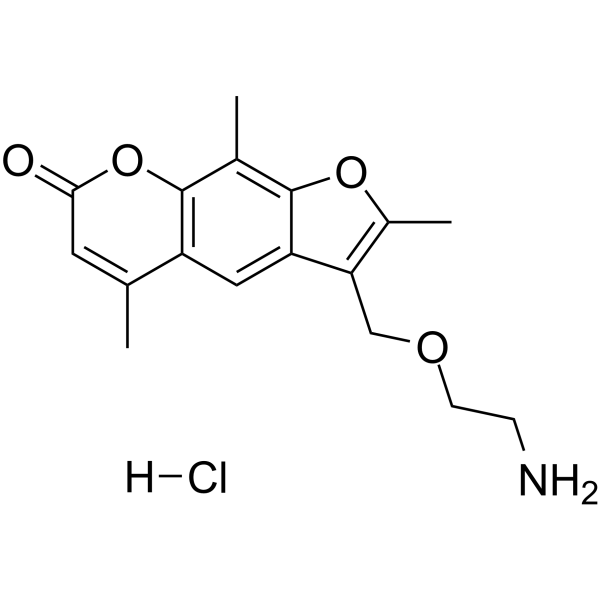
Physicochemical Properties
| Molecular Formula | C17H19NO4.HCL |
| Molecular Weight | 337.798 |
| Exact Mass | 337.108 |
| CAS # | 161262-45-9 |
| Related CAS # | 161262-45-9 (HCl);161262-29-9; |
| PubChem CID | 159598 |
| Appearance | White to light yellow solid powder |
| Boiling Point | 488.8ºC at 760mmHg |
| Flash Point | 249.4ºC |
| Vapour Pressure | 1.06E-09mmHg at 25°C |
| LogP | 4.442 |
| Hydrogen Bond Donor Count | 2 |
| Hydrogen Bond Acceptor Count | 5 |
| Rotatable Bond Count | 4 |
| Heavy Atom Count | 23 |
| Complexity | 464 |
| Defined Atom Stereocenter Count | 0 |
| SMILES | Cl.NCCOCC1=C(C)OC2C(=C3OC(=O)C=C(C)C3=CC1=2)C |
| InChi Key | MHLAMQBABOJZQW-UHFFFAOYSA-N |
| InChi Code | InChI=1S/C17H19NO4.ClH/c1-9-6-15(19)22-16-10(2)17-13(7-12(9)16)14(11(3)21-17)8-20-5-4-18;/h6-7H,4-5,8,18H2,1-3H3;1H |
| Chemical Name | 3-(2-aminoethoxymethyl)-2,5,9-trimethylfuro[3,2-g]chromen-7-one;hydrochloride |
| HS Tariff Code | 2934.99.9001 |
| Storage |
Powder-20°C 3 years 4°C 2 years In solvent -80°C 6 months -20°C 1 month Note: Please store this product in a sealed and protected environment, avoid exposure to moisture. |
| Shipping Condition | Room temperature (This product is stable at ambient temperature for a few days during ordinary shipping and time spent in Customs) |
Biological Activity
| ln Vitro | Amoxalin hydrochloride attaches to the carotene linkage and stops replication when it is exposed to light. Amoxalin hydrochloride that has been activated by light attaches to DNA and creates a permanent cross-link, which inhibits replication and halts the growth of donor T cells [1]. |
| References |
[1]. Amotosalen: Allogeneic Cellular Immunotherapies system, INTERCEPT Plasma System, INTERCEPT Platelet System, S 59. BioDrugs. 2003;17(1):66-8. |
| Additional Infomation | Amotosalen Hydrochloride is the hydrochloride salt form of amotosalen, a synthetic psoralen and light-activated DNA, RNA crosslinking agent, with protective activity against pathogens such as bacteria, viruses, protozoa, and leukocytes. Prior to administration amotosalen is added to plasma and platelets, then in vivo the agent penetrates pathogens and targets DNA and RNA. Upon activation by ultraviolet A light, this agent is able to form interstrand DNA and RNA crosslinks and prevents replication. Inactivation of leukocytes can prevent graft versus host disease upon transfusion. |
Solubility Data
| Solubility (In Vitro) | DMSO : ~7.14 mg/mL (~21.14 mM) |
| Solubility (In Vivo) |
Solubility in Formulation 1: ≥ 0.71 mg/mL (2.10 mM) (saturation unknown) in 10% DMSO + 40% PEG300 + 5% Tween80 + 45% Saline (add these co-solvents sequentially from left to right, and one by one), clear solution. For example, if 1 mL of working solution is to be prepared, you can add 100 μL of 7.1 mg/mL clear DMSO stock solution to 400 μL PEG300 and mix evenly; then add 50 μL Tween-80 to the above solution and mix evenly; then add 450 μL normal saline to adjust the volume to 1 mL. Preparation of saline: Dissolve 0.9 g of sodium chloride in 100 mL ddH₂ O to obtain a clear solution. Solubility in Formulation 2: ≥ 0.71 mg/mL (2.10 mM) (saturation unknown) in 10% DMSO + 90% (20% SBE-β-CD in Saline) (add these co-solvents sequentially from left to right, and one by one), clear solution. For example, if 1 mL of working solution is to be prepared, you can add 100 μL of 7.1 mg/mL clear DMSO stock solution to 900 μL of 20% SBE-β-CD physiological saline solution and mix evenly. Preparation of 20% SBE-β-CD in Saline (4°C,1 week): Dissolve 2 g SBE-β-CD in 10 mL saline to obtain a clear solution. Solubility in Formulation 3: ≥ 0.71 mg/mL (2.10 mM) (saturation unknown) in 10% DMSO + 90% Corn Oil (add these co-solvents sequentially from left to right, and one by one), clear solution. For example, if 1 mL of working solution is to be prepared, you can add 100 μL of 7.1 mg/mL clear DMSO stock solution to 900 μL of corn oil and mix evenly. (Please use freshly prepared in vivo formulations for optimal results.) |
| Preparing Stock Solutions | 1 mg | 5 mg | 10 mg | |
| 1 mM | 2.9603 mL | 14.8017 mL | 29.6033 mL | |
| 5 mM | 0.5921 mL | 2.9603 mL | 5.9207 mL | |
| 10 mM | 0.2960 mL | 1.4802 mL | 2.9603 mL |