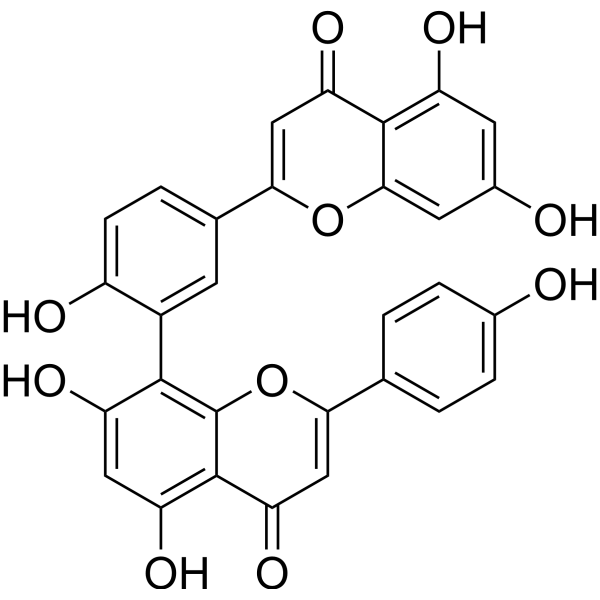
Physicochemical Properties
| Molecular Formula | C30H18O10 |
| Molecular Weight | 538.46 |
| Exact Mass | 538.09 |
| Elemental Analysis | C, 66.92; H, 3.37; O, 29.71 |
| CAS # | 1617-53-4 |
| Related CAS # | 1617-53-4 38Biapigenin |
| PubChem CID | 5281600 |
| Appearance | Light yellow to yellow solid powder |
| Density | 1.7±0.1 g/cm3 |
| Boiling Point | 910.5±65.0 °C at 760 mmHg |
| Melting Point | >300ºC |
| Flash Point | 308.5±27.8 °C |
| Vapour Pressure | 0.0±0.3 mmHg at 25°C |
| Index of Refraction | 1.793 |
| LogP | 3.11 |
| Hydrogen Bond Donor Count | 6 |
| Hydrogen Bond Acceptor Count | 10 |
| Rotatable Bond Count | 3 |
| Heavy Atom Count | 40 |
| Complexity | 1050 |
| Defined Atom Stereocenter Count | 0 |
| InChi Key | YUSWMAULDXZHPY-UHFFFAOYSA-N |
| InChi Code | InChI=1S/C30H18O10/c31-15-4-1-13(2-5-15)24-12-23(38)29-21(36)10-20(35)27(30(29)40-24)17-7-14(3-6-18(17)33)25-11-22(37)28-19(34)8-16(32)9-26(28)39-25/h1-12,31-36H |
| Chemical Name | 8-[5-(5,7-dihydroxy-4-oxochromen-2-yl)-2-hydroxyphenyl]-5,7-dihydroxy-2-(4-hydroxyphenyl)chromen-4-one |
| Synonyms | Didemethylginkgetin; Amentoflavone; 1617-53-4; Didemethyl-ginkgetin; 3',8''-Biapigenin; Amenthoflavone; I3,II8-biapigenin; Tridemethylsciadopitysin; MFCD00017470; |
| HS Tariff Code | 2934.99.9001 |
| Storage |
Powder-20°C 3 years 4°C 2 years In solvent -80°C 6 months -20°C 1 month |
| Shipping Condition | Room temperature (This product is stable at ambient temperature for a few days during ordinary shipping and time spent in Customs) |
Biological Activity
| Targets | Natural biflavonoid; antioxidative; anti-inflammatory; anti-viral; anti-tumor |
| ln Vitro | In RAW 264.7 cells, amenoflavone (1-60 μM) suppresses the generation of nitric oxide in a concentration-dependent way [2]. U-87 MG cell viability is inhibited by amentoflavone (50-200 μM) with an IC50 value of 100 μM after 48 hours [3]. In the sub-G1 phase, amentoflavone (0, 50, and 100 μM; 48 hours) causes cell cycle arrest and apoptosis [3]. In U-87 MG cells, amentoflavone (0, 50, 100 μM; 48 h) suppresses NF-κB activation and lowers MCL1 and C-FLIP protein expression [3]. With minimum inhibitory concentrations (MICs) of 8, 4, 32, 8, 16, and 8 μg/ml, amentoflavone (0-32 μg/ml) exhibits antibacterial action against Enterococcus faecium ATCC 19434, Staphylococcus aureus ATCC 25923, Streptococcus mutans ATCC 3065, and Escherichia coli. ml. They're E. O. 157 ATCC 25922, E. coli. Pseudomonas aeruginosa ATCC 27853 and Escherichia coli ATCC 43895 [4]. |
| ln Vivo | Through its anti-inflammatory properties in mice, amentoflavone (25 mg/kg; oral; once daily for 3 days) has been demonstrated to be neuroprotective in epilepsy [1]. |
| Cell Assay |
Cell viability assay [3] Cell Types: U-87 MG Cell Tested Concentrations: 0, 50, 75, 100, 200 µM Incubation Duration: 48 hrs (hours) Experimental Results: Dramatically inhibited the viability of U-87 MG cells by 23-71% at 48 hrs (hours) The IC50 value is 100 µM. Apoptosis analysis [3] Cell Types: U-87 MG Cell Tested Concentrations: 0, 50, 100 µM Incubation Duration: 48 hrs (hours) Experimental Results: Dramatically induced the accumulation of cells in the sub-G1 population and increased the levels of active caspase-3 respectively 14-52% and 24-42%, and Dramatically induced Ψm loss and active caspase-8 expression by 23-53% and 25-50%, respectively. Western Blot Analysis[3] Cell Types: U-87 MG Cell Tested Concentrations: 0, 50, 100 µM Incubation Duration: 48 hrs (hours) Experimental Results: Dramatically diminished NF-ĸB activation by 25-87% in a dose-dependent manner and diminished protein expression MCL1 and C-FLIP increased by 50-80% and 38-57% respectively. |
| Animal Protocol |
Animal/Disease Models: 5-6 weeks, 28-32 g, Kunming mice [1] Doses: 25 mg/kg Route of Administration: Po; one time/day for 3 days Experimental Results: Inhibition of the activation and nuclear activation of NF-κB subunit p65 translocation, reducing the production of IL-6 and IL-1β, and Dramatically reducing the production of NO and prostaglandin E2. |
| References |
[1]. Amentoflavone protects hippocampal neurons: anti-inflammatory, antioxidative, and antiapoptotic effects. Neural Regen Res. 2015 Jul;10(7):1125-33. [2]. Amentoflavone inhibits the induction of nitric oxide synthase by inhibiting NF-kappaB activation in macrophages. Pharmacol Res. 2005 Jun;51(6):539-46. [3]. Amentoflavone Induces Apoptosis and Inhibits NF-ĸB-modulated Anti-apoptotic Signaling in Glioblastoma Cells. In Vivo. 2018 Mar-Apr;32(2):279-285. [4]. Antibacterial effect of amentoflavone and its synergistic effect with antibiotics. J Microbiol Biotechnol. 2013;23(7):953-8. [5]. Semisynthetic preparation of amentoflavone: A negative modulator at GABA(A) receptors. Bioorg Med Chem Lett. 2003 Jul 21;13(14):2281-4. |
| Additional Infomation |
Amentoflavone is a biflavonoid that is obtained by oxidative coupling of two molecules of apigenin resulting in a bond between positions C-3 of the hydroxyphenyl ring and C-8 of the chromene ring. A natural product found particularly in Ginkgo biloba and Hypericum perforatum. It has a role as a cathepsin B inhibitor, an antiviral agent, an angiogenesis inhibitor, a P450 inhibitor and a plant metabolite. It is a biflavonoid, a hydroxyflavone and a ring assembly. Amentoflavone has been reported in Cycas beddomei, Microbiota decussata, and other organisms with data available. See also: ... View More ... |
Solubility Data
| Solubility (In Vitro) | DMSO : ~125 mg/mL (~232.14 mM) |
| Solubility (In Vivo) |
Solubility in Formulation 1: ≥ 2.5 mg/mL (4.64 mM) (saturation unknown) in 10% DMSO + 40% PEG300 + 5% Tween80 + 45% Saline (add these co-solvents sequentially from left to right, and one by one), clear solution. For example, if 1 mL of working solution is to be prepared, you can add 100 μL of 25.0 mg/mL clear DMSO stock solution to 400 μL PEG300 and mix evenly; then add 50 μL Tween-80 to the above solution and mix evenly; then add 450 μL normal saline to adjust the volume to 1 mL. Preparation of saline: Dissolve 0.9 g of sodium chloride in 100 mL ddH₂ O to obtain a clear solution. Solubility in Formulation 2: 2.5 mg/mL (4.64 mM) in 10% DMSO + 90% (20% SBE-β-CD in Saline) (add these co-solvents sequentially from left to right, and one by one), suspension solution; with ultrasonication. For example, if 1 mL of working solution is to be prepared, you can add 100 μL of 25.0 mg/mL clear DMSO stock solution to 900 μL of 20% SBE-β-CD physiological saline solution and mix evenly. Preparation of 20% SBE-β-CD in Saline (4°C,1 week): Dissolve 2 g SBE-β-CD in 10 mL saline to obtain a clear solution. (Please use freshly prepared in vivo formulations for optimal results.) |
| Preparing Stock Solutions | 1 mg | 5 mg | 10 mg | |
| 1 mM | 1.8571 mL | 9.2857 mL | 18.5715 mL | |
| 5 mM | 0.3714 mL | 1.8571 mL | 3.7143 mL | |
| 10 mM | 0.1857 mL | 0.9286 mL | 1.8571 mL |