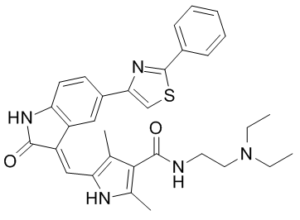
Amcasertib (formerly known as BBI-503; BBI503) is an orally bioavailable small molecule compound and a first-in-class cancer stemness kinase inhibitor. It was designed to target CSC (Cancer Stem Cell) pathways in multiple tumour types. As the first cancer stemness kinase inhibitor, it is claimed to inhibit Nanog and other CSC pathways by targeting kinases with potential anticancer activity. In a phase I study, BI503 as a monotherapy was tolerated at the recommended phase 2 dose of 300 mg once daily. At the recommended phase 2 dose, common adverse events were grade 1 to 2 diarrhea, nausea, abdominal cramping, anorexia and fatigue, and grade 3 adverse events were fatigue (n= 4), and diarrhea, nausea, and weight loss (n=1 each).
Physicochemical Properties
| Molecular Formula | C31H33N5O2S | |
| Molecular Weight | 539.69 | |
| Exact Mass | 539.235 | |
| CAS # | 1129403-56-0 | |
| Related CAS # |
|
|
| PubChem CID | 25190990 | |
| Appearance | Light yellow to yellow solid powder | |
| Density | 1.2±0.1 g/cm3 | |
| Index of Refraction | 1.651 | |
| LogP | 5.72 | |
| Hydrogen Bond Donor Count | 3 | |
| Hydrogen Bond Acceptor Count | 5 | |
| Rotatable Bond Count | 9 | |
| Heavy Atom Count | 39 | |
| Complexity | 888 | |
| Defined Atom Stereocenter Count | 0 | |
| SMILES | S1C(C2C([H])=C([H])C([H])=C([H])C=2[H])=NC(=C1[H])C1C([H])=C([H])C2=C(C=1[H])/C(/C(N2[H])=O)=C(/[H])\C1=C(C([H])([H])[H])C(C(N([H])C([H])([H])C([H])([H])N(C([H])([H])C([H])([H])[H])C([H])([H])C([H])([H])[H])=O)=C(C([H])([H])[H])N1[H] |
|
| InChi Key | QDWKGEFGLQMDAM-ULJHMMPZSA-N | |
| InChi Code | InChI=1S/C31H33N5O2S/c1-5-36(6-2)15-14-32-30(38)28-19(3)26(33-20(28)4)17-24-23-16-22(12-13-25(23)34-29(24)37)27-18-39-31(35-27)21-10-8-7-9-11-21/h7-13,16-18,33H,5-6,14-15H2,1-4H3,(H,32,38)(H,34,37)/b24-17- | |
| Chemical Name | N-[2-(diethylamino)ethyl]-2,4-dimethyl-5-[(Z)-[2-oxo-5-(2-phenyl-1,3-thiazol-4-yl)-1H-indol-3-ylidene]methyl]-1H-pyrrole-3-carboxamide | |
| Synonyms |
|
|
| HS Tariff Code | 2934.99.9001 | |
| Storage |
Powder-20°C 3 years 4°C 2 years In solvent -80°C 6 months -20°C 1 month |
|
| Shipping Condition | Room temperature (This product is stable at ambient temperature for a few days during ordinary shipping and time spent in Customs) |
Biological Activity
| ln Vitro | In PC-9/GR cells, amcasertib (0-1μM; 48h) inhibits the expression of CD133 and NANOG. Additionally, in a dose-dependent manner, amcasertib significantly inhibits the growth of PC-9/GR cells[1]. | ||
| ln Vivo |
|
||
| Cell Assay |
Cell Viability Assay[1] Cell Types: PC-9/GR cell Tested Concentrations: 0, 0.3125, 0.625, 1.25, 2.5, 5 and 10μM Incubation Duration: 48 hrs (hours) Experimental Results: Suppressed the growth of PC-9/GR cells in a dose-dependent manner for 48 hrs (hours) with a OD value diminished from over 1.5 to less than 0.2 (p< 0.0001). Western Blot Analysis[1] Cell Types: PC-9/GR cell Tested Concentrations: 0, 0.1 and 1μM Incubation Duration: 48 hrs (hours) Experimental Results: Inhibited the NANOG and CD133 expression in PC-9/GR cells. |
||
| Animal Protocol |
|
||
| References |
[1]. 1,25-dihydroxyvitamin D3 signaling-induced decreases in IRX4 inhibits NANOG-mediated cancer stem-like properties and gefitinib resistance in NSCLC cells. Cell Death Dis. 2020;11(8):670. |
||
| Additional Infomation |
Amcasertib is under investigation in clinical trial NCT02483247 (A Study of BBI503 in Combination With Selected Anti-Cancer Therapeutics in Adult Patients With Advanced Cancer). Amcasertib is an orally available cancer cell stemness kinase inhibitor with potential antineoplastic activity. Even though the exact target has not been fully elucidated, amcasertib targets and inhibits one or more pathways involved in cancer stem cell survival. As a result, cancer stem cell (CSC) growth as well as heterogeneous cancer cell growth is inhibited. CSCs, self-replicating cells able to differentiate into heterogeneous cancer cells, appear to be responsible for both tumor relapse and metastasis. |
Solubility Data
| Solubility (In Vitro) |
|
|||
| Solubility (In Vivo) |
Solubility in Formulation 1: ≥ 1.25 mg/mL (2.32 mM) (saturation unknown) in 10% DMSO + 40% PEG300 +5% Tween-80 + 45% Saline (add these co-solvents sequentially from left to right, and one by one), clear solution. For example, if 1 mL of working solution is to be prepared, you can add 100 μL of 12.5 mg/mL clear DMSO stock solution to 400 μL PEG300 and mix evenly; then add 50 μL Tween-80 + to the above solution and mix evenly; then add 450 μL normal saline to adjust the volume to 1 mL. Preparation of saline: Dissolve 0.9 g of sodium chloride in 100 mL ddH₂ O to obtain a clear solution. (Please use freshly prepared in vivo formulations for optimal results.) |
| Preparing Stock Solutions | 1 mg | 5 mg | 10 mg | |
| 1 mM | 1.8529 mL | 9.2646 mL | 18.5292 mL | |
| 5 mM | 0.3706 mL | 1.8529 mL | 3.7058 mL | |
| 10 mM | 0.1853 mL | 0.9265 mL | 1.8529 mL |