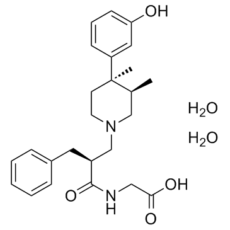
Alvimopan (also known as ADL 8-2698; LY 246736; HSDB-7704) is a novel peripheral micro opioid antagonist in clinical development for the management of post-operative ileus and opioid-induced bowel dysfunction. Alvimopan acts for a longer period of time than other antagonists that act more quickly, which may be connected to a slower rate of dissociation from the micro opioid receptor. In comparison to the long-acting partial agonist buprenorphine (t(1/2)=44 min), alvimopan's dissociation rate from the micro opioid receptor (t(1/2)=30–44 min) was slower than that of the antagonists naloxone (t(1/2)=0.82 min) and N-methylnaltrexone (t(1/2)=0.46 min). Moreover, after preincubation with the micro opioid receptor, increases were seen in the apparent affinities and potencies of buprenorphine and alvimopan, but not of naloxone or methylnaltrexone. Alvimopan has a slower rate of dissociation from the micro opioid receptor than other antagonists with shorter half-lives, which is consistent with its prolonged duration of action. It may also have greater potency if given before exogenous opioid dosing.
Physicochemical Properties
| Molecular Formula | C25H36N2O6 |
| Molecular Weight | 460.57 |
| Exact Mass | 460.257 |
| Elemental Analysis | C, 65.20; H, 7.88; N, 6.08; O, 20.84 |
| CAS # | 170098-38-1 |
| Related CAS # | Alvimopan; 156053-89-3; Alvimopan monohydrate; 1383577-62-5 |
| PubChem CID | 5488547 |
| Appearance | White to off-white solid powder |
| Density | 1.166g/cm3 |
| Boiling Point | 684.1ºC at 760mmHg |
| Melting Point | 210-213ºC |
| Flash Point | 367.5ºC |
| Vapour Pressure | 1.18E-19mmHg at 25°C |
| Index of Refraction | 1.572 |
| LogP | 3.251 |
| Hydrogen Bond Donor Count | 5 |
| Hydrogen Bond Acceptor Count | 7 |
| Rotatable Bond Count | 8 |
| Heavy Atom Count | 33 |
| Complexity | 606 |
| Defined Atom Stereocenter Count | 3 |
| SMILES | O([H])C1=C([H])C([H])=C([H])C(=C1[H])[C@]1(C([H])([H])[H])C([H])([H])C([H])([H])N(C([H])([H])[C@@]([H])(C(N([H])C([H])([H])C(=O)O[H])=O)C([H])([H])C2C([H])=C([H])C([H])=C([H])C=2[H])C([H])([H])[C@]1([H])C([H])([H])[H].O([H])[H].O([H])[H] |
| InChi Key | USPVLEIQIUNQGE-DBFLIVQGSA-N |
| InChi Code | InChI=1S/C25H32N2O4.2H2O/c1-18-16-27(12-11-25(18,2)21-9-6-10-22(28)14-21)17-20(24(31)26-15-23(29)30)13-19-7-4-3-5-8-19;;/h3-10,14,18,20,28H,11-13,15-17H2,1-2H3,(H,26,31)(H,29,30);2*1H2/t18-,20-,25+;;/m0../s1 |
| Chemical Name | 2-[[(2S)-2-benzyl-3-[(3R,4R)-4-(3-hydroxyphenyl)-3,4-dimethylpiperidin-1-yl]propanoyl]amino]acetic acid;dihydrate |
| Synonyms | LY246736 dihydrate; LY246736; LY-246736; HSDB 7704; HSDB7704 dihydrate; HSDB-7704; ADL 8-2698; ADL8-2698; ADL-8-2698 dihydrate; Alvimopan dihydrate. Brand name: Entereg. |
| HS Tariff Code | 2934.99.9001 |
| Storage |
Powder-20°C 3 years 4°C 2 years In solvent -80°C 6 months -20°C 1 month |
| Shipping Condition | Room temperature (This product is stable at ambient temperature for a few days during ordinary shipping and time spent in Customs) |
Biological Activity
| Targets | μ-opioid receptor ( Ki = 0.77 nM ); δ-opioid receptor ( Ki = 4.4 nM ); κ-opioid receptor ( Ki = 40 nM ) | ||
| ln Vitro |
|
||
| ln Vivo |
|
||
| Enzyme Assay | Alvimopan has a more modest (≥6-fold) μ/δ receptor selectivity, but is highly selective (by ≥227-fold) for the human μ receptor over the κ subtype. Alvimopan has pA2 values of 9.6 or 9.7 and is a strong antagonist of morphine, DAMGO or endomorphin-1-induced, and μ opioid receptor-mediated electrically evoked contraction inhibition in the isolated ileum of guinea pigs. The ileum of guinea pigs has lower alvimopan antagonist potencies (δ and κ antagonists, with pA2 values of 8.7 and 7.8, respectively). Tested at both 1 and 10 μM, alvimopan does not exhibit any noteworthy affinity for a wide variety of non-opioid receptors, ion channels, or enzymes. | ||
| Animal Protocol |
|
||
| References |
[1]. P T. 2008 Oct; 33(10): 574, 580-583. [2]. Therapeutics. 2009, 1: 199-213. |
||
| Additional Infomation |
Alvimopan is a synthetic trans-3,4-dimethyl-4-(3-hydroxyphenyl) piperidine with peripherally selective opioid mu receptor antagonist activity. Alvimopan is a selective and competitive antagonist at mu-opioid receptors, found in myenteric and submucosal neurons and the immune cells of the lamina propria in the human gut. Upon administration, this agent binds to mu-opioid receptors in the gut, thereby reversing opioid-related disturbances in gut motility. Alvimopan is approximately three to nine times more potent than naloxone. See also: Alvimopan (annotation moved to). |
Solubility Data
| Solubility (In Vitro) |
|
|||
| Solubility (In Vivo) |
Solubility in Formulation 1: ≥ 2.5 mg/mL (5.43 mM) (saturation unknown) in 10% DMSO + 40% PEG300 + 5% Tween80 + 45% Saline (add these co-solvents sequentially from left to right, and one by one), clear solution. For example, if 1 mL of working solution is to be prepared, you can add 100 μL of 25.0 mg/mL clear DMSO stock solution to 400 μL PEG300 and mix evenly; then add 50 μL Tween-80 to the above solution and mix evenly; then add 450 μL normal saline to adjust the volume to 1 mL. Preparation of saline: Dissolve 0.9 g of sodium chloride in 100 mL ddH₂ O to obtain a clear solution. Solubility in Formulation 2: ≥ 2.5 mg/mL (5.43 mM) (saturation unknown) in 10% DMSO + 90% (20% SBE-β-CD in Saline) (add these co-solvents sequentially from left to right, and one by one), clear solution. For example, if 1 mL of working solution is to be prepared, you can add 100 μL of 25.0 mg/mL clear DMSO stock solution to 900 μL of 20% SBE-β-CD physiological saline solution and mix evenly. Preparation of 20% SBE-β-CD in Saline (4°C,1 week): Dissolve 2 g SBE-β-CD in 10 mL saline to obtain a clear solution. Solubility in Formulation 3: ≥ 2.5 mg/mL (5.43 mM) (saturation unknown) in 10% DMSO + 90% Corn Oil (add these co-solvents sequentially from left to right, and one by one), clear solution. For example, if 1 mL of working solution is to be prepared, you can add 100 μL of 25.0 mg/mL clear DMSO stock solution to 900 μL of corn oil and mix evenly. (Please use freshly prepared in vivo formulations for optimal results.) |
| Preparing Stock Solutions | 1 mg | 5 mg | 10 mg | |
| 1 mM | 2.1712 mL | 10.8561 mL | 21.7122 mL | |
| 5 mM | 0.4342 mL | 2.1712 mL | 4.3424 mL | |
| 10 mM | 0.2171 mL | 1.0856 mL | 2.1712 mL |