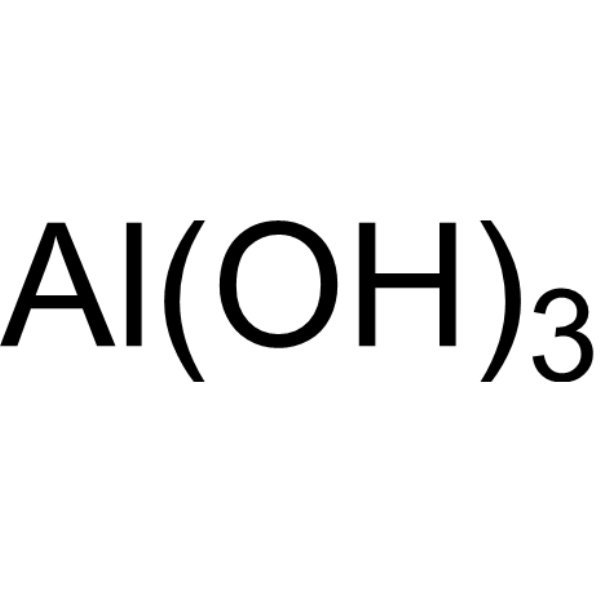
Physicochemical Properties
| Molecular Formula | H3ALO3 |
| Molecular Weight | 78.0036 |
| Exact Mass | 77.989 |
| CAS # | 21645-51-2 |
| PubChem CID | 10176082 |
| Appearance | White to off-white solid powder |
| Density | 2.40 |
| Melting Point | 300℃ |
| Hydrogen Bond Donor Count | 3 |
| Hydrogen Bond Acceptor Count | 3 |
| Heavy Atom Count | 4 |
| Complexity | 0 |
| Defined Atom Stereocenter Count | 0 |
| HS Tariff Code | 2934.99.9001 |
| Storage |
Powder-20°C 3 years 4°C 2 years In solvent -80°C 6 months -20°C 1 month |
| Shipping Condition | Room temperature (This product is stable at ambient temperature for a few days during ordinary shipping and time spent in Customs) |
Biological Activity
| Targets |
Aluminum Hydroxide targets innate immune cells (macrophages, dendritic cells) and activates immune signaling pathways[1,2] Aluminum Hydroxide affects lipid peroxidation-related cellular pathways [3] |
| ln Vitro |
Aluminum Hydroxide (10 μg/mL–100 μg/mL) activated murine bone marrow-derived dendritic cells (BMDCs): 50 μg/mL increased the expression of co-stimulatory molecules CD80 (2.8-fold) and CD86 (3.2-fold), and elevated IL-1β secretion by 4.5-fold after 24 hours [1] Aluminum hydroxide nanoparticles (20 μg/mL–80 μg/mL) stimulated human peripheral blood mononuclear cells (PBMCs) to secrete Th-1 type cytokines: 60 μg/mL increased IFN-γ by 5.3-fold and IL-2 by 4.1-fold in the presence of Mycobacterium tuberculosis antigen, without significant effect on Th-2 cytokines (IL-4, IL-10) [2] Aluminum Hydroxide (0.5 mM–2.0 mM) induced lipid peroxidation in rat hepatocytes: 1.5 mM increased malondialdehyde (MDA) levels by 2.7-fold and reduced superoxide dismutase (SOD) activity by 42% after 48 hours of incubation [3] |
| ln Vivo |
In the brain, aluminum hydroxide (lateral wall; 100 mg/kg/day for 7 days) reduces SOD activity and raises alkali peroxidation. Water is replenished by aluminum hydroxide to create a homogeneous suspension [3]. In BALB/c mice immunized with ovalbumin (OVA), intramuscular administration of Aluminum Hydroxide (50 μg/mouse) as an adjuvant enhanced humoral immunity: OVA-specific IgG antibody titer increased by 8.6-fold compared to OVA alone, and IgG1 (Th-2 associated) titer increased by 7.2-fold [1] In C57BL/6 mice challenged with Mycobacterium tuberculosis, subcutaneous injection of aluminum hydroxide nanoparticles (40 μg/mouse, q.o.d. for 3 weeks) enhanced anti-tuberculosis Th-1 immune response: splenic IFN-γ-secreting T cells increased by 6.8-fold, and lung bacterial load reduced by 58% [2] In Wistar rats, oral administration of Aluminum Hydroxide (100 mg/kg, q.d. for 4 weeks) induced lipid peroxidation in tissues: hepatic MDA levels increased by 2.3-fold, renal MDA increased by 1.9-fold, and hepatic SOD activity decreased by 38% compared to the control group [3] |
| Enzyme Assay |
Lipid peroxidation-related enzyme activity assay: Rat hepatocyte lysates were incubated with Aluminum Hydroxide (0.5 mM–2.0 mM) in assay buffer at 37°C for 60 minutes. SOD activity was measured by the xanthine oxidase method, catalase (CAT) activity by the hydrogen peroxide decomposition method, and glutathione peroxidase (GSH-Px) activity by the dithionitrobenzoic acid method [3] Cytokine quantification assay: Culture supernatants from BMDCs or PBMCs treated with Aluminum Hydroxide were collected. IL-1β, IFN-γ, IL-2, and IL-4 levels were quantified by enzyme-linked immunosorbent assay (ELISA) using specific antibodies [1,2] |
| Cell Assay |
Dendritic cell activation assay: Murine BMDCs were seeded in 6-well plates (2 × 10⁵ cells/well) and treated with Aluminum Hydroxide (10 μg/mL–100 μg/mL) for 24 hours. Cells were harvested, stained with anti-CD80 and anti-CD86 fluorescent antibodies, and analyzed by flow cytometry to quantify co-stimulatory molecule expression [1] PBMC cytokine secretion assay: Human PBMCs were isolated and seeded in 24-well plates (1 × 10⁶ cells/well), stimulated with Mycobacterium tuberculosis antigen, and treated with aluminum hydroxide nanoparticles (20 μg/mL–80 μg/mL) for 72 hours. Supernatants were collected for ELISA to detect IFN-γ and IL-2 levels [2] Hepatocyte lipid peroxidation assay: Primary rat hepatocytes were seeded in 96-well plates (5 × 10³ cells/well) and treated with Aluminum Hydroxide (0.5 mM–2.0 mM) for 48 hours. MDA levels (lipid peroxidation product) were quantified by the thiobarbituric acid reactive substances (TBARS) method [3] |
| Animal Protocol |
Vaccine adjuvant mouse model: BALB/c mice (6–8 weeks old) were randomized into OVA alone and OVA + Aluminum Hydroxide groups (n=8/group). Aluminum Hydroxide (50 μg/mouse) was mixed with OVA and administered intramuscularly twice at 2-week intervals. Serum was collected 2 weeks after the second immunization to measure OVA-specific IgG and IgG1 titers by ELISA [1] Anti-tuberculosis mouse model: C57BL/6 mice were intravenously challenged with Mycobacterium tuberculosis. One week post-challenge, mice were treated with aluminum hydroxide nanoparticles (40 μg/mouse, i.s., q.o.d.) for 3 weeks (n=10/group). Splenocytes were isolated to detect IFN-γ-secreting T cells by ELISPOT; lung tissues were homogenized to count bacterial colonies [2] Lipid peroxidation rat model: Wistar rats (180–220 g) were randomized into control and Aluminum Hydroxide groups (100 mg/kg, p.o., q.d., n=6/group). Aluminum Hydroxide was suspended in normal saline and administered by gavage for 4 weeks. Rats were sacrificed, and liver and kidney tissues were collected to measure MDA levels and SOD/CAT/GSH-Px activities [3] |
| Toxicity/Toxicokinetics |
Oral administration of Aluminum Hydroxide (100 mg/kg, q.d. for 4 weeks) in Wistar rats induced oxidative stress-related toxicity: increased lipid peroxidation (elevated MDA) and decreased antioxidant enzyme activities (SOD, CAT, GSH-Px) in liver and kidney tissues, without significant changes in body weight or overt pathological lesions [3] At adjuvant doses (≤50 μg/mouse, i.m. or s.c.) in mice, Aluminum Hydroxide did not cause obvious toxic symptoms (e.g., inflammation at injection site, organ dysfunction) [1,2] |
| References |
[1]. Advances in aluminum hydroxide-based adjuvant research and its mechanism. Hum Vaccin Immunother. 2015;11(2):477-88. [2]. Aluminum hydroxide nanoparticles show strong activity to stimulate Th-1 immune response against tuberculosis. Artif Cells Nanomed Biotechnol. 2017 Nov;45(7):1331-1335. [3]. Effect of aluminum ingestion on lipid peroxidation in rats. Chem Pharm Bull (Tokyo). 1983 Apr;31(4):1415-8. |
| Additional Infomation |
Aluminum Hydroxide is a widely used vaccine adjuvant that enhances immune responses by activating innate immune cells [1,2] Its adjuvant mechanism involves adsorbing antigens to form a depot, activating dendritic cells/macrophages via TLR4/NF-κB signaling, and promoting antigen presentation to T cells [1] Aluminum hydroxide nanoparticles exhibit enhanced ability to stimulate Th-1 immune responses, making them a potential adjuvant for tuberculosis and other intracellular pathogen vaccines [2] The toxic effect of Aluminum Hydroxide at high doses is associated with induction of lipid peroxidation and impairment of the antioxidant defense system [3] |
Solubility Data
| Solubility (In Vitro) | H2O : < 0.1 mg/mL DMSO :< 1 mg/mL |
| Solubility (In Vivo) |
Solubility in Formulation 1: 10 mg/mL (128.21 mM) in 0.5% CMC-Na/saline water (add these co-solvents sequentially from left to right, and one by one), suspension solution; with sonication. Preparation of saline: Dissolve 0.9 g of sodium chloride in 100 mL ddH₂ O to obtain a clear solution. (Please use freshly prepared in vivo formulations for optimal results.) |
| Preparing Stock Solutions | 1 mg | 5 mg | 10 mg | |
| 1 mM | 12.8205 mL | 64.1026 mL | 128.2051 mL | |
| 5 mM | 2.5641 mL | 12.8205 mL | 25.6410 mL | |
| 10 mM | 1.2821 mL | 6.4103 mL | 12.8205 mL |