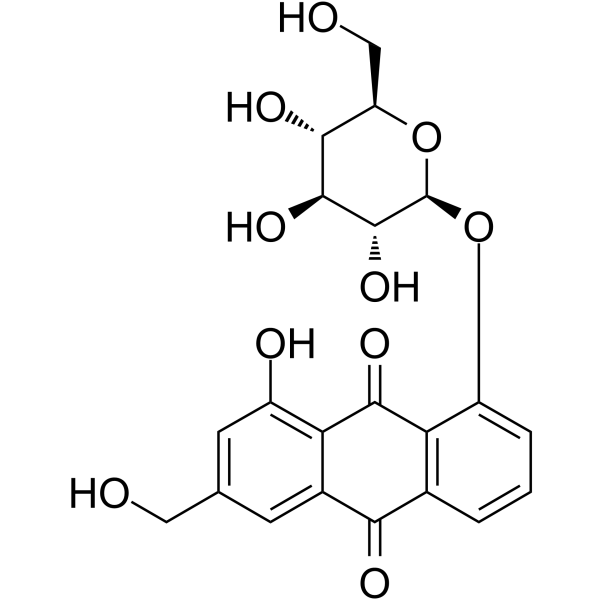
Physicochemical Properties
| Molecular Formula | C21H20O10 |
| Molecular Weight | 432.3775 |
| Exact Mass | 432.105 |
| CAS # | 33037-46-6 |
| PubChem CID | 5317644 |
| Appearance | Light yellow to yellow solid powder |
| Density | 1.673±0.06 g/cm3 |
| Boiling Point | 829.9±65.0 °C at 760 mmHg |
| Melting Point | 236-237 ºC |
| Flash Point | 295.2±27.8 °C |
| Vapour Pressure | 0.0±3.2 mmHg at 25°C |
| Index of Refraction | 1.726 |
| LogP | -0.1 |
| Hydrogen Bond Donor Count | 6 |
| Hydrogen Bond Acceptor Count | 10 |
| Rotatable Bond Count | 4 |
| Heavy Atom Count | 31 |
| Complexity | 685 |
| Defined Atom Stereocenter Count | 5 |
| SMILES | C1=CC2=C(C(=C1)O[C@H]3[C@@H]([C@H]([C@@H]([C@H](O3)CO)O)O)O)C(=O)C4=C(C2=O)C=C(C=C4O)CO |
| InChi Key | KIZBWUUJNJEYCM-JNHRPPPUSA-N |
| InChi Code | InChI=1S/C21H20O10/c22-6-8-4-10-14(11(24)5-8)18(27)15-9(16(10)25)2-1-3-12(15)30-21-20(29)19(28)17(26)13(7-23)31-21/h1-5,13,17,19-24,26,28-29H,6-7H2/t13-,17-,19+,20-,21-/m1/s1 |
| Chemical Name | 1-hydroxy-3-(hydroxymethyl)-8-[(2S,3R,4S,5S,6R)-3,4,5-trihydroxy-6-(hydroxymethyl)oxan-2-yl]oxyanthracene-9,10-dione |
| HS Tariff Code | 2934.99.9001 |
| Storage |
Powder-20°C 3 years 4°C 2 years In solvent -80°C 6 months -20°C 1 month Note: Please store this product in a sealed and protected environment (e.g. under nitrogen), avoid exposure to moisture and light. |
| Shipping Condition | Room temperature (This product is stable at ambient temperature for a few days during ordinary shipping and time spent in Customs) |
Biological Activity
| Targets |
Aloe-emodin-8-O-β-D-glucopyranoside targets protein tyrosine phosphatase 1B (PTP1B) (IC₅₀ = 38.5 μM) [1] |
| ln Vitro |
- Aloe-emodin-8-O-β-D-glucopyranoside exhibited dose-dependent inhibitory activity against recombinant human PTP1B enzyme, with an IC₅₀ value of 38.5 μM [1] - The compound showed no significant inhibitory effect on other phosphatases (e.g., TCPTP) at concentrations up to 100 μM, indicating moderate selectivity for PTP1B [1] |
| Enzyme Assay |
- Recombinant human PTP1B enzyme was used for the inhibition assay, with p-nitrophenyl phosphate (pNPP) as the synthetic substrate [1] - The reaction was conducted in a buffer system at 37°C, with serial dilutions of Aloe-emodin-8-O-β-D-glucopyranoside (0.1-100 μM) added to the mixture of enzyme and substrate [1] - After incubation for a specific period, the reaction was terminated by adding a stop solution, and the absorbance of the product (p-nitrophenol) was measured spectrophotometrically at 405 nm [1] - The inhibitory rate of PTP1B activity was calculated by comparing the absorbance of the treatment group with the blank control group, and the IC₅₀ value was determined via nonlinear regression analysis of the dose-response curve [1] |
| References |
[1]. PTP1B inhibitors from Saussrurea lappa. J Asian Nat Prod Res. 2006 Apr-May;8(3):281-6. |
| Additional Infomation |
Aloe-emodin-8-O-beta-D-glucopyranoside has been reported in Rheum palmatum, Senna alexandrina, and Rheum officinale with data available. - Aloe-emodin-8-O-β-D-glucopyranoside is a natural compound isolated from the plant Saussrurea lappa (commonly known as Aucklandia lappa or costus root) [1] - As a PTP1B inhibitor, the compound has potential therapeutic implications for metabolic diseases (e.g., type 2 diabetes mellitus) and cancer, since PTP1B is involved in regulating insulin signaling and oncogenic pathways [1] - The compound is a glycosylated derivative of aloe-emodin, with the glucopyranoside moiety potentially influencing its solubility and biological activity compared to the aglycone form [1] |
Solubility Data
| Solubility (In Vitro) | DMSO : ~50 mg/mL (~115.64 mM) |
| Solubility (In Vivo) |
Solubility in Formulation 1: 2.5 mg/mL (5.78 mM) in 10% DMSO + 40% PEG300 +5% Tween-80 + 45% Saline (add these co-solvents sequentially from left to right, and one by one), suspension solution; with sonication. For example, if 1 mL of working solution is to be prepared, you can add 100 μL of 25.0 mg/mL clear DMSO stock solution to 400 μL PEG300 and mix evenly; then add 50 μL Tween-80 + to the above solution and mix evenly; then add 450 μL normal saline to adjust the volume to 1 mL. Preparation of saline: Dissolve 0.9 g of sodium chloride in 100 mL ddH₂ O to obtain a clear solution. (Please use freshly prepared in vivo formulations for optimal results.) |
| Preparing Stock Solutions | 1 mg | 5 mg | 10 mg | |
| 1 mM | 2.3128 mL | 11.5639 mL | 23.1278 mL | |
| 5 mM | 0.4626 mL | 2.3128 mL | 4.6256 mL | |
| 10 mM | 0.2313 mL | 1.1564 mL | 2.3128 mL |