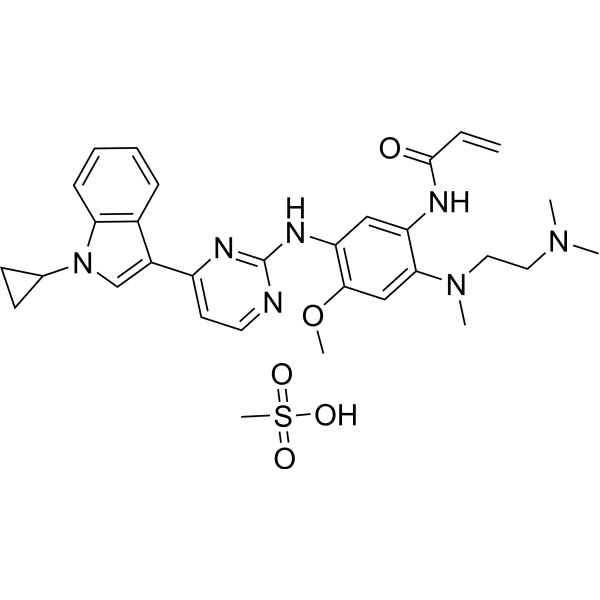
Physicochemical Properties
| Molecular Formula | C31H39N7O5S |
| Molecular Weight | 621.75 |
| Exact Mass | 621.273 |
| Elemental Analysis | C, 59.89; H, 6.32; N, 15.77; O, 12.87; S, 5.16 |
| CAS # | 2134096-06-1 |
| Related CAS # | Almonertinib;1899921-05-1;Almonertinib hydrochloride;2134096-03-8; Almonertinib mesylate;2134096-06-1;Almonertinib hydrochloride;2134096-03-8; 1899921-05-1; 2134096-04-9 (sulfate); 2134096-07-2 (fumarate); 2134096-08-3 |
| PubChem CID | 162368359 |
| Appearance | Typically exists as light yellow to yellow solids at room temperature |
| Hydrogen Bond Donor Count | 3 |
| Hydrogen Bond Acceptor Count | 10 |
| Rotatable Bond Count | 11 |
| Heavy Atom Count | 44 |
| Complexity | 916 |
| Defined Atom Stereocenter Count | 0 |
| InChi Key | WTEXJDGTVUQRQY-UHFFFAOYSA-N |
| InChi Code | InChI=1S/C30H35N7O2.CH4O3S/c1-6-29(38)32-24-17-25(28(39-5)18-27(24)36(4)16-15-35(2)3)34-30-31-14-13-23(33-30)22-19-37(20-11-12-20)26-10-8-7-9-21(22)26;1-5(2,3)4/h6-10,13-14,17-20H,1,11-12,15-16H2,2-5H3,(H,32,38)(H,31,33,34);1H3,(H,2,3,4) |
| Chemical Name | N-[5-[[4-(1-cyclopropylindol-3-yl)pyrimidin-2-yl]amino]-2-[2-(dimethylamino)ethyl-methylamino]-4-methoxyphenyl]prop-2-enamide;methanesulfonic acid |
| Synonyms | HS-10296 Mesylate; Aumolertinib mesylate; Almonertinib (mesylate); RZ6I9WX68U; Aumolertinib mesylate [USAN]; N-(5-((4-(1-cyclopropyl-1H-indol-3-yl)pyrimidin-2-yl)amino)-2-((2-(dimethylamino)ethyl)(methyl)amino)-4-methoxyphenyl)acrylamide mesylate; |
| HS Tariff Code | 2934.99.9001 |
| Storage |
Powder-20°C 3 years 4°C 2 years In solvent -80°C 6 months -20°C 1 month Note: Please store this product in a sealed and protected environment, avoid exposure to moisture. |
| Shipping Condition | Room temperature (This product is stable at ambient temperature for a few days during ordinary shipping and time spent in Customs) |
Biological Activity
| Targets | EGFRT790M (IC50 = 0.37 nM); EGFRL858R/T790M (IC50 = 0.29 nM); EGFRdel19 T790M (IC50 = 0.21 nM) |
| ln Vitro | NSCLC patients may benefit from the usage of HS-10296 mesylate, an oral epidermal growth factor receptor (EGFR) mutant T790M inhibitor with possible anti-tumor action [2]. Moreover, G719X, del19, L858R, and L861Q are among the various EGFR-sensitive mutations that HS-10296 mesylate can suppress [3]. |
| ln Vivo | The experimental results of nude mice showed that compared with the control group and the positive control ositinib (AZD9291) group, the tumor growth was significantly inhibited, the weight of nude mice, the tumor volume and the tumor mass were significantly reduced in the almonertinib treatment group (all P<0.05)[4]. |
| Cell Assay | NSCLC cells H1975 and PC-9 were cultured in vitro. The effects of almonertinib on the proliferation, apoptosis, invasion, and migration of H1975 and PC-9 cells were detected by CCK-8 assay, apoptotic assay and Transwell assay. The expression of invasion and migration related proteins was detected by Western blotting[4]. |
| Animal Protocol | Centrifuge H1975 cells, wash with PBS, and suspend in serum-free RPMI 1640 medium. Then inject 3 × 10⁶ cells per mouse subcutaneously into the right shoulder of 4-6 week old nude mice. After the tumor grows to 100 mm3, it will be randomly divided into three groups, with 5 mice in each group. Each group will be given 0.2 mL of dimethyl sulfoxide, 5 mg/kg AZD9291, and 5 mg/kg of amitinib by gavage, once every two days. Monitor the weight and tumor size of nude mice before each injection. The tumor volume is 2/2 of its length and width, and the entire process lasts for 21 days[4]. |
| References |
[1]. Safety, Efficacy, and Pharmacokinetics of Almonertinib (HS-10296) in Pretreated Patients With EGFR-Mutated Advanced NSCLC: A Multicenter, Open-label, Phase 1 Trial [published online ahead of print, 2020 Sep 9]. J Thorac Oncol. 2020;S1556-0.
[2]. Next-Generation EGFR Tyrosine Kinase Inhibitors for Treating EGFR-Mutant Lung Cancer beyond First Line. Front Med (Lausanne). 2017 Jan 18;3:76. [3]. Management of acquired resistance to EGFR TKI-targeted therapy in advanced non-small cell lung cancer. Mol Cancer. 2018 Feb 19;17(1):38. [4]. Effect of almonertinib on the proliferation, invasion, and migration in non-small cell lung cancer cells. Zhong Nan Da Xue Xue Bao Yi Xue Ban . 2021 Oct 28;46(10):1045-1053. |
Solubility Data
| Solubility (In Vitro) | DMSO : ~31.25 mg/mL (~50.26 mM) |
| Solubility (In Vivo) |
Note: Listed below are some common formulations that may be used to formulate products with low water solubility (e.g. < 1 mg/mL), you may test these formulations using a minute amount of products to avoid loss of samples. Injection Formulations (e.g. IP/IV/IM/SC) Injection Formulation 1: DMSO : Tween 80: Saline = 10 : 5 : 85 (i.e. 100 μL DMSO stock solution → 50 μL Tween 80 → 850 μL Saline) *Preparation of saline: Dissolve 0.9 g of sodium chloride in 100 mL ddH ₂ O to obtain a clear solution. Injection Formulation 2: DMSO : PEG300 :Tween 80 : Saline = 10 : 40 : 5 : 45 (i.e. 100 μL DMSO → 400 μLPEG300 → 50 μL Tween 80 → 450 μL Saline) Injection Formulation 3: DMSO : Corn oil = 10 : 90 (i.e. 100 μL DMSO → 900 μL Corn oil) Example: Take the Injection Formulation 3 (DMSO : Corn oil = 10 : 90) as an example, if 1 mL of 2.5 mg/mL working solution is to be prepared, you can take 100 μL 25 mg/mL DMSO stock solution and add to 900 μL corn oil, mix well to obtain a clear or suspension solution (2.5 mg/mL, ready for use in animals). Injection Formulation 4: DMSO : 20% SBE-β-CD in saline = 10 : 90 [i.e. 100 μL DMSO → 900 μL (20% SBE-β-CD in saline)] *Preparation of 20% SBE-β-CD in Saline (4°C,1 week): Dissolve 2 g SBE-β-CD in 10 mL saline to obtain a clear solution. Injection Formulation 5: 2-Hydroxypropyl-β-cyclodextrin : Saline = 50 : 50 (i.e. 500 μL 2-Hydroxypropyl-β-cyclodextrin → 500 μL Saline) Injection Formulation 6: DMSO : PEG300 : castor oil : Saline = 5 : 10 : 20 : 65 (i.e. 50 μL DMSO → 100 μLPEG300 → 200 μL castor oil → 650 μL Saline) Injection Formulation 7: Ethanol : Cremophor : Saline = 10: 10 : 80 (i.e. 100 μL Ethanol → 100 μL Cremophor → 800 μL Saline) Injection Formulation 8: Dissolve in Cremophor/Ethanol (50 : 50), then diluted by Saline Injection Formulation 9: EtOH : Corn oil = 10 : 90 (i.e. 100 μL EtOH → 900 μL Corn oil) Injection Formulation 10: EtOH : PEG300:Tween 80 : Saline = 10 : 40 : 5 : 45 (i.e. 100 μL EtOH → 400 μLPEG300 → 50 μL Tween 80 → 450 μL Saline) Oral Formulations Oral Formulation 1: Suspend in 0.5% CMC Na (carboxymethylcellulose sodium) Oral Formulation 2: Suspend in 0.5% Carboxymethyl cellulose Example: Take the Oral Formulation 1 (Suspend in 0.5% CMC Na) as an example, if 100 mL of 2.5 mg/mL working solution is to be prepared, you can first prepare 0.5% CMC Na solution by measuring 0.5 g CMC Na and dissolve it in 100 mL ddH2O to obtain a clear solution; then add 250 mg of the product to 100 mL 0.5% CMC Na solution, to make the suspension solution (2.5 mg/mL, ready for use in animals). Oral Formulation 3: Dissolved in PEG400 Oral Formulation 4: Suspend in 0.2% Carboxymethyl cellulose Oral Formulation 5: Dissolve in 0.25% Tween 80 and 0.5% Carboxymethyl cellulose Oral Formulation 6: Mixing with food powders Note: Please be aware that the above formulations are for reference only. InvivoChem strongly recommends customers to read literature methods/protocols carefully before determining which formulation you should use for in vivo studies, as different compounds have different solubility properties and have to be formulated differently. (Please use freshly prepared in vivo formulations for optimal results.) |
| Preparing Stock Solutions | 1 mg | 5 mg | 10 mg | |
| 1 mM | 1.6084 mL | 8.0418 mL | 16.0836 mL | |
| 5 mM | 0.3217 mL | 1.6084 mL | 3.2167 mL | |
| 10 mM | 0.1608 mL | 0.8042 mL | 1.6084 mL |