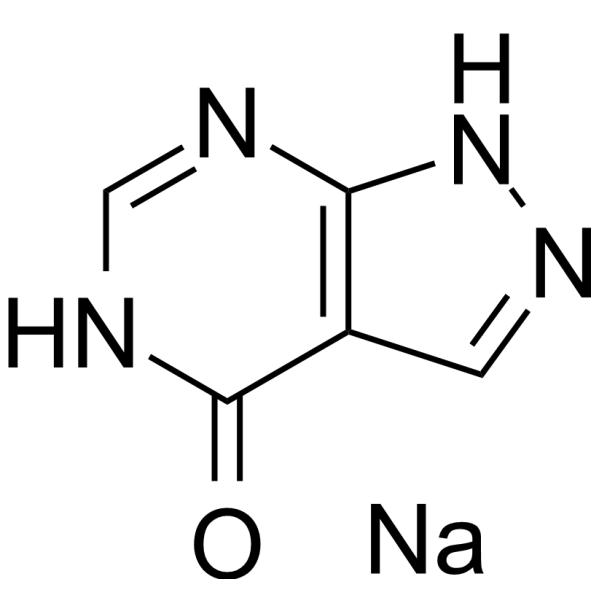
Physicochemical Properties
| Molecular Formula | C5H3N4O-.NA+ |
| Molecular Weight | 158.09332 |
| Exact Mass | 158.02 |
| CAS # | 17795-21-0 |
| Related CAS # | Allopurinol;315-30-0 |
| PubChem CID | 135566116 |
| Appearance | White to off-white solid powder |
| LogP | 0.496 |
| Hydrogen Bond Donor Count | 1 |
| Hydrogen Bond Acceptor Count | 4 |
| Rotatable Bond Count | 0 |
| Heavy Atom Count | 11 |
| Complexity | 195 |
| Defined Atom Stereocenter Count | 0 |
| InChi Key | PTJRZVJXXNYNLN-UHFFFAOYSA-M |
| InChi Code | InChI=1S/C5H4N4O.Na/c10-5-3-1-8-9-4(3)6-2-7-5;/h1-2H,(H2,6,7,8,9,10);/q;+1/p-1 |
| Chemical Name | sodium;5H-pyrazolo[3,4-d]pyrimidin-1-id-4-one |
| HS Tariff Code | 2934.99.9001 |
| Storage |
Powder-20°C 3 years 4°C 2 years In solvent -80°C 6 months -20°C 1 month Note: Please store this product in a sealed and protected environment, avoid exposure to moisture. |
| Shipping Condition | Room temperature (This product is stable at ambient temperature for a few days during ordinary shipping and time spent in Customs) |
Biological Activity
| ln Vitro | In HFF and HUVEC cells, allopurinol sodium (0, 10, 100, 1000 µg/ml; 17 hours) can decrease HIF-1α and HIF-2α protein expression [5]. HUVEC cells' angiogenic characteristics can be diminished by allopurinol sodium (0, 10, 100, or 1000 µg/ml; 24 hours) [5]. |
| ln Vivo | Allopurinol sodium (39 mg/kg; oral; daily for 21 days) showed antidepressant effect in rats [3]. Allopurinol sodium (10-400 mg/kg; i.p.) causes antinociceptive action in mice [4]. |
| Cell Assay |
Western Blot Analysis[5] Cell Types: HFF, HUVEC Cell Tested Concentrations: 0, 10, 100, 1000 µg/ml Incubation Duration: 17 hrs (hours) Experimental Results: HIF-1α and HIF-2α protein expression diminished in a dose-dependent manner. |
| Animal Protocol |
Animal/Disease Models: 20-30 g, male Swiss albino mouse [3] Doses: 39 mg/kg Route of Administration: oral; one time/day for 21 days Experimental Results: diminished immobility time in FST, immobility time was 129.8± 10.5 seconds. Animal/Disease Models: 30-40 g, male adult Swiss albino mouse [4] Doses: 10, 50, 100, 200, 400 mg/kg Route of Administration: intraperitoneal (ip) injection Experimental Results: Dose dependence in tail flick and thermal stimulation Sexual antinociceptive effects plate. |
| References |
[1]. Therapeutic effects of xanthine oxidase inhibitors: renaissance half a century after the discovery of allopurinol. Pharmacol Rev. 2006;58(1):87-114. [2]. Antileishmanial effect of allopurinol. Antimicrob Agents Chemother. 1974;5(5):469-472. [3]. Evaluation of effect of allopurinol and febuxostat in behavioral model of depression in mice. Indian J Pharmacol. 2013 May-Jun;45(3):244-7. [4]. Anti-nociceptive properties of the xanthine oxidase inhibitor allopurinol in mice: role of A1 adenosine receptors. Br J Pharmacol. 2009 Jan;156(1):163-72. [5]. Dose-dependent effects of allopurinol on human foreskin fibroblast cells and human umbilical vein endothelial cells under hypoxia. PLoS One. 2015 Apr 1;10(4):e0123649. |
| Additional Infomation |
Allopurinol Sodium is the sodium form of allopurinol, which is a structural isomer of hypoxanthine. Allopurinol inhibits xanthine oxidase, an enzyme that converts oxypurines to uric acid. By blocking the production of uric acid, this agent decreases serum and urine concentrations of uric acid, thereby providing protection against uric acid-mediated end organ damage in conditions associated with excessive production of uric acid, i.e. the massive cell lysis associated with the treatment of some malignancies. (NCI04) See also: Allopurinol Sodium (preferred); Allopurinol (has active moiety). |
Solubility Data
| Solubility (In Vitro) | H2O : ~50 mg/mL (~314.27 mM) |
| Solubility (In Vivo) |
Note: Listed below are some common formulations that may be used to formulate products with low water solubility (e.g. < 1 mg/mL), you may test these formulations using a minute amount of products to avoid loss of samples. Injection Formulations (e.g. IP/IV/IM/SC) Injection Formulation 1: DMSO : Tween 80: Saline = 10 : 5 : 85 (i.e. 100 μL DMSO stock solution → 50 μL Tween 80 → 850 μL Saline) *Preparation of saline: Dissolve 0.9 g of sodium chloride in 100 mL ddH ₂ O to obtain a clear solution. Injection Formulation 2: DMSO : PEG300 :Tween 80 : Saline = 10 : 40 : 5 : 45 (i.e. 100 μL DMSO → 400 μLPEG300 → 50 μL Tween 80 → 450 μL Saline) Injection Formulation 3: DMSO : Corn oil = 10 : 90 (i.e. 100 μL DMSO → 900 μL Corn oil) Example: Take the Injection Formulation 3 (DMSO : Corn oil = 10 : 90) as an example, if 1 mL of 2.5 mg/mL working solution is to be prepared, you can take 100 μL 25 mg/mL DMSO stock solution and add to 900 μL corn oil, mix well to obtain a clear or suspension solution (2.5 mg/mL, ready for use in animals). Injection Formulation 4: DMSO : 20% SBE-β-CD in saline = 10 : 90 [i.e. 100 μL DMSO → 900 μL (20% SBE-β-CD in saline)] *Preparation of 20% SBE-β-CD in Saline (4°C,1 week): Dissolve 2 g SBE-β-CD in 10 mL saline to obtain a clear solution. Injection Formulation 5: 2-Hydroxypropyl-β-cyclodextrin : Saline = 50 : 50 (i.e. 500 μL 2-Hydroxypropyl-β-cyclodextrin → 500 μL Saline) Injection Formulation 6: DMSO : PEG300 : castor oil : Saline = 5 : 10 : 20 : 65 (i.e. 50 μL DMSO → 100 μLPEG300 → 200 μL castor oil → 650 μL Saline) Injection Formulation 7: Ethanol : Cremophor : Saline = 10: 10 : 80 (i.e. 100 μL Ethanol → 100 μL Cremophor → 800 μL Saline) Injection Formulation 8: Dissolve in Cremophor/Ethanol (50 : 50), then diluted by Saline Injection Formulation 9: EtOH : Corn oil = 10 : 90 (i.e. 100 μL EtOH → 900 μL Corn oil) Injection Formulation 10: EtOH : PEG300:Tween 80 : Saline = 10 : 40 : 5 : 45 (i.e. 100 μL EtOH → 400 μLPEG300 → 50 μL Tween 80 → 450 μL Saline) Oral Formulations Oral Formulation 1: Suspend in 0.5% CMC Na (carboxymethylcellulose sodium) Oral Formulation 2: Suspend in 0.5% Carboxymethyl cellulose Example: Take the Oral Formulation 1 (Suspend in 0.5% CMC Na) as an example, if 100 mL of 2.5 mg/mL working solution is to be prepared, you can first prepare 0.5% CMC Na solution by measuring 0.5 g CMC Na and dissolve it in 100 mL ddH2O to obtain a clear solution; then add 250 mg of the product to 100 mL 0.5% CMC Na solution, to make the suspension solution (2.5 mg/mL, ready for use in animals). Oral Formulation 3: Dissolved in PEG400 Oral Formulation 4: Suspend in 0.2% Carboxymethyl cellulose Oral Formulation 5: Dissolve in 0.25% Tween 80 and 0.5% Carboxymethyl cellulose Oral Formulation 6: Mixing with food powders Note: Please be aware that the above formulations are for reference only. InvivoChem strongly recommends customers to read literature methods/protocols carefully before determining which formulation you should use for in vivo studies, as different compounds have different solubility properties and have to be formulated differently. (Please use freshly prepared in vivo formulations for optimal results.) |
| Preparing Stock Solutions | 1 mg | 5 mg | 10 mg | |
| 1 mM | 6.3255 mL | 31.6276 mL | 63.2551 mL | |
| 5 mM | 1.2651 mL | 6.3255 mL | 12.6510 mL | |
| 10 mM | 0.6326 mL | 3.1628 mL | 6.3255 mL |