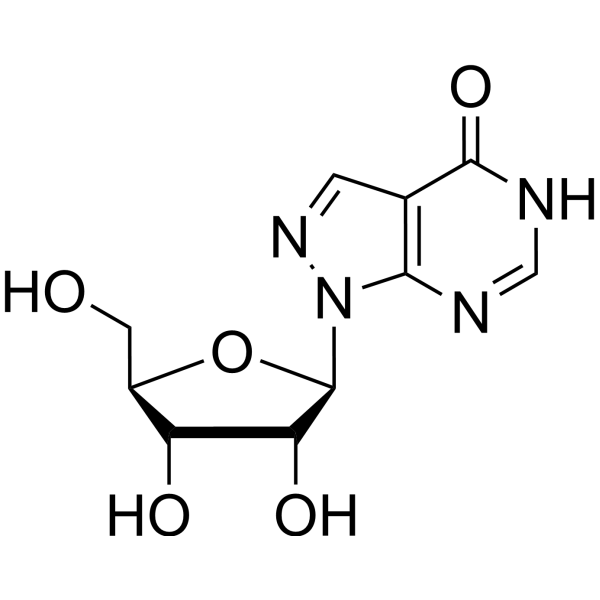
Physicochemical Properties
| Molecular Formula | C10H12N4O5 |
| Molecular Weight | 268.22608 |
| Exact Mass | 268.081 |
| CAS # | 16220-07-8 |
| Related CAS # | 16220-07-8 (ribonucleoside);315-30-0 (free); |
| PubChem CID | 135407110 |
| Appearance | White to off-white solid powder |
| Density | 2.08g/cm3 |
| Boiling Point | 570.9ºC at 760mmHg |
| Flash Point | 299ºC |
| Vapour Pressure | 3.62E-15mmHg at 25°C |
| Index of Refraction | 1.925 |
| LogP | -2.3 |
| Hydrogen Bond Donor Count | 4 |
| Hydrogen Bond Acceptor Count | 7 |
| Rotatable Bond Count | 2 |
| Heavy Atom Count | 19 |
| Complexity | 405 |
| Defined Atom Stereocenter Count | 4 |
| SMILES | C1=NN(C2=C1C(=O)NC=N2)[C@H]3[C@@H]([C@@H]([C@H](O3)CO)O)O |
| InChi Key | KFQUAMTWOJHPEJ-DAGMQNCNSA-N |
| InChi Code | InChI=1S/C10H12N4O5/c15-2-5-6(16)7(17)10(19-5)14-8-4(1-13-14)9(18)12-3-11-8/h1,3,5-7,10,15-17H,2H2,(H,11,12,18)/t5-,6-,7-,10-/m1/s1 |
| Chemical Name | 1-[(2R,3R,4S,5R)-3,4-dihydroxy-5-(hydroxymethyl)oxolan-2-yl]-5H-pyrazolo[3,4-d]pyrimidin-4-one |
| HS Tariff Code | 2934.99.9001 |
| Storage |
Powder-20°C 3 years 4°C 2 years In solvent -80°C 6 months -20°C 1 month |
| Shipping Condition | Room temperature (This product is stable at ambient temperature for a few days during ordinary shipping and time spent in Customs) |
Biological Activity
| Targets | Allopurinol nucleoside competitively inhibits the action of purine nucleoside phosphorylase on inosine, with a Ki of 277 μM. In a concentration-dependent way, allopurinol nucleoside markedly reduced the lymphocyte blastogenesis generated by PHA and Con A. When LPS was employed as a mitogen, the inhibitory impact of allopurinol-nucleoside lymphocyte proliferation was less noticeable. Allopurinol nucleoside does not suppress humoral immunity [1]. An investigational medication called allopurinol nucleoside is being used to treat Chagas disease and leishmaniasis. Allopurinol nucleoside is effective against parasites because a set of enzymes (similar to those in the body that mediate purine recycling) transform it into 4-aminopyrazolopyrimidine ribonucleoside triphosphate, a cytotoxic compound. Allopurinol nucleoside is selectively hazardous because it is not digested by the appropriate enzymes in the human body [2]. |
| ln Vitro |
Allopurinol nucleoside competitively inhibits the action of purine nucleoside phosphorylase on inosine, with a Ki of 277 μM. In a concentration-dependent way, allopurinol nucleoside markedly reduced the lymphocyte blastogenesis generated by PHA and Con A. When LPS was employed as a mitogen, the inhibitory impact of allopurinol-nucleoside lymphocyte proliferation was less noticeable. Allopurinol nucleoside does not suppress humoral immunity [1]. An investigational medication called allopurinol nucleoside is being used to treat Chagas disease and leishmaniasis. Allopurinol nucleoside is effective against parasites because a set of enzymes (similar to those in the body that mediate purine recycling) transform it into 4-aminopyrazolopyrimidine ribonucleoside triphosphate, a cytotoxic compound. Allopurinol nucleoside is selectively hazardous because it is not digested by the appropriate enzymes in the human body [2]. Allopurinol riboside competitively inhibited the action of PNP on inosine in vitro, achieving 50% inhibition at a concentration of 277 µmol (Ki = 277 µmol) [1]. After incubation of Allopurinol riboside with PNP, allopurinol was not formed, indicating it is not cleaved by PNP under the tested conditions [1]. In cultures of human peripheral blood lymphocytes, Allopurinol riboside significantly and dose-dependently suppressed blastogenesis (measured by ³H-thymidine incorporation) induced by the T-cell mitogens phytohemagglutinin (PHA) and concanavalin A (Con A). Inhibition was marked at concentrations of 2.5, 5, and 10 mM [1]. The inhibitory effect of Allopurinol riboside on lymphocyte proliferation induced by the B-cell mitogen lipopolysaccharide (LPS) was less pronounced compared to its effect on PHA and Con A responses. Inhibition of pokeweed mitogen (PWM)-induced proliferation was also observed but was less marked than for PHA/Con A [1]. |
| ln Vivo |
The elimination half-life of allopurinol nucleoside is three hours, and its steady-state concentrations remain within the therapeutic range [3]. The nucleoside peaks in plasma 1.6 hours after administration. Allopurinol nucleoside plasma levels are surprisingly low after oral administration because of incomplete absorption and quick renal clearance. Probenecid triples the levels of allopurinol nucleoside in plasma, prolongs its half-life in plasma, and reduces the renal clearance of allopurinol nucleoside [4]. In mice immunized with sheep red blood cells (SRBC), intramuscular administration of Allopurinol riboside (1 mg/g body weight/day for 7 days) did not suppress the humoral immune response, as measured by serum hemagglutinin titers, compared to control mice [1]. In the same mouse model, intramuscular administration of Allopurinol riboside (1 mg/g body weight/day for 5 days) significantly suppressed the cellular immune (delayed-type hypersensitivity) response to SRBC. The footpad swelling in treated mice was 4.3 ± 1.4 mg compared to 17.9 ± 3.3 mg in control mice [1]. |
| Enzyme Assay |
PNP activity was determined using a spectrophotometric method. The reaction mixture (final volume 3 ml) contained inosine (½ to ⅓ mM) as a substrate in 0.05 M phosphate buffer (pH 7.5), with or without 1.5 mM Allopurinol riboside. After adding xanthine oxidase and PNP to initiate the reaction, the increase in optical density at 293 nm was recorded. Xanthine oxidase activity was confirmed not to be inhibited by Allopurinol riboside [1]. To test for conversion of the drug, Allopurinol riboside was incubated with PNP in phosphate buffer at 37°C for 30 minutes. The reaction mixture was analyzed by thin-layer chromatography (using a butanol:methanol:water:ammonia solvent system) and by high-pressure liquid chromatography (using an ammonium acetate buffer at pH 4.0) to detect the possible formation of allopurinol [1]. |
| Cell Assay |
Human peripheral blood lymphocytes were isolated from heparinized blood using Ficoll-hypaque density gradient centrifugation. Cells were washed and resuspended in RPMI-1640 medium supplemented with fetal calf serum and antibiotics at a concentration of 1 x 10⁶ cells/ml [1]. For proliferation assays, 1 x 10⁵ cells in 100 µl of culture medium containing various concentrations (0, 2.5, 5, 10 mM) of sterilized Allopurinol riboside were placed into microplate wells. An equal volume (100 µl) of medium containing a mitogen (PHA, Con A, PWM, LPS) or control medium was added. Final mitogen concentrations were: PHA (4 µg/ml), Con A (50 µg/ml), PWM (1:100 dilution), LPS (1000 µg/ml) [1]. Cultures were incubated for 5 days at 37°C in a humidified 5% CO₂ atmosphere. For the final 24 hours, 1 µCi of ³H-thymidine was added to each well. Cells were harvested onto glass-fiber filters, and incorporated radioactivity was measured by liquid scintillation counting. Results were expressed as net counts per 10 minutes per 1 x 10⁵ cells [1]. |
| Animal Protocol |
For evaluation of humoral immunity, groups of 4-6 week old mice were injected intraperitoneally with 1 x 10⁸ SRBC. One group (n=10) was treated by intramuscular injection with Allopurinol riboside at a dose of 1 mg per gram of body weight per day for 7 consecutive days. The control group (n=10) did not receive the drug. Seven days after SRBC immunization, blood was collected by cardiac puncture, serum was separated, and hemagglutinin titers were measured using a microtitration assay with 1% SRBC [1]. For evaluation of cellular immunity (delayed-type hypersensitivity), a separate group of mice was first sensitized by intraperitoneal injection of 5 x 10⁵ SRBC. One group (n=10) was then treated by intramuscular injection with Allopurinol riboside at a dose of 1 mg/g/day for 5 consecutive days. The control group (n=10) was not treated. Five days after sensitization, all mice were challenged by injecting 1 x 10⁸ SRBC in 50 µl into the left footpad. Twenty-four hours later, the increase in left footpad weight was measured as an indicator of swelling [1]. |
| References |
[1]. Inhibition of purine nucleoside phosphorylase activity and of T-cell function with allopurinol-riboside. Agents Actions. 1979 Dec;9(5-6):549-52. [2]. Therapeutic effects of xanthine oxidase inhibitors: renaissance half a century after the discovery of allopurinol. Pharmacol Rev. 2006 Mar;58(1):87-114. [3]. Pharmacokinetics and metabolism of allopurinol riboside. Clin Pharmacol Ther. 1991 May;49(5):506-14. [4]. Effects of probenecid on the pharmacokinetics of allopurinol riboside. Antimicrob Agents Chemother. 1993 May;37(5):1193-6. |
| Additional Infomation |
Allopurinol riboside is a nucleoside analogue that is allopurinol with a beta-D-ribofuranosyl moiety at the 1-position. It has a role as a metabolite. It is functionally related to an allopurinol. Allopurinol riboside is a nucleoside analogue of [allopurinol] with a beta-D-ribofuranosyl moiety at the 1-position. Allopurinol riboside has been reported in Trypanosoma brucei with data available. Allopurinol riboside is proposed as an experimental tool to create a model of PNP deficiency, analogous to the genetic disorder where T-cell immunity is defective but B-cell immunity is intact [1]. The mechanism of action is competitive inhibition of PNP. This inhibition is suggested to potentially lead to the intracellular accumulation of nucleosides like inosine and guanosine, which may be responsible for the observed suppression of T-cell function [1]. The results suggest that Allopurinol riboside may be a useful inhibitor of cellular (T-cell mediated) immunity, with a preferential effect on T-cell responses compared to B-cell responses [1]. The drug was not metabolized to allopurinol by PNP under the in vitro conditions tested [1]. |
Solubility Data
| Solubility (In Vitro) | DMSO : ~100 mg/mL (~372.81 mM) |
| Solubility (In Vivo) |
Solubility in Formulation 1: ≥ 2.5 mg/mL (9.32 mM) (saturation unknown) in 10% DMSO + 40% PEG300 + 5% Tween80 + 45% Saline (add these co-solvents sequentially from left to right, and one by one), clear solution. For example, if 1 mL of working solution is to be prepared, you can add 100 μL of 25.0 mg/mL clear DMSO stock solution to 400 μL PEG300 and mix evenly; then add 50 μL Tween-80 to the above solution and mix evenly; then add 450 μL normal saline to adjust the volume to 1 mL. Preparation of saline: Dissolve 0.9 g of sodium chloride in 100 mL ddH₂ O to obtain a clear solution. Solubility in Formulation 2: ≥ 2.5 mg/mL (9.32 mM) (saturation unknown) in 10% DMSO + 90% (20% SBE-β-CD in Saline) (add these co-solvents sequentially from left to right, and one by one), clear solution. For example, if 1 mL of working solution is to be prepared, you can add 100 μL of 25.0 mg/mL clear DMSO stock solution to 900 μL of 20% SBE-β-CD physiological saline solution and mix evenly. Preparation of 20% SBE-β-CD in Saline (4°C,1 week): Dissolve 2 g SBE-β-CD in 10 mL saline to obtain a clear solution. Solubility in Formulation 3: ≥ 2.5 mg/mL (9.32 mM) (saturation unknown) in 10% DMSO + 90% Corn Oil (add these co-solvents sequentially from left to right, and one by one), clear solution. For example, if 1 mL of working solution is to be prepared, you can add 100 μL of 25.0 mg/mL clear DMSO stock solution to 900 μL of corn oil and mix evenly. (Please use freshly prepared in vivo formulations for optimal results.) |
| Preparing Stock Solutions | 1 mg | 5 mg | 10 mg | |
| 1 mM | 3.7281 mL | 18.6407 mL | 37.2814 mL | |
| 5 mM | 0.7456 mL | 3.7281 mL | 7.4563 mL | |
| 10 mM | 0.3728 mL | 1.8641 mL | 3.7281 mL |