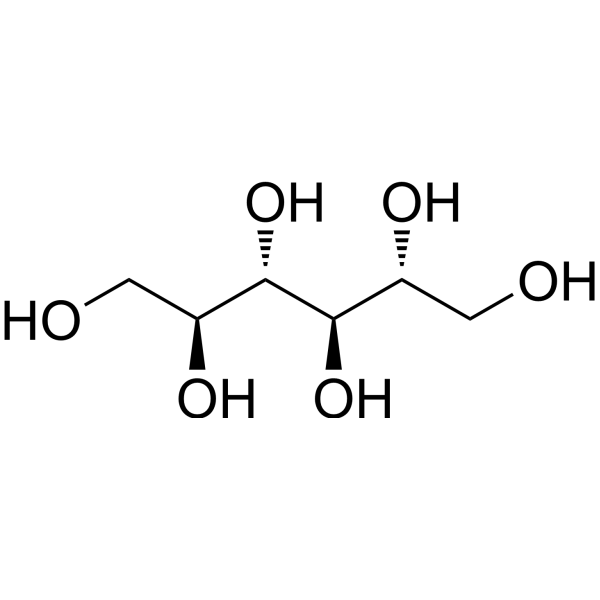
Physicochemical Properties
| Molecular Formula | C6H14O6 |
| Molecular Weight | 182.1718 |
| Exact Mass | 182.079 |
| CAS # | 488-44-8 |
| Related CAS # | Allitol-13C |
| PubChem CID | 120700 |
| Appearance | White to off-white solid powder |
| Density | 1.6±0.1 g/cm3 |
| Boiling Point | 494.9±0.0 °C at 760 mmHg |
| Melting Point | 152 °C |
| Flash Point | 292.5±23.3 °C |
| Vapour Pressure | 0.0±2.8 mmHg at 25°C |
| Index of Refraction | 1.597 |
| LogP | -4.67 |
| Hydrogen Bond Donor Count | 6 |
| Hydrogen Bond Acceptor Count | 6 |
| Rotatable Bond Count | 5 |
| Heavy Atom Count | 12 |
| Complexity | 105 |
| Defined Atom Stereocenter Count | 4 |
| SMILES | C([C@H]([C@H]([C@H]([C@H](CO)O)O)O)O)O |
| InChi Key | FBPFZTCFMRRESA-FBXFSONDSA-N |
| InChi Code | InChI=1S/C6H14O6/c7-1-3(9)5(11)6(12)4(10)2-8/h3-12H,1-2H2/t3-,4+,5-,6+ |
| Chemical Name | (2R,3R,4S,5S)-hexane-1,2,3,4,5,6-hexol |
| HS Tariff Code | 2934.99.9001 |
| Storage |
Powder-20°C 3 years 4°C 2 years In solvent -80°C 6 months -20°C 1 month Note: Please store this product in a sealed and protected environment (e.g. under nitrogen), avoid exposure to moisture and light. |
| Shipping Condition | Room temperature (This product is stable at ambient temperature for a few days during ordinary shipping and time spent in Customs) |
Biological Activity
| Enzyme Assay |
- D-Aldose 3-Epimerase (DAE) Activity Assay: The enzyme DAE, which catalyzes the conversion of D-fructose to D-psicose (a precursor of Allitol), was purified from recombinant Escherichia coli. The assay mixture contained D-fructose (50 mM), enzyme solution, and buffer (pH 7.5). The reaction was incubated at 37°C for 30 minutes, then terminated by heating at 95°C for 5 minutes. The amount of D-psicose produced (indicator of DAE activity) was quantified via high-performance liquid chromatography (HPLC) with a refractive index detector (RID), using a carbohydrate analysis column. [1] - D-Psicose Reductase (DAR) Activity Assay: DAR, which reduces D-psicose to Allitol, was extracted from engineered E. coli. The assay system included D-psicose (20 mM), NADPH (0.2 mM), enzyme extract, and buffer (pH 6.0). The reaction was carried out at 30°C, and the decrease in absorbance at 340 nm (due to NADPH oxidation) was measured continuously for 10 minutes to calculate DAR activity. The formation of Allitol was further confirmed by HPLC-RID analysis of the reaction product. [1] |
| Cell Assay |
- Engineered E. coli Construction and Cultivation for Allitol Production: Plasmids carrying genes encoding DAE and DAR (key enzymes for Allitol synthesis) were co-transformed into E. coli cells. Transformed cells were inoculated into LB medium containing selective antibiotics and cultured at 37°C with shaking (200 rpm) until the optical density at 600 nm (OD₆₀₀) reached 0.6–0.8. Isopropyl β-D-1-thiogalactopyranoside (IPTG) was added to induce enzyme expression, and the culture was continued at 30°C for 4 hours. [1] - Allitol Production and Quantification in E. coli Cultures: After induction, D-fructose (100 mM final concentration) was added to the E. coli culture as the substrate for Allitol synthesis. The culture was incubated at 30°C with shaking (180 rpm) for 24 hours. At 6-hour intervals, 1 mL of culture was centrifuged (12,000 × g for 10 minutes), and the supernatant was filtered through a 0.22 μm membrane. The concentration of Allitol in the filtrate was determined by HPLC-RID with a carbohydrate column, using a standard curve of pure Allitol. [1] |
| References |
[1]. Construction of allitol synthesis pathway by multi-enzyme coexpression in Escherichia coli and its application in allitol production. J Ind Microbiol Biotechnol. 2015 May;42(5):661-9. |
| Additional Infomation |
Allitol is a hexitol. Allitol has been reported in Tuber indicum, Aspergillus silvaticus, and other organisms with data available. See also: Sorbitol (annotation moved to). - Allitol Synthesis Pathway Background: The study constructed a heterologous Allitol synthesis pathway in E. coli, which consists of two key steps: 1) D-fructose is converted to D-psicose by DAE; 2) D-psicose is reduced to Allitol by DAR using NADPH as a cofactor. This pathway enables E. coli to produce Allitol directly from D-fructose, a low-cost substrate. [1] - Allitol Production Efficiency: The engineered E. coli strain (co-expressing DAE and DAR) achieved a Allitol yield of approximately 45 g/L from 100 mM D-fructose after 24 hours of fermentation, with a substrate conversion rate of ~48%. No by-products (e.g., other polyols) were detected in significant amounts, indicating high pathway specificity. [1] - Industrial Application Potential: Allitol is a low-calorie polyol with potential applications in food and pharmaceutical industries (e.g., as a sweetener or excipient). The study demonstrated a cost-effective microbial fermentation method for Allitol production, providing a basis for large-scale industrial manufacturing. [1] |
Solubility Data
| Solubility (In Vitro) | DMSO : ~50 mg/mL (~274.47 mM) |
| Solubility (In Vivo) |
Solubility in Formulation 1: ≥ 2.5 mg/mL (13.72 mM) (saturation unknown) in 10% DMSO + 40% PEG300 + 5% Tween80 + 45% Saline (add these co-solvents sequentially from left to right, and one by one), clear solution. For example, if 1 mL of working solution is to be prepared, you can add 100 μL of 25.0 mg/mL clear DMSO stock solution to 400 μL PEG300 and mix evenly; then add 50 μL Tween-80 to the above solution and mix evenly; then add 450 μL normal saline to adjust the volume to 1 mL. Preparation of saline: Dissolve 0.9 g of sodium chloride in 100 mL ddH₂ O to obtain a clear solution. Solubility in Formulation 2: ≥ 2.5 mg/mL (13.72 mM) (saturation unknown) in 10% DMSO + 90% (20% SBE-β-CD in Saline) (add these co-solvents sequentially from left to right, and one by one), clear solution. For example, if 1 mL of working solution is to be prepared, you can add 100 μL of 25.0 mg/mL clear DMSO stock solution to 900 μL of 20% SBE-β-CD physiological saline solution and mix evenly. Preparation of 20% SBE-β-CD in Saline (4°C,1 week): Dissolve 2 g SBE-β-CD in 10 mL saline to obtain a clear solution. Solubility in Formulation 3: ≥ 2.5 mg/mL (13.72 mM) (saturation unknown) in 10% DMSO + 90% Corn Oil (add these co-solvents sequentially from left to right, and one by one), clear solution. For example, if 1 mL of working solution is to be prepared, you can add 100 μL of 25.0 mg/mL clear DMSO stock solution to 900 μL of corn oil and mix evenly. (Please use freshly prepared in vivo formulations for optimal results.) |
| Preparing Stock Solutions | 1 mg | 5 mg | 10 mg | |
| 1 mM | 5.4894 mL | 27.4469 mL | 54.8938 mL | |
| 5 mM | 1.0979 mL | 5.4894 mL | 10.9788 mL | |
| 10 mM | 0.5489 mL | 2.7447 mL | 5.4894 mL |