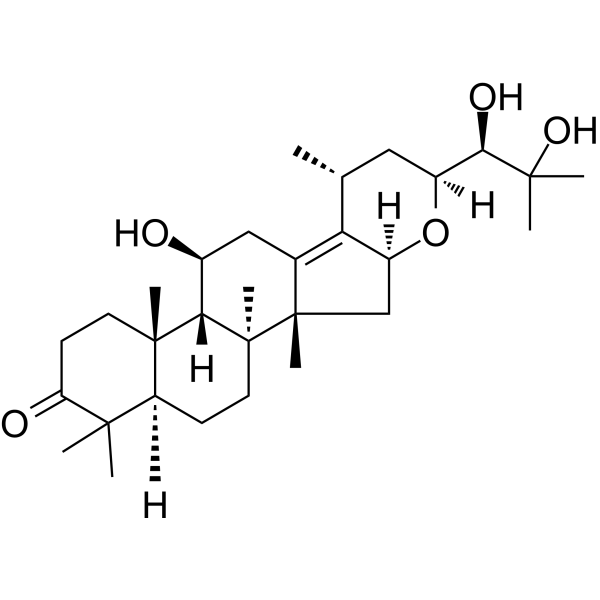
Physicochemical Properties
| Molecular Formula | C30H48O5 |
| Molecular Weight | 488.6991 |
| Exact Mass | 488.35 |
| CAS # | 155521-45-2 |
| PubChem CID | 76310822 |
| Appearance | White to off-white solid powder |
| Density | 1.2±0.1 g/cm3 |
| Boiling Point | 617.4±55.0 °C at 760 mmHg |
| Flash Point | 194.6±25.0 °C |
| Vapour Pressure | 0.0±4.0 mmHg at 25°C |
| Index of Refraction | 1.565 |
| LogP | 3.77 |
| Hydrogen Bond Donor Count | 3 |
| Hydrogen Bond Acceptor Count | 5 |
| Rotatable Bond Count | 2 |
| Heavy Atom Count | 35 |
| Complexity | 950 |
| Defined Atom Stereocenter Count | 10 |
| SMILES | C[C@@H]1C[C@H](O[C@@H]2C1=C3C[C@@H]([C@H]4[C@]5(CCC(=O)C([C@@H]5CC[C@@]4([C@]3(C2)C)C)(C)C)C)O)[C@H](C(C)(C)O)O |
| InChi Key | YNKJSQIXVXWFBK-SLGDLKFASA-N |
| InChi Code | InChI=1S/C30H48O5/c1-16-13-19(25(33)27(4,5)34)35-20-15-30(8)17(23(16)20)14-18(31)24-28(6)11-10-22(32)26(2,3)21(28)9-12-29(24,30)7/h16,18-21,24-25,31,33-34H,9-15H2,1-8H3/t16-,18+,19+,20+,21+,24+,25-,28+,29+,30+/m1/s1 |
| Chemical Name | (1S,2R,4S,6S,8R,12S,13S,14S,19R)-6-[(1R)-1,2-dihydroxy-2-methylpropyl]-12-hydroxy-1,2,8,14,18,18-hexamethyl-5-oxapentacyclo[11.8.0.02,10.04,9.014,19]henicos-9-en-17-one |
| HS Tariff Code | 2934.99.9001 |
| Storage |
Powder-20°C 3 years 4°C 2 years In solvent -80°C 6 months -20°C 1 month |
| Shipping Condition | Room temperature (This product is stable at ambient temperature for a few days during ordinary shipping and time spent in Customs) |
Biological Activity
| ln Vitro |
In the HBV-transfected Hep G2.2.15 cell line, Alisol F exhibited inhibitory activity against hepatitis B virus surface antigen (HBsAg) secretion with an IC50 value of 0.6 µM. It also inhibited HBV e antigen (HBeAg) secretion with an IC50 value of 8.5 µM. [1] The cytotoxicity (CC50) of Alisol F against the Hep G2.2.15 cell line was determined to be 2.3 µM. Based on these values, the selectivity index (SI) for HBsAg inhibition was 3.8, and for HBeAg inhibition was 0.27. [1] |
| Cell Assay |
The anti-HBV activity assay was performed using the Hep G2.2.15 cell line, which is stably transfected with the HBV genome. The test compounds were dissolved in DMSO and added to the cell culture. The final concentration of DMSO in the culture medium was maintained below 2.5 µL/mL to avoid affecting cell growth. Cells were seeded in 96-well microplates at a density of 3 x 10^4 cells/mL and cultured for 12 days in the presence of the compounds. After incubation, the cell culture supernatants were collected. The levels of secreted HBsAg and HBeAg in the supernatants were quantified using an enzyme-linked immunosorbent assay (ELISA). The absorbance was measured at 490 nm using a microplate reader. The 50% inhibitory concentration (IC50) for antigen secretion was calculated. [1] The cytotoxicity assay was performed using a modified MTT method. After seeding Hep G2.2.15 cells in a 96-well plate for 4 hours, test compounds at various concentrations were added. Following a 3-day incubation, an MTT solution was added to each well and incubated for 4 hours. The medium was then removed, and DMSO was added to dissolve the formed formazan crystals. The absorbance of the solution was measured at 490 nm using a microplate reader to determine cell viability and calculate the 50% cytotoxic concentration (CC50). [1] |
| References |
[1]. A new triterpene and anti-hepatitis B virus active compounds from Alisma orientalis.Planta Med. |
| Additional Infomation |
See also: Alisma plantago-aquatica subsp. orientale root (part of). Alisol F is a known protostane-type triterpene isolated from the rhizomes of Alisma orientalis. In this study, it was evaluated alongside other compounds for its ability to inhibit the secretion of HBV antigens (HBsAg and HBeAg) from an HBV-transfected human liver cell line. [1] |
Solubility Data
| Solubility (In Vitro) | DMSO : ~100 mg/mL (~204.62 mM) |
| Solubility (In Vivo) |
Solubility in Formulation 1: ≥ 2.5 mg/mL (5.12 mM) (saturation unknown) in 10% DMSO + 40% PEG300 + 5% Tween80 + 45% Saline (add these co-solvents sequentially from left to right, and one by one), clear solution. For example, if 1 mL of working solution is to be prepared, you can add 100 μL of 25.0 mg/mL clear DMSO stock solution to 400 μL PEG300 and mix evenly; then add 50 μL Tween-80 to the above solution and mix evenly; then add 450 μL normal saline to adjust the volume to 1 mL. Preparation of saline: Dissolve 0.9 g of sodium chloride in 100 mL ddH₂ O to obtain a clear solution. Solubility in Formulation 2: ≥ 2.5 mg/mL (5.12 mM) (saturation unknown) in 10% DMSO + 90% (20% SBE-β-CD in Saline) (add these co-solvents sequentially from left to right, and one by one), clear solution. For example, if 1 mL of working solution is to be prepared, you can add 100 μL of 25.0 mg/mL clear DMSO stock solution to 900 μL of 20% SBE-β-CD physiological saline solution and mix evenly. Preparation of 20% SBE-β-CD in Saline (4°C,1 week): Dissolve 2 g SBE-β-CD in 10 mL saline to obtain a clear solution. Solubility in Formulation 3: ≥ 2.5 mg/mL (5.12 mM) (saturation unknown) in 10% DMSO + 90% Corn Oil (add these co-solvents sequentially from left to right, and one by one), clear solution. For example, if 1 mL of working solution is to be prepared, you can add 100 μL of 25.0 mg/mL clear DMSO stock solution to 900 μL of corn oil and mix evenly. (Please use freshly prepared in vivo formulations for optimal results.) |
| Preparing Stock Solutions | 1 mg | 5 mg | 10 mg | |
| 1 mM | 2.0462 mL | 10.2312 mL | 20.4625 mL | |
| 5 mM | 0.4092 mL | 2.0462 mL | 4.0925 mL | |
| 10 mM | 0.2046 mL | 1.0231 mL | 2.0462 mL |