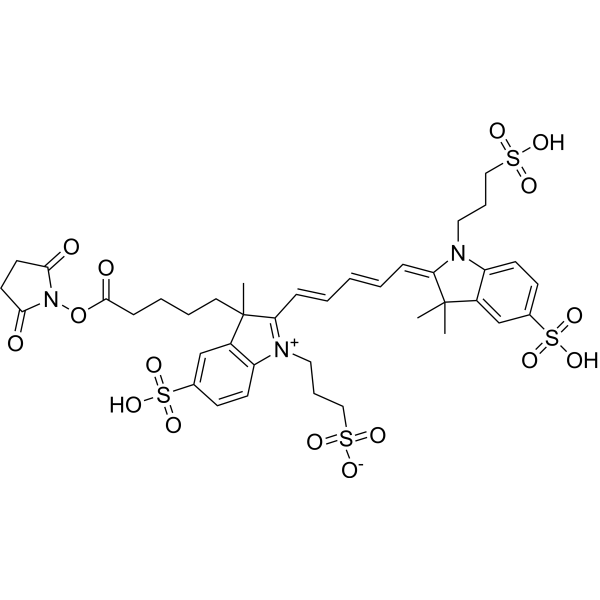
Physicochemical Properties
| Molecular Formula | C39H47N3O16S4 |
| Molecular Weight | 942.06 |
| Exact Mass | 941.183 |
| CAS # | 1620475-28-6 |
| PubChem CID | 167996453 |
| Appearance | Typically exists as solid at room temperature |
| LogP | 1.8 |
| Hydrogen Bond Donor Count | 3 |
| Hydrogen Bond Acceptor Count | 17 |
| Rotatable Bond Count | 19 |
| Heavy Atom Count | 62 |
| Complexity | 2270 |
| Defined Atom Stereocenter Count | 0 |
| SMILES | CC1(C2=C(C=CC(=C2)S(=O)(=O)O)[N+](=C1/C=C/C=C/C=C\3/C(C4=C(N3CCCS(=O)(=O)[O-])C=CC(=C4)S(=O)(=O)O)(C)CCCCC(=O)ON5C(=O)CCC5=O)CCCS(=O)(=O)O)C |
| InChi Key | WTYBXOVGGRVXPB-UHFFFAOYSA-N |
| InChi Code | InChI=1S/C39H47N3O16S4/c1-38(2)29-25-27(61(52,53)54)14-16-31(29)40(21-9-23-59(46,47)48)33(38)11-5-4-6-12-34-39(3,20-8-7-13-37(45)58-42-35(43)18-19-36(42)44)30-26-28(62(55,56)57)15-17-32(30)41(34)22-10-24-60(49,50)51/h4-6,11-12,14-17,25-26H,7-10,13,18-24H2,1-3H3,(H3-,46,47,48,49,50,51,52,53,54,55,56,57) |
| Chemical Name | 3-[(2Z)-2-[(2E,4E)-5-[3,3-dimethyl-5-sulfo-1-(3-sulfopropyl)indol-1-ium-2-yl]penta-2,4-dienylidene]-3-[5-(2,5-dioxopyrrolidin-1-yl)oxy-5-oxopentyl]-3-methyl-5-sulfoindol-1-yl]propane-1-sulfonate |
| Synonyms | Alexa Fluor 647 NHS Ester; AF 647 NHS Ester; 1620475-28-6; HY-D2096; CS-0897477; 3-(2-(5-(3,3-Dimethyl-5-sulfo-1-(3-sulfopropyl)indolin-2-ylidene)penta-1,3-dien-1-yl)-3-(5-((2,5-dioxopyrrolidin-1-yl)oxy)-5-oxopentyl)-3-methyl-5-sulfo-3H-indol-1-ium-1-yl)propane-1-sulfonate; 3-[(2Z)-2-[(2E,4E)-5-[3,3-dimethyl-5-sulfo-1-(3-sulfopropyl)indol-1-ium-2-yl]penta-2,4-dienylidene]-3-[5-(2,5-dioxopyrrolidin-1-yl)oxy-5-oxopentyl]-3-methyl-5-sulfoindol-1-yl]propane-1-sulfonate |
| HS Tariff Code | 2934.99.9001 |
| Storage |
Powder-20°C 3 years 4°C 2 years In solvent -80°C 6 months -20°C 1 month |
| Shipping Condition | Room temperature (This product is stable at ambient temperature for a few days during ordinary shipping and time spent in Customs) |
Biological Activity
| Targets | Fluorescent Dye |
| ln Vitro | Cyanine dyes, as used in super-resolution fluorescence microscopy, undergo light-induced "blinking", enabling localization of fluorophores with spatial resolution beyond the optical diffraction limit. Despite a plethora of studies, the molecular origins of this blinking are not well understood. Here, we examine the photophysical properties of a bio-conjugate cyanine dye (AF-647), used extensively in dSTORM imaging. In the absence of a potent sacrificial reductant, light-induced electron transfer and intermediates formed via the metastable, triplet excited state are considered unlikely to play a significant role in the blinking events. Instead, it is found that, under conditions appropriate to dSTORM microscopy, AF-647 undergoes reversible photo-induced isomerization to at least two long-lived dark species. These photo-isomers are characterized spectroscopically and their interconversion probed by computational means. The first-formed isomer is light sensitive and transforms to a longer-lived species in modest yield that could be involved in dSTORM related blinking. Permanent photobleaching of AF-647 occurs with very low quantum yield and is partially suppressed by the anaerobic redox buffer [2]. |
| References |
[1]. Multicolor Caged dSTORM Resolves the Ultrastructure of Synaptic Vesicles in the Brain. Angew Chem Int Ed Engl. 2015 Nov 2;54(45):13230-5. [2]. Photo-isomerization of the Cyanine Dye Alexa-Fluor 647 (AF-647) in the Context of dSTORM Super-Resolution Microscopy. Chemistry . 2019 Nov 22;25(65):14983-14998. |
| Additional Infomation | The precision of single-molecule localization-based super-resolution microscopy, including dSTORM, critically depends on the number of detected photons per localization. Recently, reductive caging of fluorescent dyes followed by UV-induced recovery in oxidative buffer systems was used to increase the photon yield and thereby the localization precision in single-color dSTORM. By screening 39 dyes for their fluorescence caging and recovery kinetics, we identify novel dyes that are suitable for multicolor caged dSTORM. Using a dye pair suited for registration error-free multicolor dSTORM based on spectral demixing (SD), a multicolor localization precision below 15 nm was achieved. Caged SD-dSTORM can resolve the ultrastructure of single 40 nm synaptic vesicles in brain sections similar to images obtained by immuno-electron microscopy, yet with much improved label density in two independent channels.[1] |
Solubility Data
| Solubility (In Vitro) | May dissolve in DMSO (in most cases), if not, try other solvents such as H2O, Ethanol, or DMF with a minute amount of products to avoid loss of samples |
| Solubility (In Vivo) |
Note: Listed below are some common formulations that may be used to formulate products with low water solubility (e.g. < 1 mg/mL), you may test these formulations using a minute amount of products to avoid loss of samples. Injection Formulations (e.g. IP/IV/IM/SC) Injection Formulation 1: DMSO : Tween 80: Saline = 10 : 5 : 85 (i.e. 100 μL DMSO stock solution → 50 μL Tween 80 → 850 μL Saline) *Preparation of saline: Dissolve 0.9 g of sodium chloride in 100 mL ddH ₂ O to obtain a clear solution. Injection Formulation 2: DMSO : PEG300 :Tween 80 : Saline = 10 : 40 : 5 : 45 (i.e. 100 μL DMSO → 400 μLPEG300 → 50 μL Tween 80 → 450 μL Saline) Injection Formulation 3: DMSO : Corn oil = 10 : 90 (i.e. 100 μL DMSO → 900 μL Corn oil) Example: Take the Injection Formulation 3 (DMSO : Corn oil = 10 : 90) as an example, if 1 mL of 2.5 mg/mL working solution is to be prepared, you can take 100 μL 25 mg/mL DMSO stock solution and add to 900 μL corn oil, mix well to obtain a clear or suspension solution (2.5 mg/mL, ready for use in animals). Injection Formulation 4: DMSO : 20% SBE-β-CD in saline = 10 : 90 [i.e. 100 μL DMSO → 900 μL (20% SBE-β-CD in saline)] *Preparation of 20% SBE-β-CD in Saline (4°C,1 week): Dissolve 2 g SBE-β-CD in 10 mL saline to obtain a clear solution. Injection Formulation 5: 2-Hydroxypropyl-β-cyclodextrin : Saline = 50 : 50 (i.e. 500 μL 2-Hydroxypropyl-β-cyclodextrin → 500 μL Saline) Injection Formulation 6: DMSO : PEG300 : castor oil : Saline = 5 : 10 : 20 : 65 (i.e. 50 μL DMSO → 100 μLPEG300 → 200 μL castor oil → 650 μL Saline) Injection Formulation 7: Ethanol : Cremophor : Saline = 10: 10 : 80 (i.e. 100 μL Ethanol → 100 μL Cremophor → 800 μL Saline) Injection Formulation 8: Dissolve in Cremophor/Ethanol (50 : 50), then diluted by Saline Injection Formulation 9: EtOH : Corn oil = 10 : 90 (i.e. 100 μL EtOH → 900 μL Corn oil) Injection Formulation 10: EtOH : PEG300:Tween 80 : Saline = 10 : 40 : 5 : 45 (i.e. 100 μL EtOH → 400 μLPEG300 → 50 μL Tween 80 → 450 μL Saline) Oral Formulations Oral Formulation 1: Suspend in 0.5% CMC Na (carboxymethylcellulose sodium) Oral Formulation 2: Suspend in 0.5% Carboxymethyl cellulose Example: Take the Oral Formulation 1 (Suspend in 0.5% CMC Na) as an example, if 100 mL of 2.5 mg/mL working solution is to be prepared, you can first prepare 0.5% CMC Na solution by measuring 0.5 g CMC Na and dissolve it in 100 mL ddH2O to obtain a clear solution; then add 250 mg of the product to 100 mL 0.5% CMC Na solution, to make the suspension solution (2.5 mg/mL, ready for use in animals). Oral Formulation 3: Dissolved in PEG400 Oral Formulation 4: Suspend in 0.2% Carboxymethyl cellulose Oral Formulation 5: Dissolve in 0.25% Tween 80 and 0.5% Carboxymethyl cellulose Oral Formulation 6: Mixing with food powders Note: Please be aware that the above formulations are for reference only. InvivoChem strongly recommends customers to read literature methods/protocols carefully before determining which formulation you should use for in vivo studies, as different compounds have different solubility properties and have to be formulated differently. (Please use freshly prepared in vivo formulations for optimal results.) |
| Preparing Stock Solutions | 1 mg | 5 mg | 10 mg | |
| 1 mM | 1.0615 mL | 5.3075 mL | 10.6150 mL | |
| 5 mM | 0.2123 mL | 1.0615 mL | 2.1230 mL | |
| 10 mM | 0.1062 mL | 0.5308 mL | 1.0615 mL |