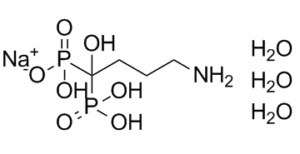
Alendronate sodium hydrate, the sodium salt of alendronate, is a novel and potent farnesyl diphosphate synthase inhibitor with IC50 of 460 nM. Alendronate sodium is a second generation bisphosphonate and synthetic analog of pyrophosphate with bone anti-resorption activity. Alendronate sodium binds to and inhibits the activity of geranyltranstransferase (farnesyl pyrophosphate synthetase), an enzyme involved in terpenoid biosynthesis. Inhibition of this enzyme prevents the biosynthesis of isoprenoid lipids (FPP and GGPP) that are donor substrates of farnesylation and geranylgeranylation during the post-translational modification of small GTPase signalling proteins, which is important in the process of osteoclast turnover. As a result, osteoclast activity is inhibited and bone resorption and turnover are reduced.
Physicochemical Properties
| Molecular Formula | C4H18NNAO10P2 |
| Molecular Weight | 325.1237 |
| Exact Mass | 325.03 |
| Elemental Analysis | C, 14.78; H, 5.58; N, 4.31; Na, 7.07; O, 49.21; P, 19.05 |
| CAS # | 121268-17-5 |
| Related CAS # | Alendronic acid;66376-36-1;Alendronic acid-d6;1035437-39-8;Alendronate sodium;129318-43-0; 121268-17-5 (sodium hydrate) ; 134606-40-9 (disodium); 137504-90-6 (calcium); 138624-11-0 (free acid hydrate) |
| PubChem CID | 23681107 |
| Appearance | White to off-white solid powder |
| Density | 1.857g/cm3 |
| Boiling Point | 616.7ºC at 760 mmHg |
| Melting Point | 245°C |
| Flash Point | 326.7ºC |
| Hydrogen Bond Donor Count | 8 |
| Hydrogen Bond Acceptor Count | 11 |
| Rotatable Bond Count | 5 |
| Heavy Atom Count | 18 |
| Complexity | 293 |
| Defined Atom Stereocenter Count | 0 |
| InChi Key | DCSBSVSZJRSITC-UHFFFAOYSA-M |
| InChi Code | InChI=1S/C4H13NO7P2.Na.3H2O/c5-3-1-2-4(6,13(7,8)9)14(10,11)12;;;;/h6H,1-3,5H2,(H2,7,8,9)(H2,10,11,12);;3*1H2/q;+1;;;/p-1 |
| Chemical Name | (4-amino-1-hydroxybutylidene) bisphosphonic acid monosodium salt trihydrate. |
| Synonyms | MK 217; MK-217; G-704650 Adronat; Alendronate; Alendronate sodium trihydrate; Fosamax; Adronat; Alendros; Alendronate sodium hydrate; Sodium alendronate; Alendronic Acid Monosodium Salt Trihydrate. trade names: Fosamax; Adronat; Alendros; Onclast. Code names: G704650; MK217. |
| HS Tariff Code | 2934.99.9001 |
| Storage |
Powder-20°C 3 years 4°C 2 years In solvent -80°C 6 months -20°C 1 month Note: Please store this product in a sealed and protected environment, avoid exposure to moisture. |
| Shipping Condition | Room temperature (This product is stable at ambient temperature for a few days during ordinary shipping and time spent in Customs) |
Biological Activity
| Targets |
Farnesyl diphosphate synthase (IC50 = 460 nM) The rate-limiting stage of phospholipid production, which is essential for osteoclast function, is inhibited by alendronate sodium hydrate when it directly acts on osteoclasts [1]. Alendronate Sodium Hydrate dose-dependently inhibits [3H]MVA uptake of sterols, with concurrent increases in dose markers for IPP and DMAPP [3]. Alendronate Sodium Hydrate inhibits [3H]mevalonolactone due to reduced levels of geranylgeranyl diphosphate, a protein of 18–25 kDa and a non-saponifiable inhibitor, including sterols in osteoclasts [2]. |
| ln Vitro |
The rate-limiting stage of phospholipid production, which is essential for osteoclast function, is inhibited by alendronate sodium hydrate when it directly acts on osteoclasts [1]. Alendronate Sodium Hydrate dose-dependently inhibits [3H]MVA uptake of sterols, with concurrent increases in dose markers for IPP and DMAPP [3]. Alendronate Sodium Hydrate inhibits [3H]mevalonolactone due to reduced levels of geranylgeranyl diphosphate, a protein of 18–25 kDa and a non-saponifiable inhibitor, including sterols in osteoclasts [2]. Alendronate (10–60 μM) inhibits osteoclast formation from mouse bone marrow cocultures with osteoblastic MB1.8 cells, as assessed by counting tartrate-resistant acid phosphatase (TRAP)-positive multinucleated cells (≥250 μm). This inhibition is partially blocked by 1 mM mevalonate and more effectively blocked by 10 μM geranylgeraniol (GGOH), but not by farnesol or squalene. [1] Alendronate (10 μM) reduces osteoclast number and bone resorption in mouse calvaria explants; this inhibition is fully reversed by 1 mM mevalonate. [1] Alendronate (15–60 μM) inhibits rabbit osteoclast-mediated bone resorption on bovine bone slices, as measured by collagen degradation products (C-telopeptide). GGOH (10 μM) fully blocks this inhibition, while mevalonate does not. [1] Alendronate (30 μM) activates a 34-kDa kinase in purified murine osteoclast-like cells (Ocls) after 17–24 hours of treatment. This activation is blocked by 10 μM GGOH but not by mevalonate or farnesol. [1] |
| ln Vivo | In rabbits, alendronate sodium hydrate results in gastric erosion but not the development of gastric antrums. The frequency and magnitude of stomach antrums caused by caromethacin are increased by alendronate sodium hydrate. Gastric healing is delayed and the effects of the carbohydrate carotethacin are amplified by alendronate sodium hydrate [4]. When combined with paclitaxel (10–50 mg/kg/day twice or twice a day), alendronate sodium hydrate (0.04-0.1 mg/kg twice weekly or 0.1 mg/kg weekly) partially inhibits the bone metastasis of human PC-3 ML cells in mice treated with it. This can lead to a fatal outbreak of tumor growth of PC-3 ML in bone marrow and soft tissue, but the rate is significantly improved within 4-5 weeks [5]. |
| Enzyme Assay |
Alendronate, a nitrogen-containing bisphosphonate, is a potent inhibitor of bone resorption used for the treatment and prevention of osteoporosis. Recent findings suggest that alendronate and other N-containing bisphosphonates inhibit the isoprenoid biosynthesis pathway and interfere with protein prenylation, as a result of reduced geranylgeranyl diphosphate levels. This study identified farnesyl disphosphate synthase as the mevalonate pathway enzyme inhibited by bisphosphonates. HPLC analysis of products from a liver cytosolic extract narrowed the potential targets for alendronate inhibition (IC(50) = 1700 nM) to isopentenyl diphosphate isomerase and farnesyl diphosphate synthase. Recombinant human farnesyl diphosphate synthase was inhibited by alendronate with an IC(50) of 460 nM (following 15 min preincubation). Alendronate did not inhibit isopentenyl diphosphate isomerase or GGPP synthase, partially purified from liver cytosol. Recombinant farnesyl diphosphate synthase was also inhibited by pamidronate (IC(50) = 500 nM) and risedronate (IC(50) = 3.9 nM), negligibly by etidronate (IC50 = 80 microM), and not at all by clodronate. In osteoclasts, alendronate inhibited the incorporation of [(3)H]mevalonolactone into proteins of 18-25 kDa and into nonsaponifiable lipids, including sterols. These findings (i) identify farnesyl diphosphate synthase as the selective target of alendronate in the mevalonate pathway, (ii) show that this enzyme is inhibited by other N-containing bisphosphonates, such as risendronate, but not by clodronate, supporting a different mechanism of action for different bisphosphonates, and (iii) document in purified osteoclasts alendronate inhibition of prenylation and sterol biosynthesis.[2] Alendronate (ALN), an aminobisphosphonate compound used for the treatment of osteoporosis and other disorders of bone resorption, has been suggested to act by inhibition of the formation of GGPP. In the present study we used an S(10) homogenate fraction of rat liver to show that ALN causes a dose-dependent inhibition of [(3)H]MVA incorporation into sterols and a concomitant increase in incorporation of radiolabel into IPP and DMAPP. We further show that ALN is a potent inhibitor of cytosolic trans-prenyltransferase (FPP synthase). The inhibition is competitive with respect to allylic pyrophosphate substrates, but not IPP, suggesting that ALN acts as an allylic pyrophosphate analog and binds to the free enzyme. The K(i) is in the 0.5 microM range.[3] |
| Cell Assay |
Nitrogen-containing bisphosphonates were shown to cause macrophage apoptosis by inhibiting enzymes in the biosynthetic pathway leading from mevalonate to cholesterol. This study suggests that, in osteoclasts, geranylgeranyl diphosphate, the substrate for prenylation of most GTP binding proteins, is likely to be the crucial intermediate affected by these bisphosphonates. We report that murine osteoclast formation in culture is inhibited by both lovastatin, an inhibitor of hydroxymethylglutaryl CoA reductase, and alendronate. Lovastatin effects are blocked fully by mevalonate and less effectively by geranylgeraniol whereas alendronate effects are blocked partially by mevalonate and more effectively by geranylgeraniol. Alendronate inhibition of bone resorption in mouse calvaria also is blocked by mevalonate whereas clodronate inhibition is not. Furthermore, rabbit osteoclast formation and activity also are inhibited by lovastatin and alendronate. The lovastatin effects are prevented by mevalonate or geranylgeraniol, and alendronate effects are prevented by geranylgeraniol. Farnesol and squalene are without effect. Signaling studies show that lovastatin and alendronate activate in purified osteoclasts a 34-kDa kinase. Lovastatin-mediated activation is blocked by mevalonate and geranylgeraniol whereas alendronate activation is blocked by geranylgeraniol. Together, these findings support the hypothesis that alendronate, acting directly on osteoclasts, inhibits a rate-limiting step in the cholesterol biosynthesis pathway, essential for osteoclast function. This inhibition is prevented by exogenous geranylgeraniol, probably required for prenylation of GTP binding proteins that control cytoskeletal reorganization, vesicular fusion, and apoptosis, processes involved in osteoclast activation and survival[1]. Osteoclast Formation Assay (Murine): Mouse bone marrow cells are cocultured with osteoblastic MB1.8 cells in α-MEM supplemented with fetal calf serum and 1,25-(OH)₂ vitamin D₃ for 5 days. Test compounds (e.g., Alendronate, lovastatin) are added during the last 48 hours. Cells are fixed and stained for TRAP activity, and TRAP-positive multinucleated cells (≥250 μm) are counted microscopically. [1] Osteoclast Resorption Assay (Rabbit): Rabbit osteoclasts are isolated from tibiae, plated onto bovine bone slices, and treated with compounds for 3 days. Collagen degradation products in the medium are measured using a CrossLaps ELISA assay. [1] Osteoclast Purification and Kinase Assay: Ocls are purified from cocultures by sequential collagenase and EDTA treatment. Cells are treated with compounds, lysed, and kinase activity is assessed using an in-gel kinase assay with myelin basic protein as a substrate, followed by autoradiography. [1] |
| Animal Protocol |
Gastric ulceration associated with the use of NSAIDs is most frequently observed in elderly women, the same sector of society most likely to be receiving therapy for osteoporosis. As some anti-osteoporosis medications have been suggested to irritate the upper gastrointestinal mucosa, we evaluated the ability of one such drug, alendronate, to damage the gastric mucosa and to influence the severity and healing of gastric ulcers in rodents. The effects of alendronate on indomethacin-induced antral ulceration was evaluated in the rabbit, while effects on ulcer healing and on the formation of gastric erosions was evaluated in the rat. Effects of alendronate on gastric acid secretion, blood flow and prostaglandin synthesis were also evaluated. Alendronate caused erosions in the rabbit stomach, but not antral ulceration. However, at the highest doses tested (80 mg) alendronate increased the incidence and size of indomethacin-induced antral ulcers. Alendronate also enhanced indomethacin-induced gastric damage in the rat, and delayed gastric ulcer healing. These effects of alendronate were not attributable to changes in gastric acid secretion, blood flow, prostaglandin synthesis or the pharmacokinetics of indomethacin. The damaging effects of alendronate on the stomach were due to topical irritant effects and could be observed at concentrations as low as 4 mg/ml within 30 min of oral administration or topical superfusion. These results support preliminary clinical evidence that alendronate can damage the gastric mucosa. While gastric injury may be a rare occurrence in patients taking this drug, concomitant use of alendronate and NSAIDs may increase the incidence or severity of ulceration.[4] The combined influence of alendronate, a bisphosphonate compound, and taxol on the establishment and growth of human PC-3 ML subclones injected intravenously via the tail vein in SCID mice was investigated. The pretreatment of SCID mice with alendronate (0.04-0.1 mg/kg twice weekly or 0.1 mg/kg weekly) partially blocked the establishment of bone metastases by human PC-3 ML cells and resulted in tumor formation in the peritoneum and other soft tissues. However, alendronate pretreatment of mice (0.1 mg/kg twice weekly or weekly) and dosing along with taxol (10-50 mg/kg/day, twice weekly, or weekly) blocked the growth of PC-3 ML tumors in the bone marrow and soft tissues in a statistically significant manner and improved survival rates significantly (p < 0.001) by 4-5 weeks. ELISAs and zymography of matrix metalloproteinase production in vitro and in vivo showed that alendronate and taxol alone partially inhibited metalloproteinase production, but that taxol in combination with alendronate totally blocked protease production and release. The combined activities of alendronate and taxol appeared to inhibit the establishment and growth of tumors in SCID mice, perhaps, in part, as a result of inhibition of protease production and release.[5] |
| References |
[1]. Alendronate mechanism of action: geranylgeraniol, an intermediate in the mevalonate pathway, prevents inhibition of osteoclast formation, bone resorption, and kinase activation in vitro. Proc Natl Acad Sci U S A. 1999 Jan 5;96(1):133-8. [2]. Alendronate is a specific, nanomolar inhibitor of farnesyl diphosphate synthase. Arch Biochem Biophys. 2000 Jan 1;373(1):231-41. [3]. Mechanism of aminobisphosphonate action: characterization of alendronate inhibition of the isoprenoid pathway. Biochem Biophys Res Commun. 1999 Dec 20;266(2):560-3. [4]. Alendronate induces gastric injury and delays ulcer healing in rodents. Life Sci. 1998;62(1):77-91. [5]. Effects of alendronate and taxol on PC-3 ML cell bone metastases in SCID mice. Invasion Metastasis. 1996;16(3):116-31. |
| Additional Infomation |
Alendronate sodium trihydrate is a hydride that is the trihydrate of alendronate sodium It has a role as a bone density conservation agent and an EC 2.5.1.1 (dimethylallyltranstransferase) inhibitor. It is an organic sodium salt and a hydrate. It contains an alendronate(1-). Alendronate Sodium is the sodium salt of alendronate, a second generation bisphosphonate and synthetic analog of pyrophosphate with bone anti-resorption activity. Alendronate sodium binds to and inhibits the activity of geranyltranstransferase (farnesyl pyrophosphate synthetase), an enzyme involved in terpenoid biosynthesis. Inhibition of this enzyme prevents the biosynthesis of isoprenoid lipids (FPP and GGPP) that are donor substrates of farnesylation and geranylgeranylation during the post-translational modification of small GTPase signalling proteins, which is important in the process of osteoclast turnover. As a result, osteoclast activity is inhibited and bone resorption and turnover are reduced. A nonhormonal medication for the treatment of postmenopausal osteoporosis in women. This drug builds healthy bone, restoring some of the bone loss as a result of osteoporosis. See also: Alendronic Acid (has active moiety); Alendronate Sodium; Cholecalciferol (component of). Drug Indication Treatment of postmenopausal osteoporosis in patients at risk of vitamin-D insufficiency. Adrovance reduces the risk of vertebral and hip fractures. Alendronate is a nitrogen-containing bisphosphonate that binds to bone mineral and is taken up by osteoclasts during bone resorption. It inhibits osteoclast function by interfering with the mevalonate pathway, likely reducing geranylgeranyl diphosphate (GGPP) production, which is essential for prenylation of GTP-binding proteins (e.g., Rac, Rho, Cdc42, Rab) involved in cytoskeletal organization, vesicular trafficking, and osteoclast survival. This leads to disruption of the ruffled border and osteoclast inactivation. [1] The study suggests that Alendronate acts directly on osteoclasts, as shown by kinase activation in purified Ocls and by the ability of GGOH to reverse its effects. [1] |
Solubility Data
| Solubility (In Vitro) | H2O : ≥ 28.57 mg/mL (~87.88 mM) |
| Solubility (In Vivo) |
Solubility in Formulation 1: 10 mg/mL (30.76 mM) in PBS (add these co-solvents sequentially from left to right, and one by one), clear solution; with sonication (<60°C). (Please use freshly prepared in vivo formulations for optimal results.) |
| Preparing Stock Solutions | 1 mg | 5 mg | 10 mg | |
| 1 mM | 3.0758 mL | 15.3789 mL | 30.7579 mL | |
| 5 mM | 0.6152 mL | 3.0758 mL | 6.1516 mL | |
| 10 mM | 0.3076 mL | 1.5379 mL | 3.0758 mL |