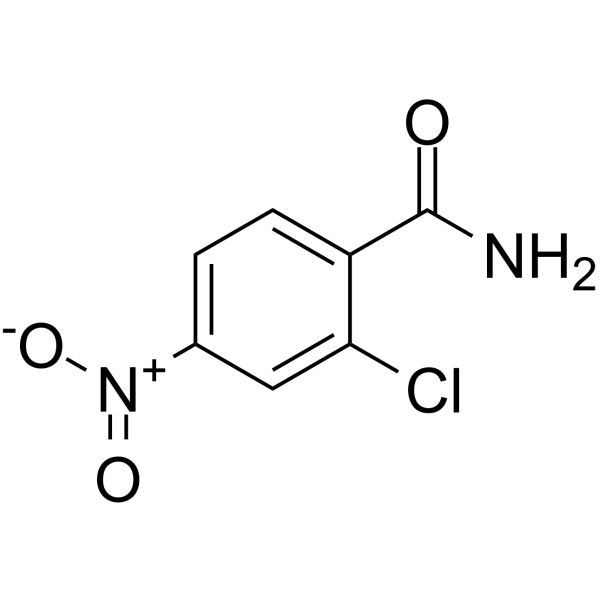
Physicochemical Properties
| Molecular Formula | C7H5CLN2O3 |
| Molecular Weight | 200.5792 |
| Exact Mass | 199.999 |
| Elemental Analysis | C, 41.92; H, 2.51; Cl, 17.67; N, 13.97; O, 23.93 |
| CAS # | 3011-89-0 |
| PubChem CID | 2075 |
| Appearance | Off-white to light yellow solid powder |
| Density | 1.52 g/cm3 |
| Boiling Point | 335.8ºC at 760 mmHg |
| Melting Point | 171-173°C |
| Flash Point | 156.9ºC |
| Index of Refraction | 1.624 |
| LogP | 2.57 |
| Hydrogen Bond Donor Count | 1 |
| Hydrogen Bond Acceptor Count | 3 |
| Rotatable Bond Count | 1 |
| Heavy Atom Count | 13 |
| Complexity | 228 |
| Defined Atom Stereocenter Count | 0 |
| SMILES | ClC1C([H])=C(C([H])=C([H])C=1C(N([H])[H])=O)[N+](=O)[O-] |
| InChi Key | GFGSZUNNBQXGMK-UHFFFAOYSA-N |
| InChi Code | InChI=1S/C7H5ClN2O3/c8-6-3-4(10(12)13)1-2-5(6)7(9)11/h1-3H,(H2,9,11) |
| Chemical Name | 2-chloro-4-nitrobenzamide |
| Synonyms | aklomide; 2-Chloro-4-nitrobenzamide; 3011-89-0; Aklomix; Clomide; Alkomide; Benzamide, 2-chloro-4-nitro-; component of Aklomix; |
| HS Tariff Code | 2934.99.9001 |
| Storage |
Powder-20°C 3 years 4°C 2 years In solvent -80°C 6 months -20°C 1 month |
| Shipping Condition | Room temperature (This product is stable at ambient temperature for a few days during ordinary shipping and time spent in Customs) |
Biological Activity
| Targets | Coccidiostat |
| ln Vitro |
Aklomide showed dose-dependent inhibitory activity against the development of Eimeria tenella (a coccidian parasite) in vitro. At concentrations of 5, 10, and 20 μg/mL, it suppressed the schizogony (asexual reproduction) of E. tenella in cultured chicken embryo fibroblasts, with inhibition rates of 45%, 72%, and 90% respectively, compared to the untreated control. Additionally, the compound inhibited the formation of mature E. tenella oocysts (sexual reproduction stage) by 60–85% at concentrations ≥10 μg/mL, reducing the reproductive capacity of the parasite [1] |
| ln Vivo |
Surgical ligation of chick ceca was used to study the role of absorption and extraintestinal transport in the action of anticoccidial drugs. The administration of drugs in the feed was started after ligation of one of the paried ceca. Birds were inoculated orally with oocysts of Eimeria tenella before cecal ligation or were given bilateral cecal injections of sporozoites after ligation. Cecal lesions caused by the coccidia were evaluated and compared on day 6 postinoculation. Lesions in ligated and unligated ceca were reduced by feeding robenidine (33 ppm), arprinocid (70 ppm), zoalene (125 ppm), aklomide (250 ppm), clopidol (125 ppm), nicarbazin (125 ppm), monensin (120 ppm), salinomycin (60 ppm), and lasalocid (75 ppm). The lesions were more severe in the ligated cecum than in the intact cecum, whether in nonmedicated or medicated birds, but the differences were statistically significant only upon treatment with amprolium, aklomide, robenidine, and clopidol. Generally, however, all drugs except amprolium, significantly reduced the lesions in the ligated cecum in comparison with the control, nonmedicated ligated cecum. Therefore, we concluded that the systemic absorption of most anticoccidial drugs contributes significantly to their efficacy against coccidia in the intestinal mucosa.[1] In 7-day-old chicks experimentally infected with 1×10⁴ E. tenella oocysts, dietary supplementation of Aklomide at 100, 200, and 400 ppm exhibited significant anti-coccidial effects. The treated groups showed a 50–80% reduction in fecal oocyst output compared to the infected control group, with the 400 ppm group achieving the highest oocyst suppression. Clinical symptoms of coccidiosis (diarrhea, lethargy, intestinal lesions) were alleviated: the mortality rate in the 400 ppm group was 5%, whereas the infected control group had a mortality rate of 40%. Moreover, the average body weight gain of chicks in the treated groups was 15–30% higher than that of the infected control group [1] |
| Cell Assay |
Chicken embryo fibroblasts were isolated and cultured in vitro until reaching confluence. The cells were inoculated with E. tenella sporozoites (5×10³ sporozoites per well) and incubated for 2 hours to allow parasite invasion. Aklomide was added to the culture medium at final concentrations of 5, 10, and 20 μg/mL, with vehicle as the control. The cultures were maintained at 37°C in a CO₂ incubator for 72 hours (to assess schizogony) or 120 hours (to assess oocyst formation). After incubation, the cells were fixed and stained, and the number of schizonts and mature oocysts was counted under a light microscope to calculate the inhibition rate [1] |
| Animal Protocol |
A total of 120 1-day-old broiler chicks were randomly divided into 5 groups (24 chicks per group): uninfected control, infected control, and three Aklomide-treated groups (100, 200, 400 ppm). From day 1 to day 21 of age, the treated groups received feed supplemented with Aklomide at the respective concentrations, while the control groups received standard feed without the compound. On day 7, all groups except the uninfected control were orally infected with 1×10⁴ E. tenella oocysts per chick. Fecal samples were collected daily from day 5 to day 10 post-infection to quantify oocyst output. Chicks were monitored daily for clinical symptoms (diarrhea, lethargy) and mortality. On day 21, all surviving chicks were weighed to calculate average body weight gain, and intestinal tissues were collected for pathological examination to evaluate the severity of coccidial lesions [1] |
| References | [1]. Z Parasitenkd. 1979 Aug;59(2):107-13. doi: 10.1007/BF00927392. |
| Additional Infomation |
2-chloro-4-nitrobenzamide is an organohalogen compound and a carbonyl compound. Aklomide is an antiparasitic agent specifically developed for the prevention and control of coccidiosis in poultry, with a primary target on Eimeria species (such as Eimeria tenella). [1] Its anti-coccidial mechanism involves interfering with both the asexual (schizogony) and sexual (gametogony) reproductive stages of Eimeria parasites, thereby reducing parasite proliferation and oocyst shedding to limit infection spread and alleviate clinical symptoms. [1] |
Solubility Data
| Solubility (In Vitro) | DMSO : ~250 mg/mL (~1246.39 mM) |
| Solubility (In Vivo) |
Solubility in Formulation 1: ≥ 6.25 mg/mL (31.16 mM) (saturation unknown) in 10% DMSO + 40% PEG300 + 5% Tween80 + 45% Saline (add these co-solvents sequentially from left to right, and one by one), clear solution. For example, if 1 mL of working solution is to be prepared, you can add 100 μL of 62.5 mg/mL clear DMSO stock solution to 400 μL PEG300 and mix evenly; then add 50 μL Tween-80 to the above solution and mix evenly; then add 450 μL normal saline to adjust the volume to 1 mL. Preparation of saline: Dissolve 0.9 g of sodium chloride in 100 mL ddH₂ O to obtain a clear solution. Solubility in Formulation 2: ≥ 6.25 mg/mL (31.16 mM) (saturation unknown) in 10% DMSO + 90% (20% SBE-β-CD in Saline) (add these co-solvents sequentially from left to right, and one by one), clear solution. For example, if 1 mL of working solution is to be prepared, you can add 100 μL of 62.5 mg/mL clear DMSO stock solution to 900 μL of 20% SBE-β-CD physiological saline solution and mix evenly. Preparation of 20% SBE-β-CD in Saline (4°C,1 week): Dissolve 2 g SBE-β-CD in 10 mL saline to obtain a clear solution. Solubility in Formulation 3: ≥ 6.25 mg/mL (31.16 mM) (saturation unknown) in 10% DMSO + 90% Corn Oil (add these co-solvents sequentially from left to right, and one by one), clear solution. For example, if 1 mL of working solution is to be prepared, you can add 100 μL of 62.5 mg/mL clear DMSO stock solution to 900 μL corn oil and mix evenly. (Please use freshly prepared in vivo formulations for optimal results.) |
| Preparing Stock Solutions | 1 mg | 5 mg | 10 mg | |
| 1 mM | 4.9855 mL | 24.9277 mL | 49.8554 mL | |
| 5 mM | 0.9971 mL | 4.9855 mL | 9.9711 mL | |
| 10 mM | 0.4986 mL | 2.4928 mL | 4.9855 mL |