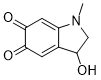
Physicochemical Properties
| Molecular Formula | C9H9NO3 |
| Molecular Weight | 179.18 |
| Exact Mass | 179.058 |
| Elemental Analysis | C, 60.33; H, 5.06; N, 7.82; O, 26.79 |
| CAS # | 54-06-8 |
| PubChem CID | 5898 |
| Appearance | Solid powder |
| Density | 1.42g/cm3 |
| Boiling Point | 375.1ºC at 760 mmHg |
| Melting Point | 115-120ºC |
| Flash Point | 180.7ºC |
| Index of Refraction | 1.63 |
| LogP | -1.3 |
| Hydrogen Bond Donor Count | 1 |
| Hydrogen Bond Acceptor Count | 4 |
| Rotatable Bond Count | 0 |
| Heavy Atom Count | 13 |
| Complexity | 354 |
| Defined Atom Stereocenter Count | 0 |
| SMILES | CN1CC(C2=CC(=O)C(=O)C=C21)O |
| InChi Key | RPHLQSHHTJORHI-UHFFFAOYSA-N |
| InChi Code | InChI=1S/C9H9NO3/c1-10-4-9(13)5-2-7(11)8(12)3-6(5)10/h2-3,9,13H,4H2,1H3 |
| Chemical Name | 3-hydroxy-1-methyl-2,3-dihydroindole-5,6-dione |
| Synonyms | Adrenochrome Adraxone |
| HS Tariff Code | 2934.99.9001 |
| Storage |
Powder-20°C 3 years 4°C 2 years In solvent -80°C 6 months -20°C 1 month |
| Shipping Condition | Room temperature (This product is stable at ambient temperature for a few days during ordinary shipping and time spent in Customs) |
Biological Activity
| ln Vitro | Calcium uptake, microsomal calcium binding, and Ca2+-stimulated Mg2+-dependent ATPase activity are all decreased by adrenochrome. There is no correlation between pH (6.0-8.0), calcium concentration (10-200 μM), protein concentration (0.02-0.10 mg/mL), temperature (25-37 degrees C), and incubation period (2-30 minutes) and the inhibitory impact of adrenochrome on the calcium uptake activity of separation membrane microsomes [2]. |
| ln Vivo | Adrenochrome concentrations ranging from 1 to 1000 ng/mL induced dose- and time-dependent increases in coronary artery pressure in isolated rat hearts. Moreover, the concentration of CaCl2 in the perfusion medium determines the degree of adrenochrome contraction [1]. |
| References |
[1]. M Karmazyn,, et al. Adrenochrome-induced coronary artery constriction in the rat heart. J Pharmacol Exp Ther. 1981 Oct;219(1):225-30. [2]. S Takeo,et al. Effects of adrenochrome on calcium accumulating and adenosine triphosphatase activities of the rat heart microsomes. J Pharmacol Exp Ther. 1980 Sep;214(3):688-93. [3]. Koji Ueda, et al. Catecholamine oxidation-mediated transcriptional inhibition in Mn neurotoxicity. J Toxicol Sci. 2020;45(10):619-624. |
| Additional Infomation |
Adrenochrome is a member of indoles. Pigment obtained by the oxidation of epinephrine. |
Solubility Data
| Solubility (In Vitro) | DMSO : ~100 mg/mL (~558.13 mM) |
| Solubility (In Vivo) |
Solubility in Formulation 1: 2.5 mg/mL (13.95 mM) in 10% DMSO + 40% PEG300 + 5% Tween80 + 45% Saline (add these co-solvents sequentially from left to right, and one by one), suspension solution; with sonication. For example, if 1 mL of working solution is to be prepared, you can add 100 μL of 25.0 mg/mL clear DMSO stock solution to 400 μL PEG300 and mix evenly; then add 50 μL Tween-80 to the above solution and mix evenly; then add 450 μL normal saline to adjust the volume to 1 mL. Preparation of saline: Dissolve 0.9 g of sodium chloride in 100 mL ddH₂ O to obtain a clear solution. Solubility in Formulation 2: 2.5 mg/mL (13.95 mM) in 10% DMSO + 90% (20% SBE-β-CD in Saline) (add these co-solvents sequentially from left to right, and one by one), suspension solution; with ultrasonication. For example, if 1 mL of working solution is to be prepared, you can add 100 μL of 25.0 mg/mL clear DMSO stock solution to 900 μL of 20% SBE-β-CD physiological saline solution and mix evenly. Preparation of 20% SBE-β-CD in Saline (4°C,1 week): Dissolve 2 g SBE-β-CD in 10 mL saline to obtain a clear solution. (Please use freshly prepared in vivo formulations for optimal results.) |
| Preparing Stock Solutions | 1 mg | 5 mg | 10 mg | |
| 1 mM | 5.5810 mL | 27.9049 mL | 55.8098 mL | |
| 5 mM | 1.1162 mL | 5.5810 mL | 11.1620 mL | |
| 10 mM | 0.5581 mL | 2.7905 mL | 5.5810 mL |