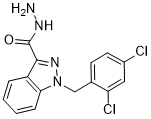
Adjudin, formerly known as AF-2364, is a medication that is being researched as a possible non-hormonal male contraceptive. It works by preventing the production of sperm in the testes while having no effect on testosterone production. Further research is being done on this class of drugs as potential contraceptives. It is an analogue of the chemotherapy drug lonidamine, an indazole-carboxylic acid. Adjudin, like its analogue lonidamine, has properties that inhibit cancer growth by targeting mitochondria and obstructing energy metabolism in specific types of tumor cells in mice, according to a 2013 study, suggesting that it has potential as a drug for cancer therapy.
Physicochemical Properties
| Molecular Formula | C15H12CL2N4O |
| Molecular Weight | 335.19 |
| Exact Mass | 334.038 |
| Elemental Analysis | C, 53.75; H, 3.61; Cl, 21.15; N, 16.72; O, 4.77 |
| CAS # | 252025-52-8 |
| Related CAS # | 252025-52-8 |
| PubChem CID | 9819086 |
| Appearance | White to off-white solid powder |
| Density | 1.5±0.1 g/cm3 |
| Index of Refraction | 1.705 |
| LogP | 2.67 |
| Hydrogen Bond Donor Count | 2 |
| Hydrogen Bond Acceptor Count | 3 |
| Rotatable Bond Count | 3 |
| Heavy Atom Count | 22 |
| Complexity | 411 |
| Defined Atom Stereocenter Count | 0 |
| SMILES | O=C(C1=NN(CC2=CC=C(Cl)C=C2Cl)C3=C1C=CC=C3)NN |
| InChi Key | VENCPJAAXKBIJD-UHFFFAOYSA-N |
| InChi Code | InChI=1S/C15H12Cl2N4O/c16-10-6-5-9(12(17)7-10)8-21-13-4-2-1-3-11(13)14(20-21)15(22)19-18/h1-7H,8,18H2,(H,19,22) |
| Chemical Name | 1-[(2,4-dichlorophenyl)methyl]indazole-3-carbohydrazide |
| Synonyms | Adjudin; AF-2364; AF2364; AF 2364 |
| HS Tariff Code | 2934.99.9001 |
| Storage |
Powder-20°C 3 years 4°C 2 years In solvent -80°C 6 months -20°C 1 month |
| Shipping Condition | Room temperature (This product is stable at ambient temperature for a few days during ordinary shipping and time spent in Customs) |
Biological Activity
| Targets | Cl- channel; NF-κB |
| ln Vitro | Adjudin is a potent blocker of Cl- channels; it decreases the capacity and ability of human sperm to fertilize in vitro[1] by interfering with Cl- ion transport function. Adjudin (ADD) is an inhibitor of the mitochondria[2]. The Sertoli-germ cell interface is where adherens junction disruption is mediated by the molecule adjudin. More than ten different types of cancer cell lines from mice or humans are treated with increasing concentrations of adjudin to examine how it affects cancer cells. The proliferation of the cells is then measured using a modified MTT assay. Human gastric adenocarcinoma cell SGC-7901, human breast adenocarcinoma cell MDA-MB-231, human hepatoma cell Smmc-7721, and human pancreatic adenocarcinoma cell MIA Paca-2 exhibit dose-dependent inhibition of cell proliferation. After being administered for 24 hours, Adjudin's IC50 against SGC-7901, MDA-MB-231, Smmc-7721, and MIA Paca-2 cells were found to be 58.0 µM, 13.8 µM, 72.3 µM and 52.7 µM, respectively. Other cancer cell lines from humans and mice have produced results that are comparable. Adjudin's IC50 values in PC3 cells and A549 cells are 63.1 µM and 93.0 µM, respectively. The IC50 of Adjudin for WI-38 and BPH-1 cells can be observed at more than 300 µM and 200 µM, respectively. These values are approximately 5 times and 2 times higher than those for the cancer cell lines A549 and PC3, respectively[3]. |
| ln Vivo | The effectiveness of Adjudin is examined in a subcutaneous lung and prostate cancer model to ascertain whether it can inhibit the growth of lung and prostate cancer in vivo. A549 human lung cancer cells and PC3 prostate cancer cells are subcutaneously injected into athymic nude mice at different sites on the lower back. Then, mice are randomly divided into two treatment groups—adjudin and vehicle (control), which have comparable mean tumor sizes. Adjudin is administered intraperitoneally once every three days in lung carcinoma cells and once every other day in prostate carcinoma cells, beginning about two weeks after tumor inoculation. In rodents, adjuvant therapy is generally well tolerated. Additionally, mice treated with Adjudin exhibit a notable inhibition of tumor growth when compared to the control group(P<0.0001 in the human lung carcinoma cells A549 and P=0.006 in the prostate carcinoma cells PC3)[3]. |
| Cell Assay | In 96-well plates with complete growth medium, 0.5×10⁴ A549 cells, WI-38 cells, BPH-1 cells, PC-12 cells, and other cell lines are seeded. The cells are then incubated for 24 hours. Adjudin is then serially diluted in growth medium (without serum) at concentrations of 300 µM, 100 µM, 30 µM, 10 µM, 3 µM and 0. After another 24 hours of incubation, 10 µl of the Cell Counting Kit-8 solution is added to each well. A microplate reader is used to measure the absorbance at 450 nm following 4 h of incubation at 37 °C in the cell incubator[3]. |
| Animal Protocol | Mice: Equal amounts of A549 cells (0.5×10⁷ cells) and PC3 cells (1×10⁶ cells) are hypodermically implanted into male BALB/C nude mice weighing under ~20g. After two weeks, the mice with palpable tumors are split into two groups (n = 4 per group in each experiment; repeated three times total): one group receives an i.p. injection of Adjudin, which is dissolved in corn oil from a DMSO stock solution and has a final administered quantity of 100 mg/kg (~300 µM used in vitro); the other group receives an injection of the same quantities of corn oil and DMSO as the equivalent vehicle control group. Adjudin or vehicles are given every three days to A549 patients and every other day to PC3 patients for up to two weeks. Calculated and determined tumor volumes. |
| References |
[1]. Inhibition of sperm capacitation and fertilizing capacity by adjudin is mediated by chloride and its channels in humans. Hum Reprod. 2013 Jan;28(1):47-59. [2]. Combination delivery of Adjudin and Doxorubicin via integrating drug conjugation and nanocarrier approaches for the treatment of drug-resistant cancer cells. J Mater Chem B. 2015 Feb 28;3(8):1556-1564. [3]. Male contraceptive Adjudin is a potential anti-cancer drug. Biochem Pharmacol. 2013 Feb 1;85(3):345-55. |
Solubility Data
| Solubility (In Vitro) |
DMSO: 16.67~67 mg/mL (49.7~199.9 mM) Ethanol: 2 mg/mL (6.0 mM) |
| Solubility (In Vivo) |
Solubility in Formulation 1: ≥ 1.67 mg/mL (4.98 mM) (saturation unknown) in 10% DMSO + 40% PEG300 + 5% Tween80 + 45% Saline (add these co-solvents sequentially from left to right, and one by one), clear solution. For example, if 1 mL of working solution is to be prepared, you can add 100 μL of 16.7 mg/mL clear DMSO stock solution to 400 μL PEG300 and mix evenly; then add 50 μL Tween-80 to the above solution and mix evenly; then add 450 μL normal saline to adjust the volume to 1 mL. Preparation of saline: Dissolve 0.9 g of sodium chloride in 100 mL ddH₂ O to obtain a clear solution. Solubility in Formulation 2: ≥ 1.67 mg/mL (4.98 mM) (saturation unknown) in 10% DMSO + 90% Corn Oil (add these co-solvents sequentially from left to right, and one by one), clear solution. For example, if 1 mL of working solution is to be prepared, you can add 100 μL of 16.7 mg/mL clear DMSO stock solution to 900 μL of corn oil and mix evenly. (Please use freshly prepared in vivo formulations for optimal results.) |
| Preparing Stock Solutions | 1 mg | 5 mg | 10 mg | |
| 1 mM | 2.9834 mL | 14.9169 mL | 29.8338 mL | |
| 5 mM | 0.5967 mL | 2.9834 mL | 5.9668 mL | |
| 10 mM | 0.2983 mL | 1.4917 mL | 2.9834 mL |