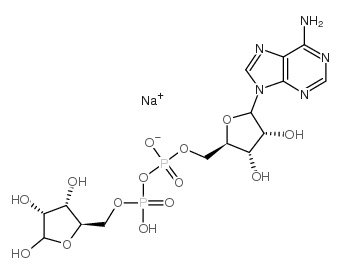
Adenosine 5′-diphosphoribose sodium (ADP ribose sodium) is a novel nicotinamide adenine nucleotide (NAD+) metabolite, and is the most potent and primary intracellular Ca2+-permeable cation TRPM2 channel activator. Also enhances autophagy. The Ca(2+)-permeable cation channel transient receptor potential melastatin 2 (TRPM2) plays a key role in pathogen-evoked phagocyte activation, postischemic neuronal apoptosis, and glucose-evoked insulin secretion, by linking these cellular responses to oxidative stress.
Physicochemical Properties
| Molecular Formula | C₁₅H₂₂N₅NAO₁₄P₂ |
| Molecular Weight | 581.30 |
| Exact Mass | 581.054 |
| CAS # | 68414-18-6 |
| PubChem CID | 16218837 |
| Appearance | White to light yellow solid powder |
| Hydrogen Bond Donor Count | 8 |
| Hydrogen Bond Acceptor Count | 18 |
| Rotatable Bond Count | 12 |
| Heavy Atom Count | 37 |
| Complexity | 860 |
| Defined Atom Stereocenter Count | 0 |
| InChi Key | LVIWKNSMPKNKBI-UHFFFAOYSA-N |
| InChi Code | InChI=1S/C15H23N5O14P2.Na/c16-13-9-14(18-4-17-13)20(5-19-9)15-12(26)11(25)8(33-15)3-32-36(29,30)34-35(27,28)31-2-7(23)10(24)6(22)1-21;/h1,4-8,10-12,15,22-26H,2-3H2,(H,27,28)(H,29,30)(H2,16,17,18); |
| Synonyms | Adenosine 5′diphosphoribose sodiumADP ribose sodium |
| HS Tariff Code | 2934.99.9001 |
| Storage |
Powder-20°C 3 years 4°C 2 years In solvent -80°C 6 months -20°C 1 month Note: Please store this product in a sealed and protected environment, avoid exposure to moisture. |
| Shipping Condition | Room temperature (This product is stable at ambient temperature for a few days during ordinary shipping and time spent in Customs) |
Biological Activity
| ln Vitro | Treatment with H2O2 activates poly(ADP-ribose) (PAR) polymerase-1 (PARP-1) in mouse embryonic stem cells (MEFs) to produce sodium adenosine 5′-bisphosphate ribose (ADP-ribose), a signal that activates the TRPM2 channel and promotes Ca2+ release via extracellular Ca2+ influx and/or lysosomes. In the end, this process determines whether to trigger early or late autophagy in response to various oxidations [1]. Adenosine 5'-ribose diphosphate (ADP-ribose) binds to the distinct intracellular NUDT9 homology (NUDT9-H) domain of TRPM2, which is found at its C terminator, to activate it. Intracellular Ca2+ is a significant co-activator alongside ADPR; the TRPM2 channel only opens in the presence of both ligands [2]. |
| References |
[1]. The potential regulatory roles of NAD(+) and its metabolism in autophagy. Metabolism. 2016 Apr;65(4):454-62. [2]. Pore collapse underlies irreversible inactivation of TRPM2 cation channel currents. Proc Natl Acad Sci U S A. 2012 Aug 14;109(33):13440-5. |
Solubility Data
| Solubility (In Vitro) |
H2O : ~125 mg/mL (~215.04 mM) DMSO : ~25 mg/mL (~43.01 mM) |
| Solubility (In Vivo) |
Solubility in Formulation 1: 100 mg/mL (172.03 mM) in PBS (add these co-solvents sequentially from left to right, and one by one), clear solution; with sonication. (Please use freshly prepared in vivo formulations for optimal results.) |
| Preparing Stock Solutions | 1 mg | 5 mg | 10 mg | |
| 1 mM | 1.7203 mL | 8.6014 mL | 17.2028 mL | |
| 5 mM | 0.3441 mL | 1.7203 mL | 3.4406 mL | |
| 10 mM | 0.1720 mL | 0.8601 mL | 1.7203 mL |