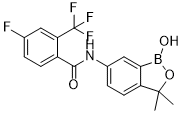
Physicochemical Properties
| Molecular Formula | C17H14BF4NO3 |
| Molecular Weight | 367.1066 |
| Exact Mass | 367.1 |
| CAS # | 1266084-51-8 |
| PubChem CID | 44178354 |
| Appearance | White to off-white solid powder |
| LogP | 3.433 |
| Hydrogen Bond Donor Count | 2 |
| Hydrogen Bond Acceptor Count | 7 |
| Rotatable Bond Count | 2 |
| Heavy Atom Count | 26 |
| Complexity | 545 |
| Defined Atom Stereocenter Count | 0 |
| InChi Key | PTYGDEXEGLDNAZ-UHFFFAOYSA-N |
| InChi Code | InChI=1S/C17H14BF4NO3/c1-16(2)12-6-4-10(8-14(12)18(25)26-16)23-15(24)11-5-3-9(19)7-13(11)17(20,21)22/h3-8,25H,1-2H3,(H,23,24) |
| Chemical Name | 4-fluoro-N-(1-hydroxy-3,3-dimethyl-1,3-dihydrobenzo[c][1,2]oxaborol-6-yl)-2-(trifluoromethyl)benzamide |
| Synonyms | SCYX-7158 SCYX 7158SCYX7158 AcoziboroleOxaborole |
| HS Tariff Code | 2934.99.9001 |
| Storage |
Powder-20°C 3 years 4°C 2 years In solvent -80°C 6 months -20°C 1 month |
| Shipping Condition | Room temperature (This product is stable at ambient temperature for a few days during ordinary shipping and time spent in Customs) |
Biological Activity
| ln Vitro | In vitro, acoziborole exhibits efficacy against strains of Trypanosoma brucei, such as T. b. Rhodesia and T. b. Acoziborole demonstrated strong efficacy against representative T in whole-cell tests. b. Brussels, T. b. Rhodesia and T. b. strains of Gambiae. Following a 72-hour incubation period, the IC50 value of Acoziborole for the parasite strains was around 0.07 µg/mL to 0.37 µg/mL. As in Tb. Acoziborole's minimum inhibitory concentration (MIC) for the Brucei S427 strain is 0.6 µg/mL, which is roughly double the strain's IC50. At drug concentrations up to 50 µg/mL, no discernible decrease of cell growth was seen in in vitro mammalian cell (L929 mouse cell line) experiments, in contrast to the strong action of acoziborole against trypanosomes. Using the P450-Glo test, the ability of Acoziborole to inhibit CYP enzymes was assessed for the human isoforms of CYP3A4, CYP1A2, CYP2C19, CYP2C9, and CYP2D6. In these tests, acetazolamide's IC50 values were greater than 10 µM [1]. |
| ln Vivo | Acoxiborole at an intravenous dose of 4.3 mg/kg had a substantial elimination half-life (t1/2) of 26.6 hours, systemic clearance (CL) of 0.089 L/h/kg, volume of distribution (Vdss) of 1.69 L/kg, and an area under the concentration-time curve (AUC0-24 h) of 48 h·μg/mL in mice that were not infected. At 13.4 mg/kg, which is the least effective dose in the mouse phase 2 HAT model, acoziboral was absorbed quickly, as evidenced by a plasma Cmax of 6.96 µg/mL six hours after administration. The oral clearance (Cl/F) value was 0.163 L/h/kg, the AUC0–24 h was 82 h·μg/mL, and the absolute oral bioavailability was 55%. Cmax climbed to 9.8 μg/mL and AUC0-24 h was 113 h·μg/mL following an oral dose of 26 mg/kg, which corresponds to the dose of 100% cure rate in the mouse phase 2 HAT model. When oral acoziboral was administered at a nominal dose of 25 mg/kg (the dose at which the mouse cure rate was 100%), the Cmax of uninfected rats increased approximately 2-fold compared to mice, and the oral clearance rate increased approximately 4-fold (AUC0-24 hours 291h·μg/mL and CL/F=0.092L/kg/h). Similar to mice, it takes the same amount of time (tmax=8 hours) to achieve maximum concentration. Acoziborole 2 mg/kg (IV) on study day 1 and 10 mg/kg (NG) on study day 8 were administered to uninfected male and female cynomolgus monkeys. Upon intravenous administration, the Vdss of AUC0-24 h and AUC0-inf are 0.656 L/kg, and the area under the concentration-time curve is 78.8, respectively. Acoziborole demonstrates excellent plasma pharmacokinetics, with a CL of 0.022 L/h/kg. 94.4 and h•μg/mL.[1] |
| References |
[1]. SCYX-7158, an orally-active benzoxaborole for the treatment of stage 2 human African trypanosomiasis. PLoS Negl Trop Dis. 2011 Jun;5(6):e1151. |
| Additional Infomation |
Acoziborole is a member of (trifluoromethyl)benzenes. SCYX-7158 has been used in trials studying the treatment of Trypanosomiasis, Parasitic Diseases, Protozoan Infections, and Trypanosomiasis, African. |
Solubility Data
| Solubility (In Vitro) | DMSO : ≥ 125 mg/mL (~340.51 mM) |
| Solubility (In Vivo) |
Solubility in Formulation 1: ≥ 8 mg/mL (21.79 mM) (saturation unknown) in 10% DMSO + 40% PEG300 + 5% Tween80 + 45% Saline (add these co-solvents sequentially from left to right, and one by one), clear solution. For example, if 1 mL of working solution is to be prepared, you can add 100 μL of 80.0 mg/mL clear DMSO stock solution to 400 μL of PEG300 and mix evenly; then add 50 μL of Tween-80 to the above solution and mix evenly; then add 450 μL of normal saline to adjust the volume to 1 mL. Preparation of saline: Dissolve 0.9 g of sodium chloride in 100 mL ddH₂ O to obtain a clear solution. Solubility in Formulation 2: ≥ 8 mg/mL (21.79 mM) (saturation unknown) in 10% DMSO + 90% Corn Oil (add these co-solvents sequentially from left to right, and one by one), clear solution. For example, if 1 mL of working solution is to be prepared, you can add 100 μL of 80.0 mg/mL clear DMSO stock solution to 900 μL of corn oil and mix evenly. (Please use freshly prepared in vivo formulations for optimal results.) |
| Preparing Stock Solutions | 1 mg | 5 mg | 10 mg | |
| 1 mM | 2.7240 mL | 13.6199 mL | 27.2398 mL | |
| 5 mM | 0.5448 mL | 2.7240 mL | 5.4480 mL | |
| 10 mM | 0.2724 mL | 1.3620 mL | 2.7240 mL |